
Israel’s 2026 parliamentary elections are set to amount to political deadlock, with neither Prime Minister Benjamin Netanyahu nor Gadi Eisenkot getting enough votes to form a government. One clear winner did emerge, however, with enough votes to decisively influence the outcome: Israeli Arabs.
The latest results, as of 8:30 p.m. local time, give Ra’am and Joint List, the two Arab parties, 19 seats in the Knesset altogether, with over 85% of the vote counted. With the pro-Netanyahu bloc at 53 seats and Eisenkot at 48, neither is in range of the 61-seat majority needed in the 120-seat Knesset. The 19 seats for the Arab parties, stripping both Eisenkot and Netanyahu of their needed majorities, put the outcasts of Israeli politics in the most powerful position they have ever been in.
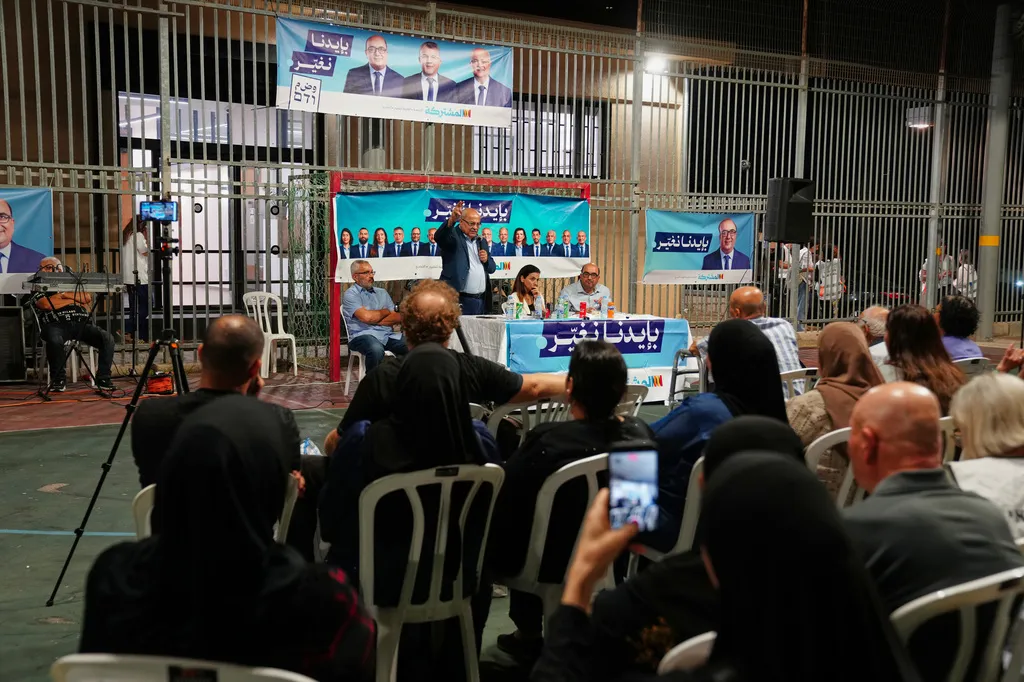
Yousef Jabareen, leader of the Ra’am Party, said he was open to negotiations with everyone and implied his party had spoken with negotiators from Netanyahu’s Likud Party and Eisenkot’s.
“Anyone who wants to offer a substantive and genuine alternative to Netanyahu’s government of bloodshed will have to talk to us in order to pave the way for the change that the Israeli public longs for,” he told Israel’s Channel 13. “It is either continued racism, continued exclusion and continued supremacy, or genuine Jewish-Arab partnership.”
NETANYAHU AND HIS OPPONENT BOTH SPIN ELECTION AS VICTORY AS RESULTS TRICKLE IN
However, experts view the prospect of any major bloc taking up his offer as unlikely. In the history of modern Israel, Arab parties have only been part of a government in the Lapid-Bennett coalition, which held power from June 2021 to November 2022. However, their presence was contingent on the implicit knowledge of their subservient status, occupying only a small number of seats. They exchanged their limited influence for concessions largely irrelevant to Israel’s wider concerns, including budget concessions for Arab areas.
The presence of Arabs in the territory of modern Israel has always formed a deep tension within the Zionist movement. Even the founder of the modern Zionist movement, Theodor Herzl, privately acknowledged that coexistence with Arabs in lands eyed as their new state was likely impossible, according to Israeli historian Benny Morris.
Arabs have voted since Israel’s first election in 1949, and citizens enjoy full voting rights and legal equality with Jews. Early voting participation was extremely high, peaking at 90% turnout among eligible Arabs in 1955. Most of Israel’s Arab citizens are descendants of the 156,000 Arabs who decided to stay in their lands after Israel won its war of independence, and make up around one-fifth of Israel’s population. Most Palestinians in the West Bank, seized after the Six Day War in 1967, do not have citizenship.
Every Arab party that is eligible accepts Israel’s status as a Jewish and democratic state, doesn’t support armed struggle against Israel, and avoids incitement to racism, the three grounds by which the Knesset can ban a list or candidate under Section 7A of Basic Law. Petitions targeting Arab parties frequently invoke the first two clauses, but Arab lawmakers strongly dispute those accusations, arguing that Section 7A is selectively weaponized by political opponents to delegitimize Arab representation.
The prospect of the law’s strict enforcement has created a mellowing effect among Arab parties, and both Ra’am and Joint List have had to fight off bans in the past. The fear of a ban by Netanyahu’s government is widely believed to have led Abbas to announce the Ra’am Party would cut ties with the Southern Branch of the Islamic Movement and its Shura Council in December 2025.
Arab turnout has declined in recent years as its parties have been kept out of nearly every government and kept in an inferior position when they are let in. Turnout fell below 45% in 2021, a record low. It took two seismic shifts to change turnout to the levels seen on Tuesday.
The factor largely unknown outside of Israel is skyrocketing crime in Arab areas, almost tripling the number of murders in Arab areas from 2019 to 2025, when a record 252 people were murdered. The spike was driven by the growth of organized crime groups, and is blamed by some Arabs on official neglect.
This played a role in driving some voters out, but Mohammad Darawshe, the director of strategy at Givat Haviva’s Center for Shared Society, a group that advocates Jewish-Arab equality, said this was only indicative of a wider problem.
“The crime crisis was certainly a major factor, but it is only part of a much broader story,” he told the Washington Examiner. “Arab citizens have experienced years of neglect, including unprecedented levels of violence and organized crime, alongside severe underfunding of Arab municipalities and growing socioeconomic disparities. Many voters felt that basic issues affecting their daily lives were not being addressed.”
An even bigger factor was the perceived anti-Arab position of Netanyahu’s government, especially from controversial figures such as National Security Minister Itamar Ben-Gvir and Finance Minister Bezalel Smotrich.
“What mobilized many voters was the sense that the current government has engaged in an unprecedented campaign of delegitimization against Arab citizens and their political representatives,” Darawshe said. “People felt their citizenship, belonging, and legitimacy were being challenged. That created a strong motivation to participate politically rather than withdraw.”
The fallout from the Oct. 7, 2023, massacres sent shockwaves through Israeli society and smashed what little remained of the trust between Arab and Jewish communities. Much of Jewish Israeli society has come to view Arab Israelis as “an extension of the enemy rather than as fellow citizens,” Darawshe said.
“This perception has been reinforced by political rhetoric that often blurs the distinction between Arab citizens of Israel and external actors involved in the conflict,” he added. “As a result, many Arab citizens feel they are being judged not by their actions or loyalty as citizens, but by their ethnicity and identity.”
The rhetoric from Netanyahu and his government partners only served to increase the fears of Arab Israelis. Netanyahu explicitly framed the high turnout of Arab Israelis at the polls as an existential danger to Jewish Israelis.
In one video, the prime minister held up a phone showing a picture of a group of Arab women, which he claimed was them going to the polls but that a fact-checker found was actually a group of women going to pray in February. Nevertheless, he cast it as a moment of life and death.
“Have you seen this?” he said in a caption to the video. “Dear right-wing voters, you must go out and vote for Likud, this is a matter of life and death for us.”
In his election night speech, he purposefully excluded Arab parties from the electorate in casting the results as a victory, given his bloc took the majority of Jewish votes. To form a government with the Arab parties was “simply forbidden” and would “endanger Israel,” he said.
Even the anti-Netanyahu bloc may find allying with the Arab parties a step too far. Eisenkot’s bloc is made up of a wide plethora of groups and risks losing some if Arab parties are invited to join his government. A government involving Arab parties would also have to survive a confidence vote in the Knesset, a difficult prospect.
The increasing hostility toward Arabs in politics in Israel has been troubling to Arab voters, Darawshe said.
“The message many Arab voters hear is troubling: that they are welcome to participate in elections, but not welcome to influence the formation of a government,” he said. “That creates a fundamental democratic contradiction. Citizens are being asked to vote while simultaneously being told that the representatives they elect are not legitimate governing partners.
“The stakes are therefore much larger than the next election. Continued exclusion risks increasing cynicism, alienation, and disengagement among Arab voters. More importantly, it will deepen polarization across Israeli society. A democracy cannot remain healthy when a fifth of its citizens are treated as politically illegitimate.”
Not everyone in Israeli politics is opposed to partnering with the Arabs, however. The leader of the left-wing Democrats, Yair Golan, whose party ran as part of Eisenkot’s coalition, said the opposition must partner with the Arabs to oust Netanyahu.
NETANYAHU WARNS OF HIGH TURNOUT IN ISRAELI ELECTION: ‘EMERGENCY HOUR’
“Netanyahu lost,” Golan said in a post on X. “I know how to count to 120. 65 is more than 55. That’s how Israeli democracy works. Period.
“The reality must teach us one resounding lesson: We have no future here if we don’t stop being afraid. And if we don’t stop with the racism. We must no longer accept Netanyahu’s racist division between Jewish votes and Arab votes.”