
Israeli Prime Minister Benjamin Netanyahu and opposition leader Gadi Eisenkot both spun the parliamentary results as a victory for their respective sides on election night, despite full results not yet being confirmed.
As of 12:30 p.m. Wednesday local time, 84.5% of the vote had been counted, with the Central Elections Committee giving Netanyahu’s bloc 54 seats, followed by Eisenkot’s bloc at 49 seats, and the Arab-led parties of Joint List and Ra’am at 17 seats, in Israel’s 120-seat Knesset. Many of the remaining votes come from double envelopes, submitted by soldiers, reservists, diplomats, hospital patients, and displaced Israelis. These votes historically lean heavily towards right-wing Zionist parties.
What analysts agree on is that Netanyahu outperformed expectations, especially compared to exit polls, though his bloc’s share of the vote decreased substantially. The current parliament has 67 seats for Netanyahu’s coalition and 10 for Arab parties in the opposition.
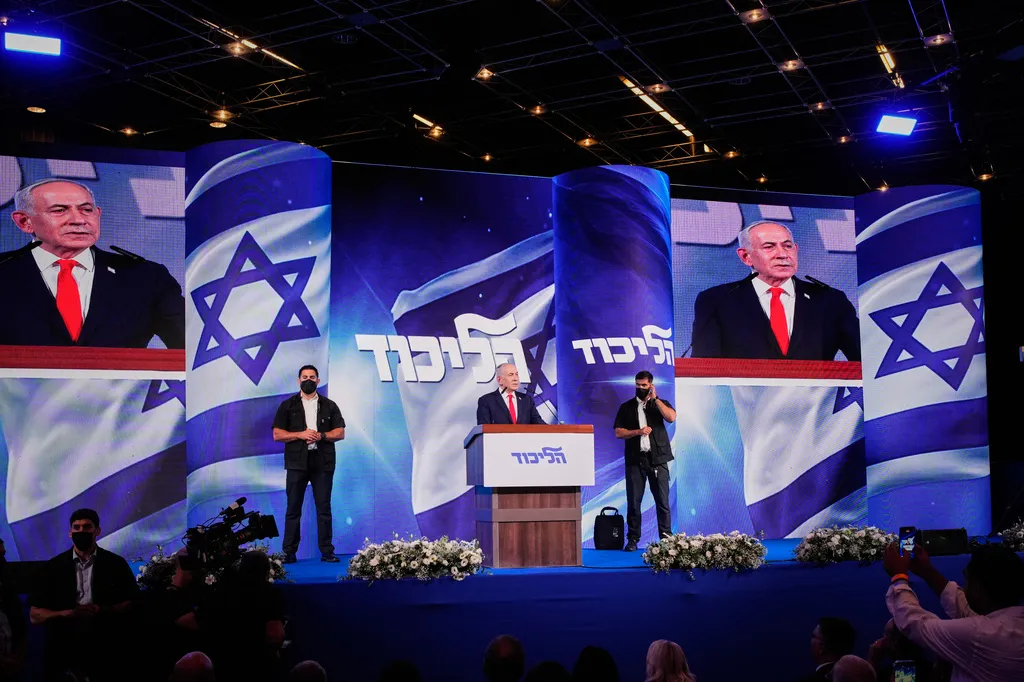
Netanyahu cast the vote as an assured victory in his emotional election night speech.
The one thing clear from the results, he said, “is that the right-wing bloc has a clear, decisive majority among the Zionist public, among the Jewish public and all those who support the Jewish state. That is what has become clear. A decisive majority.”
“And therefore I said, and I say again, that we must form a strong, national, right-wing government. That is what must be done,” Netanyahu said.
His characterization purposefully excluded Arab parties, which drew historic numbers of voters and are set to win their largest-ever share of the vote. The prime minister said that forming a government with the Arab parties was “simply forbidden,” and would “endanger Israel.” This makes his technical characterization true — he won a majority of Jewish votes — but Israel’s democracy still functions around the participation of its roughly 20% Arab population.
Eisenkot cast his own reading of the election results as a win, pointing to Netanyahu’s bloc’s fall in seat numbers and lack of a majority among the entire electorate.
“I stand before you deeply moved,” Eisenkot said late on election night. “This morning the people of Israel held a referendum on who will lead this country in the years ahead. Tonight we have our answer. The public has chosen change. The coalition of failure has lost the people’s trust. The Israeli public voted against Benjamin Netanyahu continuing as prime minister.”
“These are still only exit polls, and we must wait for the real results,” Eisenkot continued. “But this much is already clear: Netanyahu tonight finds himself facing a Zionist, national majority that is larger and stronger than his own. A decisive majority among the public at large, and among those who serve and those who work. A leader worthy of the name would accept the people’s verdict and announce today that he is leaving political life.”
The results shifted significantly in Netanyahu’s favor after the speech, but, in fact, Eisenkot’s sentiment remained correct, given his inclusion of the entire Israeli electorate.
Former Israeli Prime Minister Naftali Bennett, another leader in the opposition bloc, declared that “Netanyahu has lost.”
The remaining votes are unlikely to give any party a majority, setting off a difficult process of negotiations and coalition building. The unstable coalition formed to oust Netanyahu from June 2021 to November 2022 became the first to include Arab parties, but their small number of seats limited their influence, which they largely traded for budget concessions for Arab areas.
Having greatly increased their share, they now stand as a kingmaker. Ra’am Party leader Yousef Jabareen said he was willing to work with anyone and was in active negotiations.
“Anyone who wants to offer a substantive and genuine alternative to Netanyahu’s government of bloodshed will have to talk to us in order to pave the way for the change that the Israeli public longs for,” he told Israel’s Channel 13. “It is either continued racism, continued exclusion and continued supremacy, or genuine Jewish-Arab partnership.”
But the prospect of adding a powerful Arab party to a new government remains a taboo. Some members of Eisenkot’s coalition are highly opposed to the prospect, though it has some notable backers. The leader of the left-wing Democrats, Yair Golan, said the opposition must partner with the Arabs to oust Netanyahu.
“Netanyahu lost. I know how to count to 120. 65 is more than 55. That’s how Israeli democracy works. Period,” he said in a post on X.
“The reality must teach us one resounding lesson: We have no future here if we don’t stop being afraid. And if we don’t stop with the racism. We must no longer accept Netanyahu’s racist division between Jewish votes and Arab votes,” Golan added.
Netanyahu still has a path to victory, too. If his bloc’s current share holds, he’ll only need to win the support of seven lawmakers to expand his coalition to a majority. He could also form a unity government with the non-Arab parties, a coalition certain to be unstable but viable.
His speech certainly reflected his confidence in victory, striking a more pious-than-usual tone.
“And finally, I want to thank the creator of the world, who gives me the strength to go on acting for the eternity of Israel, for our beloved people and our beloved, one and only country,” Netanyahu said.
President Donald Trump, seeing Netanyahu in the lead, claimed credit for the result.
“I heard the poll numbers were wrong … the exit polls; I heard [Netanyahu] did very well,” Trump told reporters near Air Force One. “It was pretty close, but very well. When the endorsement went out, it helped him a lot.”
“It’s a little bit early, but I’m hearing in Israel, top people say, ‘Wow! He did a lot better than people thought.’ It’s looking like maybe a stalemate or a win,” Trump added.
ISRAELI CONSERVATIVE PARTIES LOSE LAST-DITCH BID TO EXTEND VOTING AS ELECTION SEES RECORD TURNOUT
The U.S. president featured prominently in Netanyahu’s speech as well, with the prime minister invoking him to accomplish his decadeslong goal of taking out the Iranian government.
“I want to tell you: Israel stands before a historic, once-in-a-lifetime opportunity, with our partner President Trump, to remove the existential threat from Iran once and for all,” Netanyahu said. “We must not let any extraneous considerations divert us from this sacred mission.”