
The next fight in this election cycle’s redistricting wars will take place on election night in Maryland. And it might determine the future of whether the fight to redraw congressional maps mid-decade will be sustained or fall short.
House Democrats need to net three seats in the Nov. 3 midterm elections to claim a majority in the 435-member chamber. It’s been a goal made tougher with House Republicans, spurred by President Donald Trump’s political team, seemingly benefiting from rare mid-decade congressional redistricting efforts in GOP-controlled state houses.
Democrats have not disarmed unilaterally. After Republicans began redistricting efforts in Texas, followed by Florida and North Carolina, Democrats have attempted to retaliate by redrawing congressional maps themselves. Last year, California voters approved Proposition 50, which allowed the state legislature to do a one-time redraw of the its congressional map to create five Democratic-leaning seats in response to Texas creating five Republican-friendly districts.
On Nov. 3, the redistricting wars come to Maryland as Old Line State voters consider Question 3. The statewide ballot measure would essentially pave the way for Maryland lawmakers to redraw the state’s congressional map. If approved, it would eliminate the state constitution requirement that congressional districts be compact and connected.
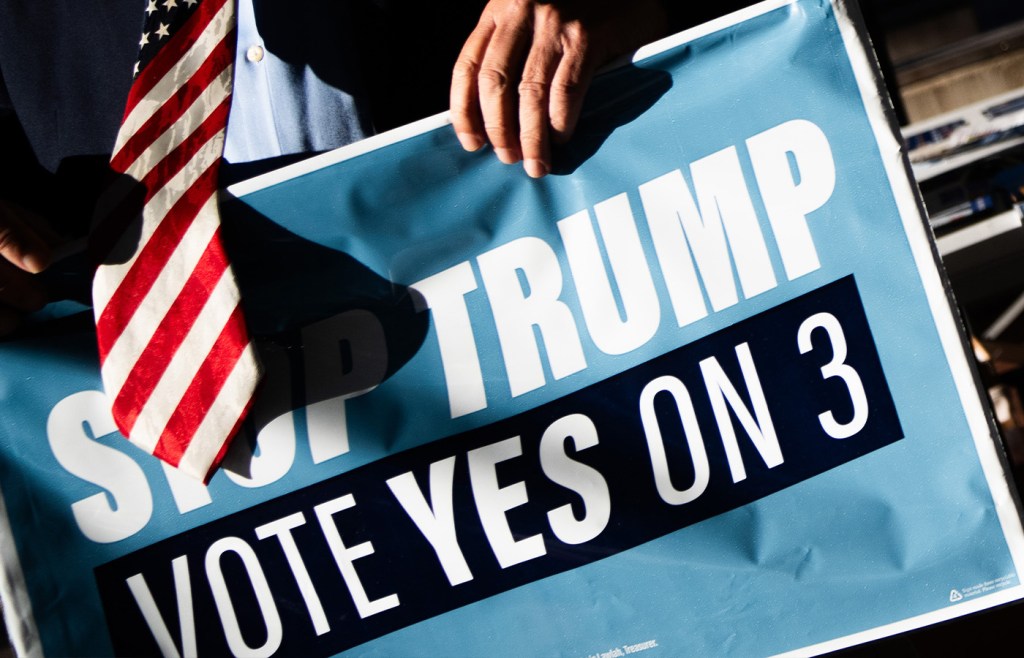
The proposal would have the practical effect of shifting Maryland’s already-daunting 7-1 House delegation edge over Republicans to an 8-0 shutout. Specifically, state Democrats who dominate both chambers of the legislature and Gov. Wes Moore (D-MD) could, without much effort, eliminate the district comprising the Eastern Shore and northeastern Baltimore exurbs held by Rep. Andy Harris (R-MD) since 2011.
District voters chose Trump over Democratic rival Kamala Harris, 57%-40%. But pieces of the district would be parceled out to those of Democratic House members in the Baltimore and Annapolis areas. Those House Democrats would need to take on some new conservative-leaning areas, but not enough to seriously threaten their electoral chances.
Harris has long been the odd-man-out in Maryland’s House delegation and often rubs Hill Democrats the wrong way. After an Oct. 15 debate against his Democratic opponent, Harris wrongly told a student reporter from the University of Maryland that she did not have permission to record him and threatened prosecution. Harris had just left a contentious debate, where he faced scrutiny from audience members over the Iran war and rising diesel prices.

The Maryland redistricting initiative has the backing of Moore, who, like Gov. Gavin Newsom (D-CA), is a possible 2028 Democratic presidential candidate, along with many other prominent Democrats and advocates.
State Democrats are open about their stated goals of retaliating for a GOP-initiated redistricting war, starting with Texas in the summer of 2025.
“This is an initiative that was started by President Trump to push red states and GOP-leaning legislatures to redraw their maps in a way that oftentimes would eliminate black representation in Congress,” Democratic state Sen. Clarence Lam said in an interview. “And I think voters will recognize that this is their ability to kind of weigh in on national politics, even though for the most part there aren’t any competitive federal elections going on in Maryland.”
Democrats also argue they need to respond after the Supreme Court’s Louisiana v. Callais decision narrowed Section 2 of the Voting Rights Act, which restricts voting practices that discriminate based on race.
“We don’t want to have our own hands tied when it comes to responding to things like Florida and Texas, and the Supreme Court absolutely gutting the VRA,” state Del. Nick Allen said in an interview. “We want to be able to have every tool in the tool kit to respond should we choose to respond.”
But the initiative in Maryland differs widely from the one in California. When Proposition 50 passed, Democrats created five blue-leaning seats. The impact would be much smaller in Maryland, with Harris presumably the only Republican political casualty.
The other possible drawback is that despite Democrats having the potential to gain only one seat in Congress, the change to the state constitution is sweeping in its nature.
“They’re basically saying there are no guardrails other than whatever federal law there might be, and anybody who studies this knows there’s almost no federal guidance at all,” Todd Eberly, a professor of political science and public policy at St. Mary’s College of Maryland, said in an interview.
And the push came after a drawn-out process to get the initiative on the ballot. In September, the state Supreme Court agreed with a lower-court ruling that the question was “misleading and therefore violates due process requirements.” But the court allowed the amendment to go forward after revising some of the language.
There’s also the fact that many voters might not fully understand what the initiative does. In late September, Fight Back Maryland, which supports Question 3, released a poll showing that 25% of voters were undecided, while 40% of Marylanders said they supported it and 35% opposed it. The survey, conducted by Democratic pollster Hart Research, also found that the most common response when the ballot was read to voters was “I don’t understand the amendment.”
Lam expressed confidence in the Maryland redistricting proposal getting enacted.
“We believe it has passed full muster, including through a third party, our judiciary, who looked at it and came up with how this question is worded,” Lam said. “I think it can be a little challenging to kind of fully grasp what the wording means because it is so technical, as I mentioned, and that’s why we’re trying to raise awareness to get word out about what this means in the broader context.”
But Democrats said they think voters will understand what the question asks. Lam said that if Marylanders are engaged enough in politics, statewide and nationally, and feel the effects of the Trump administration, then they will go to the polls well-informed.
“I think for the most part, Marylanders are able to parse the question and also kind of understand, big-picture level, what we’re talking about and what’s at stake,” Allen said.
There’s also the possibility that the whole redistricting effort turns out to be a bust. Texas Republicans largely redrew their map mid-decade based on assumptions about Hispanic voters shifting toward Trump in 2024. But poll after poll and special elections show Hispanics turning against Trump. Missouri’s efforts to redistrict will also go to a ballot on Election Day, and it could very easily fail.
ANDY HARRIS LASHES OUT AT REPORTER AFTER VOTERS LAUGH AT HIS BLAMING OF DEMOCRATS FOR ENERGY COSTS
“Say that this is defeated in Maryland and that Republicans discover that all of the effort they undertook to redraw districts doesn’t actually net them seats,” Eberly said. “Will this be sort of a come-to-Jesus moment to realize that maybe all of this effort that we’re expending to engage in this redistricting and mid-cycle redistricting is a lot of wasted effort?”
Yet de-escalating seems unlikely. Republicans might find that the redistricting war is similar to the war in Iran: easy to initiate, but hard to end.
Eric M. Garcia (@EricMGarcia) is a Washington-based reporter focused on politics, policy, and campaigns. He was most recently the senior Washington correspondent for the Independent and has written numerous freelance pieces for publications including the Washington Post.