
HBO’s new legal drama War is pure escapist fun with an irresistible British accent. Legal ethics, human decency, an honest day’s work in court: Goodbye to all of that.
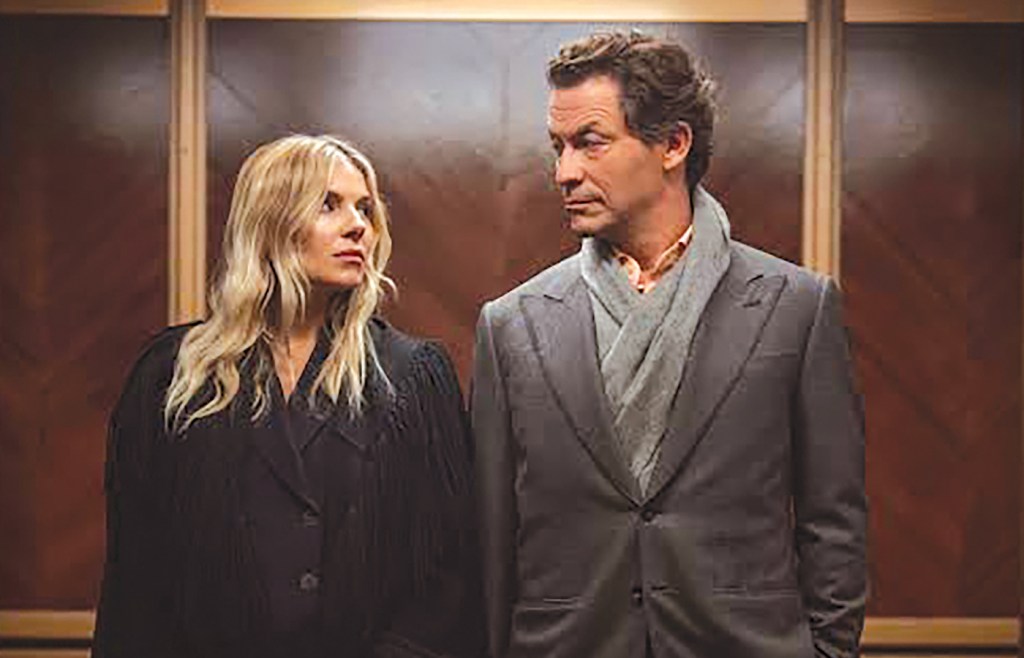
Taking as its subject the fictional “biggest divorce trial in British legal history,” War pits Dominic West’s ruthless tech mogul Morgan Henderson against his equally cruel wife, Carla Duval (Sienna Miller). A film star of no small reputation, Carla has nonetheless seen her bank balances dwindle of late, as age and the arrival of fresher ingénues have done their terrible work. Morgan, meanwhile, has prospered. Thanks to Zephyr, an X-like social-media app with a ballooning valuation, our hero’s own fortune has reached a cool $700 million.
On hand to win Carla her share of this loot is the law firm of Taylor & Byrne, a husband-and-wife shop not above the occasional sneaky tactic. When made aware that Carla has ensnared Morgan with a honey trap, married partners Serena Byrne (Phoebe Fox) and Nicholas Taylor (James McArdle) decide within moments to look the other way. (Him: “We need the moral high ground.” Her: “We’re lawyers. We need no such thing.”) Later, offered a settlement that will secure Carla’s finances for generations, Nicholas turns it down without so much as a “by your leave.”
Astonishingly, the shysters of Taylor & Byrne are by no means the least savory legal minds that War has to offer. That distinction belongs to Morgan’s representatives at Cathcarts, an old-guard firm as patrician as a Victorian snooker room. Played by the masterful Pip Torrens (Poldark, The Iron Lady), Cathcarts’s St. John Smallwood is an establishment bully of the kind upon whom, say, the former Prince Andrew might gratefully call. Sitting across from Nicholas at the bargaining table, St. John reduces the younger man to a stutter with little more than a disdainful look. Not since Torrens’s turn as The Crown’s fearsome private secretary Tommy Lascelles has a performance benefited quite so much from the musculature of a tight-lipped stare.
If St. John and henchman David Schill (Miles Jupp) were merely aloof, one might tip one’s hat to their professional savoir faire. Instead, the pair are brazenly contemptuous of the rules of fair play, willing not only to cheat but to do so in one of the brashest ways imaginable. Learning, for example, that prospective Cathcarts hire Johnny Warren (Archie Renaux) has a competing offer from Taylor & Byrne, St. John and David spot an unseemly “in”: Johnny will ostensibly join the other team but will, in reality, report Carla’s entire legal strategy back to Cathcarts.
Despite its occasional silliness, the show is not unmindful of the psychological intrigues that interrupt even the best-laid Machiavellian plans. Faced with Morgan’s inconvenient guilt, St. John must manipulate his client into casting off all restraints for the sake of the win. And what of Johnny, whose seduction of (or by) a lonely Carla threatens to sever Cathcarts’s illicit intelligence line?
I liked the show’s first half better than its second, greatly preferring the gamesmanship of mediation and arbitration to the PR battles in which the series eventually bogs down. If things recover as the trial itself arrives, thanks are due in part to Celia Imrie, a familiar British screen presence since the 1970s and a winning contributor here as Taylor & Byrne’s sharp-eyed barrister. Surely I am not the only Yank who will delight in the barbed decorum on display as the show moves deeper into the halls of justice. “Thank you, my Lord. Yes, my Lord. And now let me slit my opponent’s throat before this august chamber.”
‘BROTHERS’ IS AN APPEALING SHOWCASE FOR WOODY HARRELSON AND MATTHEW MCCONAUGHEY
One might wish that War were as smart throughout as it is in its cleverest scenes. Alas, a lack of faith in the audience’s intelligence too often brings creator George Kay (Lupin, Hijack) to underline moments that require no such mark. Case in point: an exchange in which Nicholas boasts that the opposition has “no way of knowing” what he’s up to, followed by a camera swoop to Johnny, the mole. All that’s missing to seal our comprehension is a melodramatic duh-duh-duh from the score.
As for the show’s ending, it will certainly thrill a particular kind of viewer, never mind its basic incompatibility with legal reasoning, corporate practice, and human nature itself. Be honest: Having spent some hours with the case, did you see its inevitable shuffling resolution from miles away? MeToo.
Graham Hillard is the TV critic for the Washington Examiner magazine.