
Less than a year after submitting its initial bid for Warner Bros. Discovery, Paramount Skydance finally won the for-sale studio and began integrating both entertainment companies under one corporate umbrella.
Skydance, a small production company founded by David Ellison in 2006, has turned into a media giant that unites not only two legacy Hollywood studios but also broadcasting, streaming, and news network assets. What was once a one-man startup is now, in Ellison’s words, a “creative-first home for bold, quality storytelling.”
The chief executive is unsurprisingly bullish about his combined company’s trajectory, but outside observers are not so sure.
Ellison will surely try to prove the naysayers wrong, but only time will tell if the merger proves beneficial or detrimental for U.S. consumers.
What does the merger mean for Hollywood?
Theatrical distribution will receive a boost with Skydance’s commitment to release 30 films per year over two years and 32 films per year over three years under the court-approved five-year consent decree with California and 11 other states. This pledge was why major theater chains, including AMC Theatres and Regal Cinemas, publicly backed the merger.
It may be a sign that Ellison genuinely wants to preserve the moviegoing experience and deliver a robust slate of theatrical films. But what kind of films will he prioritize?
Lee Hepner, a California-based antitrust lawyer and senior legal counsel for the American Economic Liberties Project, speculates Skydance will invest more in sequels and remakes based on the combined entity’s intellectual properties. This is a markedly different approach from Warner Bros., which Hepner says was taking “big swings” with its films in recent years.
A similar pattern of recycled intellectual property overtaking original content emerged following the Walt Disney Company’s 2019 acquisition of 21st Century Fox, which included the 20th Century Fox studio. Film output from the two newly merged studios dropped by 52% in the years that followed, primarily affecting Fox’s theatrical lineup.
Hepner described the Disney-Fox merger as a “cautionary tale” for what could happen with the combination of Paramount and Warner Bros., the outcome being less variety in the types of films being made.
Moreover, Hollywood becomes more concentrated when fewer studios are at play. Skydance is one of the four major studios now, joining Disney, Universal, and Sony. Before the Disney-Fox merger, there were six big studios.
Before the most recent merger closed, the states’ antitrust lawsuit estimated the four studios would control 93% of the theatrical market in box office revenue. Skydance controls more than 30% of these films.
While the plaintiffs were concerned that large-scale consolidation would result in fewer films, the settlement ensures Skydance will have to pay a $30 million penalty for every unreleased film that falls below the annual film quota. If triggered, most of the penalty funds will go to entertainment workers and unions.
The settlement also includes a commitment by the defendants to invest an additional $1.5 billion into domestic film and television production over the next five years, or $300 million annually. The U.S. production requirements scale up if Congress passes legislation to create a national film tax credit or either California or New York approves an uncapped film tax incentive.
The problem with these remedies, in Hepner’s view, is that they are mostly behavioral rather than structural. Behavioral remedies regulate how a company operates, while structural remedies require a company to sell certain assets.
Before the settlement, California Attorney General Rob Bonta insisted on a deal requiring robust structural remedies and dismissed any possible behavioral remedies, which are harder to enforce. Two months after filing the lawsuit, Bonta reversed course by agreeing to a settlement with no immediate structural remedy.
Should Skydance fail to meet any of its obligations under the settlement, the states reserve the right to take the company back to court.
A settlement could be extended after the five-year period expires, but that is not guaranteed.
“Five years is a countdown to a cliff because after five years, there’s no protection in place whatsoever,” Hepner said. “So even to the extent we can find merit and comfort in the remedies that are set forth in this consent decree, they all go poof in five years. And Paramount is free to do whatever it wants.”
Hepner works in antimonopoly law and policy at the AELP, which is a member of the Block the Merger coalition. The group started challenging the merger in April when thousands of actors, filmmakers, and other creative professionals signed an open letter opposing the deal.
Though its campaign against the merger was unsuccessful, the coalition vowed to “continue the fight,” the next chapter of which has not been written yet.
What are the corporate challenges facing Skydance?
Chief among the countless corporate restructuring challenges facing Skydance following the $111 billion merger is the tall task of targeting $6 billion in annual cost savings over the next three years, and one way to achieve that goal is through mass layoffs.
Thousands of employees could be let go as Paramount and Warner Bros. integrate their business operations. A Los Angeles County economic report projects a loss of some 4,500 film and television jobs in LA over three years.
Skydance has not said how many jobs it plans to cut, but the extent of the layoffs will likely be similar to what happened after the company bought Paramount last year. Paramount let go of about 1,000 employees in October 2025 and planned another 1,000 layoffs for a later date.
Skydance co-CEO Ynon Kreiz said the planned $6 billion in cost savings will involve some workforce reduction, though that will not be an area for the majority of savings.
Paul Nary, a University of Pennsylvania professor and mergers and acquisitions expert, said it is a “tough ask” for Skydance to cut costs proportional to the company’s value while preserving the underlying value of its existing businesses and employee morale.
Skydance is also racked with upward of $80 billion in debt after closing, prompting Fitch Ratings to downgrade the company’s credit rating to junk status. For comparison, Skydance has nearly $70 billion in revenue.
Ellison can tap into his family’s financial resources through his father, Oracle co-founder Larry Ellison, to reduce the company’s expensive leverage if necessary.
The Ellison family and their co-investors invested $47 billion in equity financing, including an irrevocable personal guarantee of $40.4 billion from Larry Ellison, to back the merger. The company is reportedly courting Elon Musk as a possible equity investor. Musk has not said anything about the prospect, though he did congratulate David Ellison on completing the merger.
Nary says it will be a “minor miracle” if Skydance can pull off the merger, which he skeptically hopes will be the case. Hepner is more adamant about his pessimism.
“They need to squeeze so much money out of this business,” Hepner said. “There is no room for error. There is no room for risk. Everything has to work, or else it all falls apart.”
Nary wants to wait a few years to see how the merger impacts Hollywood and the broader media landscape, the full extent of which no one knows yet.
“When can you actually definitively say that this will be a success or failure?” he asked. “I think we might see some short-term ups and downs, but at the end of the day, it’s going to take a few years to really see what’s happening.”
Why did the states’ lawsuit end sooner than anticipated?
Bonta and 11 other Democratic state attorneys general were prepared to take Paramount Skydance and Warner Bros. Discovery to federal trial in March 2027 before they agreed to a settlement last month.
The move shocked everyone, impartial observers and antimerger figures alike, because it conflicted with Bonta’s initially fierce opposition to the merger. Bonta, however, appeared to be facing pressure from his own party to resolve the case quickly.
Gov. Gavin Newsom (D-CA), California Democratic gubernatorial candidate Xavier Becerra, and Los Angeles Mayor Karen Bass all supported a settlement before trial.
“All of them had different agendas in terms of what they wanted from this challenge,” Nary said, “and that just made Bonta’s job a lot harder. Because when you have people in your own camp consistently pressuring you with often conflicting agendas, that’s not a side that’s united together to win.”
Newsom publicly denied the notion that he pressured Bonta into resolving the case in the boardroom rather than the courtroom. Still, the perception is there.
Part of the governor’s reasoning for favoring a settlement could have been related to Paramount’s threat to leave California.
After the negotiated settlement, Paramount clarified that its headquarters would remain in the historic Hollywood neighborhood. David Ellison’s about-face suggested he was using the threat of relocating his business elsewhere as political leverage over Bonta.
There was also the added pressure of Paramount’s efforts to secure a $1.88 billion bond from the states to cover its incurred losses stemming from the delayed merger. Though it is unlikely the full bond amount would have been approved by a federal judge, the move demonstrated Paramount’s desperation to close the transaction before it had to pay a $7 million-per-day “ticking fee,” starting Oct. 1, for every day the merger was not completed.
Nary said he was surprised by how “quickly and materially Bonta had folded” to Paramount for a deal that is “so much more in Paramount’s favor rather than his favor.” But both parties made a deal because, in Nary’s words, Bonta needed a “political win” and Paramount needed a “financial win.”
Hepner was displeased with the outcome, saying California politicians should have questioned “Paramount’s ability to leave the state” or weighed its floated departure “against the harms of them staying” if the merger were finalized.
“California Democrats,” Hepner said, “are going to have to answer for the effects of this merger for years to come.”
The states could still return to court if Skydance breaches the enforceable settlement, which tasks an independent trustee with ensuring the company’s compliance with the agreed terms.
What happens next?
One of the first films greenlit by Skydance after the merger closed was the next live-action Transformers entry. The announcement may be a sign that the media conglomerate releases more blockbuster movies that have a higher success rate at the box office than original stories.
This is exactly what worried Hepner, who said he believes Skydance may become just a distribution and marketing business down the line and pull back on the production end of its business as much as possible while relying on licensing IP content. The result is independent productions getting locked out of the industry.
“I suspect,” Hepner said, “that Skydance is actually trying to put together a data surveillance distribution and marketing empire that sits in the middle of this industry and squeezes independent producers on the one side and squeezes movie chains on the other side and just kind of lords over this industry as a middleman.”
It remains to be seen if that bleak prediction of the entertainment industry will come true. In the meantime, Skydance will be integrating the core parts of its film and television businesses while keeping the identities of Paramount and Warner Bros. distinct.
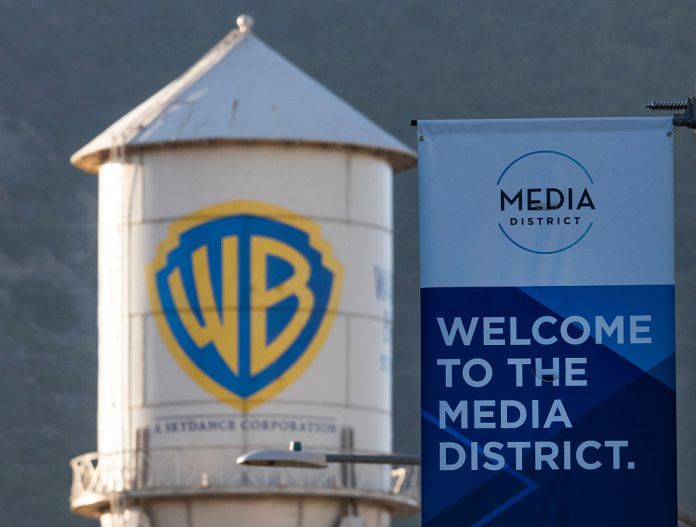
Shortly after the merger closed, Skydance wasted no time in adding its brand name to the iconic Warner Bros. water tower with the words: “A Skydance Corporation.” That phrase was added to Paramount’s water tower after Skydance bought the studio in August 2025.
PARAMOUNT MERGES WITH WARNER BROS., CREATING SKYDANCE MEDIA EMPIRE
Nary said that while Skydance is “not the worst naming decision,” he wonders whether the two Hollywood studio names should have been combined.
“Maybe it should have been Warner Bros. Paramount or something similar,” Nary said, “because that leaves some goodwill for Warner Bros. being such a core part of this combined company.”