
Gov. Josh Shapiro (D-PA) has spent months insisting he’s focused on winning reelection and helping Democrats in his state. But a new federal political action committee gives him a way to start building beyond Pennsylvania.
Shapiro’s New Path PAC is not a presidential campaign. Its stated purpose is to help Democrats win competitive Pennsylvania House races and flip the chamber.
The PAC also gives Shapiro a vehicle to support candidates, cultivate donors, and build relationships beyond his home state — all potentially valuable if he decides to run for the White House.
“I wouldn’t call it firing the starting gun,” Democratic strategist Jason Palmer told the Washington Examiner. “I’d call it moving into the starting blocks.”
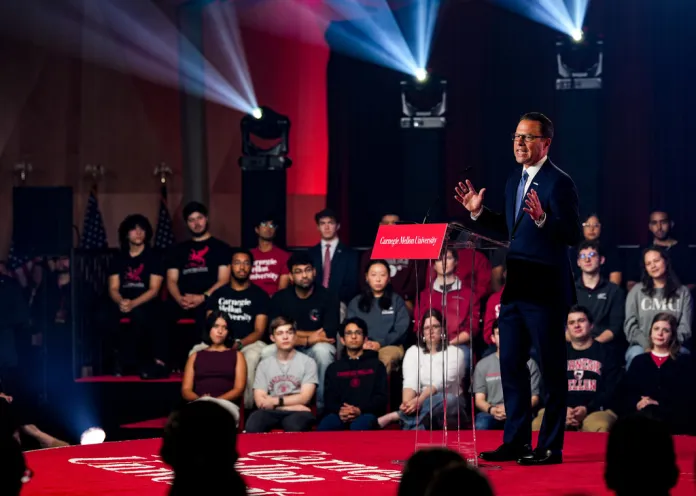
That distinction is important for Shapiro, who has repeatedly brushed aside questions about whether he is laying the groundwork for a 2028 presidential campaign. A federal PAC gives him a political operation that can exist alongside his reelection campaign without declaring a national bid.
It also gives Shapiro another way to engage with Democratic candidates and donors outside the governor’s race, potentially expanding a network that could matter if he ultimately seeks the White House.
Shapiro is joining a group of prominent Democrats who have built federal political operations as the party looks toward the post-2026 political landscape. Govs. Gavin Newsom (D-CA) and JB Pritzker (D-IL), both frequently mentioned as potential 2028 contenders, have also built federal PACs.
Shapiro already has a formidable political operation in Pennsylvania. He has raised tens of millions of dollars, campaigned alongside national Democratic figures, and appeared regularly in national media. He also recently declined to commit to serving a full second term as governor if reelected, adding speculation about his political future.
Palmer said Shapiro already has the fundraising network, executive experience, and swing-state credentials Democrats value in a presidential candidate.
“Presidential campaigns run on money, but nominations run on relationships,” Palmer said.
Midterm elections offer an early test
For now, the committee’s stated mission is to help Democrats compete in Pennsylvania’s closely contested House districts. Shapiro has backed congressional candidates and appeared with House Minority Leader Hakeem Jeffries (D-NY) to promote the party’s efforts to win seats.
The PAC’s longer-term significance will depend in part on what happens after Election Day. Continued fundraising, expanded staffing, and activity beyond Pennsylvania could signal an effort to build a broader national operation. If the committee remains focused on the state’s congressional races, it would align more closely with Shapiro’s immediate political tasks.
Irina Tsukerman, a geopolitical analyst, said the PAC has a practical purpose regardless of Shapiro’s eventual decision about 2028. Four competitive Pennsylvania House races have drawn national attention, she told the Washington Examiner, giving Shapiro an opportunity to support those candidates while strengthening relationships with their campaigns.
David McLaughlin, host of the Kudzu Vine political podcast, suggested that Shapiro’s Republican opponent has done little to pull the governor away from the national conversation.
“Maybe if the Republicans in Pennsylvania could field a candidate that could poll within three touchdowns of Josh Shapiro, they could hold his focus in the reelection campaign,” McLaughlin told the Washington Examiner.
The midterm results could also shape Shapiro’s standing within the Democratic Party. Strong reelection numbers, coupled with Democratic gains in the House, would let him point to his performance in a battleground state and his role in helping other candidates.
Presidential bid carries risk in Pennsylvania
A potential presidential bid could carry political risks at home, particularly if Pennsylvania voters reelect Shapiro only to see him quickly turn his attention to the White House.
Garry South, a Democratic political expert, warned that governors who pursue the presidency shortly after winning reelection risk alienating the constituents who got them there.
“Shapiro ought to take into account that home-state voters more often than not feel like they’ve been the victims of a political bait and switch when they overwhelmingly reelect a governor based on all the promises they made about the Shangri-la they’re going to bring about in a second term — then 15 minutes after they’re sworn in they’re off running for president,” South told the Washington Examiner.
South pointed to former California Gov. Pete Wilson, who won reelection in 1994 and announced a presidential bid a few months later. A Los Angeles Times poll in March 1995 found that two-thirds of Californians, including 59% of Republicans, opposed Wilson’s presidential run, South said.
“Shapiro better take into account the reaction of his fellow Pennsylvanians if he decides to take the plunge,” he said.
Shapiro’s own comments have already given Republicans an opening to question his commitment to a second term. During an October debate, he declined to pledge to serve all four years if reelected, prompting Republican state Treasurer Stacy Garrity, his general election opponent, to challenge his intentions.
Democratic divisions complicate Shapiro’s path
Shapiro was among the Democrats considered as a potential running mate for former Vice President Kamala Harris in 2024. The PAC offers another way to build the relationships and political infrastructure a presidential campaign would require.
But money and organization alone may not determine how far he could go in a Democratic primary.
Jeff Burton, a Republican campaign strategist and founding partner at Maven Advocacy Partners, argued that the focus on 2028 is unlikely to let up after the midterm elections.
“I give it about seven minutes after the first polls close on Nov. 3 before everyone in Washington moves on to the 2028 presidential race,” Burton said. “The truth is, the starting gun went off the day after Trump was elected.”
Burton told the Washington Examiner that the party will also face debates over its identity, the influence of its progressive and socialist wings, and its approach to Israel and Gaza.
That debate could pose a particular challenge for Shapiro, a prominent Jewish Democrat who has been outspoken in his support for Israel.
“He could find himself right in the middle of one of the deepest divisions inside the Democratic coalition,” Burton said.
DEMOCRATS GIVE BRIAN FITZPATRICK A RUN FOR HIS MONEY IN PENNSYLVANIA HOUSE BATTLEGROUND
Palmer said the midterm elections could give Shapiro a chance to show his political appeal extends beyond his own campaign.
“If Shapiro wins big in Pennsylvania and helps flip three or four Republican congressional seats, he’ll enter 2027 with something more valuable than money: proof that his political appeal extends beyond his own elections,” Palmer said.