
Debate about Minnesota Lt. Gov. Peggy Flanagan’s role in the state’s fraud crisis, and whether she stood idly by and allowed fraud to fester for years, is haunting her Senate aspirations.
It is a lingering question that her Republican opponent, Michele Tafoya, has dangled in front of voters in the lead-up to the midterm election.
“Peggy Flanagan let fraudsters steal hundreds of millions from you,” declares a recent attack ad from the Tafoya campaign. “Let’s fire her in November.”
Flanagan, meanwhile, is dancing around the fraud culpability issue, which soured the reelection chances of her boss, Gov. Tim Walz (D-MN).
Critics allege that the two-term lieutenant governor, like other Walz administration officials, failed to take proper action when she was first made aware of the widespread billing schemes that were draining Minnesota’s taxpayer-funded public assistance programs out of millions of dollars.
Flanagan, now the Democratic nominee vying for the state’s open Senate seat, stresses that she was not in charge of the state agencies responsible for administering those fraud-fraught services, nor was she the administration’s point person directing the state’s fraud response.
“The governor was the one who took the lead on fraud,” Flanagan told the Minnesota Star Tribune.
Although she agrees that “more should’ve been done sooner,” Flanagan insists she can’t bear the blame for the state’s fraud scandal and has repeatedly deflected responsibility — on the debate stage and in local media interviews — citing her limited authority as lieutenant governor.
But she has made her time in office serving as Walz’s second-in-command the cornerstone of her Senate campaign, telling voters that her nearly eight-year tenure of being the highest-ranking official in state government, behind Walz, qualifies her for federal office.
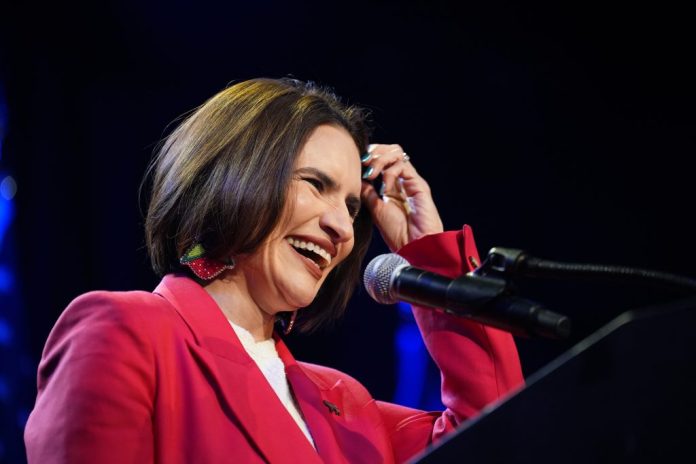
Policy experts and political strategists say she can’t have it both ways and that Flanagan’s main line of defense against the fraud accusations undercuts her central campaign pitch.
“Her value proposition is: Elect me because I’m so experienced in government and on the pulse of current issues, yet I was just parked in an office for eight years and didn’t do anything,” said Bill Glahn, a policy fellow at the Minnesota-based Center of the American Experiment.
Flanagan’s dilemma is a similar situation that Dr. Amy Acton, the Democrat running for Ohio governor, is facing. Acton has built her campaign around her brief stint as the director of Ohio’s health department during the COVID-19 pandemic. But she attributes all the negatively received lockdown orders she signed to the governor she served, asserting it was really Gov. Mike DeWine (R-OH) at the helm of the state’s COVID-19 response.
“She continues to fall back on this defense,” Glahn said of Flanagan in an interview with the Washington Examiner. “’Oh, I’ve had the No. 2 job in state government, I’ve had all this experience, and I’m ready to lead in the U.S. Senate, but I didn’t make any decisions, and I didn’t have any real responsibilities.’”
‘Just taking up space’
Flanagan has treaded carefully when confronted about her level of awareness and involvement in the fraud takedown efforts, maintaining that oversight of the fraud-infected programs wasn’t part of her portfolio.
The statutory duties of Minnesota lieutenant governor are broadly defined as “assisting the governor in carrying out the functions of the executive branch” and “exercising powers delegated by the governor.”
But besides succeeding Walz in the event of a vacancy and presiding over the state Senate on the first day of a regular session until the chamber’s president is sworn in, only a few relatively minor tasks are assigned to Flanagan.
Her job primarily involves chairing the Capitol Area Architectural and Planning Board, the Advisory Committee on Capitol Area Security, and the Minnesota Interagency Council on Homelessness, which leads the state’s efforts on “moving towards housing, health, and racial justice for people experiencing homelessness.”
“What exactly does a lieutenant governor do?” Glahn remarked. “Nothing seems to be the real answer.”
Flanagan has, however, taken credit for some of the Walz administration’s touted achievements, including pushing for free school meals and rolling out paid family and medical leave. She herself was raised by a mother who utilized food stamps and Minnesota’s Child Care Assistance Program, a subsidy program that would later be defrauded allegedly largely by Somali-run daycare centers.
WALZ RECEIVED $10,000 FROM DONORS TIED TO SOMALI-RUN DAYCARE CENTERS
Though she has distanced herself from the state’s handling of fraud, Flanagan says she was present at some high-level meetings addressing the misuse of public funds. But again, policing fraud, according to Flanagan, was outside of her purview.
“I certainly was part of conversations,” Flanagan acknowledged, “but I did not lead in this area of work.”
Her inclusion in those briefings, which Walz attended, was corroborated by congressional testimony from current and former state officials.
Walz’s longtime chief of staff, Chris Schmitter, told Congress that Flanagan was included “by default” in any discussion involving the governor because of her senior position in the Walz administration. Due to this operating model, Schmitter said she likely would have been present when Walz was briefed on fraud.
Jodi Harpstead, the former Walz-appointed commissioner of the Minnesota Human Services Department, similarly testified before the U.S. House oversight committee that Flanagan was there during early strategizing sessions when she and Walz were first figuring out the scope of the social services fraud and “how we might resolve it.”
Critics have questioned why Flanagan was important enough to have a seat at the table but remained merely a spectating guest to the party.
“She says, ‘I was in the discussions. I was in a leadership role, but I didn’t participate in any decision-making.’ Well, why were you in the room?” Glahn questioned. “Just taking up space?”
Degrees of separation
Walz and Flanagan may have known about fraud spreading in the state’s safety-net system since the early days of the Walz administration.
In early 2019, right after they were elected as running mates, the Minnesota Office of the Legislative Auditor, the government watchdog that audits state agencies, published a pair of reports about fraud in the state’s childcare subsidy program and a lack of internal controls.
Tafoya, her GOP rival, argues that Flanagan cannot separate herself from the administration’s systemic failures to root out fraud. If fraud happened on Walz’s watch, then by extension, Flanagan is equally at fault.
She served alongside Walz throughout the ensuing years in which senior Walz appointees missed or outright ignored fraud indicators that ultimately snowballed into several state and federal investigations still ongoing today.
THESE ARE THE WALZ APPOINTEES WHO FAILED TO STOP RAMPANT MINNESOTA FRAUD
Glahn agreed she can’t sever her association with Walz’s fraud-tinged legacy, no matter how much Flanagan tries to distance herself.
“The Walz administration is single-handedly responsible for billions of dollars in fraud,” Glahn told the Washington Examiner. “I don’t know how you get away from that. She was in the Walz administration. She didn’t speak out. She didn’t say anything at the time.”
As for any possible fraud connections, Flanagan toured a Somali market in Minneapolis last December flanked by two individuals linked to fraud cases.
During her visit, which was broadcast on Somali TV of Minnesota, she described a woman appearing next to her, the Somali operator of an autism treatment center, as a longtime friend.
“I want to be incredibly clear that the Somali community is part of the fabric of the state of Minnesota,” Flanagan said while wearing a hijab as a show of solidarity for Minnesota’s Muslim-majority Somali population. “I think about my friendship with Nimco. We’ve been friends for almost 25 years.”
Nimco Ahmed, the woman Flanagan mentioned, operates an autism therapy center reportedly under active investigation by the Minnesota DHS.
DHS told local right-wing outlet Alpha News that Ahmed’s autism services facility was terminated from participating in the Medicaid program as the result of revalidation, a statewide audit of medical providers meant to verify which agencies are credentialed and otherwise compliant with regulations. Ahmed has denied any wrongdoing and appealed the state’s decision.
In the footage of their Dec. 25 visit, Ahmed thanked Flanagan for standing with the Somali community amid public scrutiny over the fraud scandal and even referred to the lieutenant governor as “my sister.”
Glahn said the other individual accompanying her, Abdirizak Diis, is named along with his bank records in exhibits entered by federal prosecutors in the last Feeding Our Future fraud trial.
Feeding Our Future, a Minnesota nonprofit organization, acted as a program sponsor to dozens of fake food distributors, many of them Somali-owned, that claimed more than $250 million in child nutrition money from the federal government despite never actually feeding any children.
Diis, who has never been charged in connection with the Feeding Our Future case, served as executive director of the As-Sunnah Islamic Center during the period in which it was registered as a meal distribution site in the free food delivery program.
“[Flanagan] is just standing there in the video,” Glahn added. “You don’t see her handing out wads of cash. It is interesting, though, the company she keeps. I wouldn’t be seen in public with those two individuals if I was running for office.”
Flanagan’s office and her Senate campaign did not respond to the Washington Examiner’s requests for comment.
Fraud still a top issue for voters
Recent polling shows that Flanagan is struggling to win the support of voters in an unexpectedly tight race. While the lieutenant governor handily defeated Rep. Angie Craig (D-MN) in the Democratic primary, composite survey results indicate she is essentially tied with Tafoya for the general election.
GOP strategist Carly Moran, of On Brand Strategies, said Minnesota voters want to see heads roll and for Flanagan to face her judgment on Election Day.
“Peggy Flanagan turned a blind eye to billions of taxpayer dollars stolen by fraudsters,” Moran told the Washington Examiner. “Voters demand accountability and Flanagan will be held to account at the ballot box in November.”
Glahn stressed that no Minnesota officeholder has been held criminally accountable and that Flanagan, relative to the roles of other officials who actually removed program safeguards, would be last on the docket of prosecutable figures.
“She would be so far down the list,” Glahn said. “Tim Walz, Keith Ellison, Ilhan Omar all need to be thrown in prison way before you get to Peggy Flanagan.” None of those Democrats have been accused of any criminal wrongdoing in connection with the state’s fraud problem, however.
Fraud remains a top concern among Minnesotans, according to the findings of a KSTP/SurveyUSA poll published in September. Most voters want Minnesota’s next governor to focus on fighting fraud, while roughly a fifth of constituents said they believe cracking down on fraud should also be a priority of the state’s incoming U.S. senator.
An earlier June survey from the local Twin Cities outlet found that Walz drew nearly as much public blame for the state’s fraud problems as the actual fraudsters, with 33% of residents blaming Walz compared to 36% who faulted the criminals committing the fraud.
That same poll showed that the cost of living is the single most important issue to voters, followed by affordable healthcare.
Another GOP strategist, speaking to the Washington Examiner on the condition of anonymity, said that in order to win crucial races, the party needs to demonstrate to voters that Republicans are working to drive healthcare costs down.
“Republicans should absolutely call Flanagan out for her role as Walz’s No. 2 during the Medicaid fraud scandal,” the GOP strategist said. “At the same time, we have to show voters we’re delivering on affordability, especially on healthcare. Our fraud crackdown message would carry a lot more weight if Congress had extended the enhanced premium tax credits and lowered healthcare premiums.”