
Los Angeles Mayor Karen Bass and challenger Nithya Raman spent part of their final debate competing for the same prize: voters who backed third-place finisher Spencer Pratt in the primary and remain disillusioned with City Hall.
In Tuesday night’s debate, Bass appealed to Pratt supporters’ public safety concerns, using a social media video to question Raman’s approach to policing. Raman countered by challenging Bass’s record on public safety, police accountability, and homelessness.
But winning over Pratt’s supporters may be easier said than done. Many remain undecided, and some may be so dissatisfied with the city’s political establishment that they would rather sit out the Nov. 3 runoff than choose between two Democrats.
“It’s really all of the above,” Dave Spencer, host of the Practically Political podcast, told the Washington Examiner when asked what motivates Pratt’s voters. “There’s widespread dissatisfaction with public safety, homelessness, and how City Hall is operating, and the Palisades fire only made that frustration worse.”
Pratt, 43, rose to fame on MTV’s reality series The Hills. After his home was destroyed in the January 2025 Palisades fire, he turned his anger over the disaster into a campaign against the city’s Democratic leadership.

Pratt is a registered Republican and got President Donald Trump’s seal of approval. Pratt built his campaign around viral social media videos and attacks on Bass and other Democratic officials, including Gov. Gavin Newsom (D-CA). He finished third in June’s primary with about 26% of the vote, behind Bass at 34% and Raman at 29%.
Nick E. Smith, president of Polaris NY, said Pratt’s performance amounted to a stinging rebuke of the city’s political leadership.
“A guy from The Hills got nearly 26% of the vote,” Smith told the Washington Examiner. “That’s a pretty brutal Yelp review of City Hall.”
Pratt’s appeal extended beyond traditional Republican voters, Smith said, drawing residents frustrated with the response to the fires, crime, homelessness, and city services.
“People don’t care which agency owns a problem,” Smith said. “They want someone to fix it.”
Spencer said Pratt connected with voters who believe the system is broken and unresponsive.
“That’s something we’re seeing in elections across the country,” he said. “People are desperate for someone who can come in and change things.”
A fight over policing and accountability
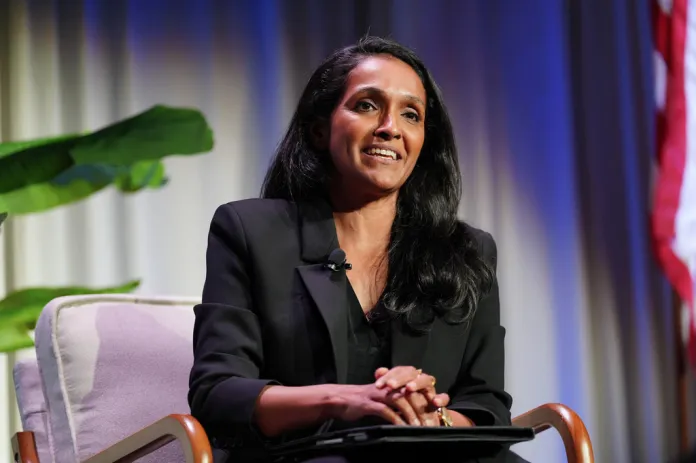
Bass used the latest debate to question whether Raman was ready to lead America’s second-largest city, pointing to a social media video in which Raman appeared alongside an influencer using the phrase “only you can stop fascist liars.” Bass said the remarks targeted her and police Chief Jim McDonnell.
Raman said the video had been edited to distort her message and that she was referring to federal immigration enforcement, not the mayor or police chief.
“As soon as we realized it was a mis-edited video, we took it down,” Raman said during the debate, acknowledging an error while disputing Bass’s characterization.
The candidates also clashed over McDonnell’s future. Raman called for replacing the police chief over the department’s handling of federal immigration raids, while Bass warned that changing leadership ahead of the 2028 Olympics could disrupt the department.
Raman also questioned the administration’s transparency on public safety data, while Bass defended her record on policing and homelessness.
“Bass emphasizes policing; Raman emphasizes accountability,” Smith said. “Voters can want safer streets AND police oversight.”
Jamie E. Wright, a California-based political pundit, said Pratt gave frustrated residents an outlet for their dissatisfaction.
“You can’t label Spencer Pratt’s voters as only celebrity worshipers or standard conservative voters,” Wright told the Washington Examiner. “There is a population that feels fed up with unsafe cities and homelessness. People who don’t think our City Hall is doing the right things. Pratt was able to give those people an outlet for that.”
Bass must convince those voters that her administration has done enough to address their concerns, while Raman must show she can deliver meaningful change, Wright said.
A September poll by the UC Berkeley Institute of Governmental Studies, co-sponsored by the Los Angeles Times, found Raman leading Bass among likely voters, 39% to 28%, with 33% undecided. Among voters who supported Pratt in the June primary, 63% remained undecided about the runoff. Of those Pratt supporters who had chosen a candidate, 22% favored Bass and 16% Raman.
The numbers give both campaigns an opportunity to make their case, but they don’t guarantee either candidate can win over Pratt’s voters.
“There’s little evidence that these voters are necessarily up for grabs,” Spencer said. “Pratt did well because he connected with people who are fed up with the status quo. He also had the advantage of being a recognizable television personality who knew how to connect with an audience.”
Supporting Pratt in the primary, he added, does not mean those voters are now looking for another candidate to support.
Risk of staying home
For Bass and Raman, the challenge may be less about persuading Pratt’s supporters to switch sides than giving them a reason to vote at all.
More than 200,000 people voted for Pratt in the primary, Spencer said, but neither Democrat may offer an appealing alternative to voters who backed an outsider to protest the city’s political leadership.
“There’s an old saying that there are three choices in an election: the two candidates and the couch,” Spencer said. “For many Pratt voters, the couch may be the most appealing option.”
Bass is the incumbent, and many Pratt supporters are dissatisfied with her performance, Spencer said. Raman, meanwhile, is further left politically, which could make her an unappealing choice for voters who backed the Republican.
“For many of these voters, the choice is ‘known bad, unknown potentially worse,’” Spencer said. “Who is going to get excited about that?”
Political analyst Seamus Love said Pratt’s support reflected both traditional Republican voters and Angelenos disillusioned with one-party rule. The fires, homelessness, and the cost of living fueled that dissatisfaction, he told the Washington Examiner, though it is difficult to separate Pratt’s celebrity appeal from his outsider message.
“I don’t believe Pratt’s support was personal loyalty as much as it was an aversion people have to the status quo in Los Angeles,” Love said.
BASS SPLITS FROM PROGRESSIVE RIVAL ON ISRAEL IN LA MAYORAL RACE
Smith cautioned that undecided voters should not automatically be treated as persuadable.
“We shouldn’t treat undecided as synonymous with persuadable,” he said. “There’s a difference between answering a poll and actually casting a ballot.”