
The attacks in Thursday night’s general election debate between Michigan Senate candidates Abdul el Sayed and Mike Rogers began with the very first question, with the candidates trading personal insults and clashing over surveillance technology, immigration enforcement, healthcare, gas prices, and U.S. policy in the Middle East while producing no policy agreements.
The barbs were unrelenting, such that, at one point, upon returning from a commercial break, the moderator said “that in 30 years of doing debates, I’ve never seen it continue during the commercial, but it did.”
That seemed to define the tone for the hourlong spar, the first televised debate between the two candidates.
One of the sharpest exchanges came during a dispute over Flock Safety surveillance cameras. El Sayed argued that the technology needed federal oversight, while Rogers advocated local oversight but defended the use of some surveillance processes in identifying people suspected of terrorism. Rogers then raised the possibility that el Sayed might oppose such surveillance because someone in his family could appear on a watch list, prompting the Democrat to challenge him to make his insinuation explicit.
“Go ahead and say it, you’ve been tiptoeing around it,” el Sayed said.
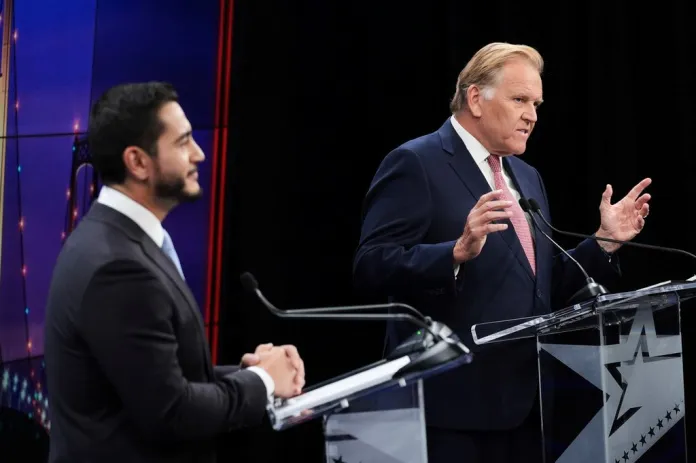
Throughout the debate, Rogers — as expected — claimed that el Sayed, through people who have contributed to his campaign and family members including his biological mother, is tied to U.S.-designated terrorist organizations, including Hamas and the Muslim Brotherhood.
The Detroit Free Press and other Michigan- and national-based media organizations have said the claims are misleading or lacking context.
The confrontation was part of a debate in which neither candidate shied away from personal attacks. Rogers repeatedly called el Sayed a “conman” and a “glitchy chatbot,” while el Sayed accused the Republican of acting as a “sock puppet” for President Donald Trump. El Sayed also called Rogers “weak” and “cowardly,” arguing that he would not stand up to Trump unless his political standing began to deteriorate.
The candidates also clashed over immigration enforcement and deportation policy, healthcare, and high gas prices. Rogers repeatedly returned to allegations involving el Sayed’s background, his views on Israel, and people associated with Islamist organizations, while el Sayed sought to portray his opponent as too closely aligned with the president.
The debate came just hours after Trump launched a personal attack on el Sayed, misidentifying him as “Mohammed” and calling the Democratic nominee a “RADICAL Extremist, Terrorist Sympathizer.” El Sayed responded on social media, arguing that Trump was using his name and faith to distract voters from the effects of his policies.
Foreign policy emerged as another major point of contention, particularly when moderator Rick Albin repeatedly pressed el Sayed to say whether Israel or Iran posed the greater threat to the United States.
El Sayed rejected the question as a “ridiculous hypothetical,” arguing that the U.S. should focus on domestic priorities rather than become further entangled in a conflict with Tehran.
“I want our tax dollars spent here,” el Sayed said, pointing to education, healthcare, and other needs at home.
The former public health official and vocal critic of Israel’s military campaign accused Israel of lobbying the U.S. to go to war against Iran and criticized Rogers for supporting the U.S. campaign against Tehran.
“Let’s be honest, Israel has lobbied us to go to war with Iran,” el Sayed said. He also pointed to Iran’s attacks across the Middle East and the disruption to global energy supplies, arguing that the U.S. should not be drawn into a costly conflict that does not serve American interests.
“I don’t want to be pushed into a war by Israel, and I don’t want to be in a war with Iran,” he said.
Rogers, for his part, commended the U.S.’s military’s actions in setting back Iran’s nuclear program but said “this would be the time to wrap it [the war] up.”
El Sayed acknowledged that both Israel and Iran could cause harm but refused twice to rank one as the greater threat. Rogers, a former Republican congressman who supports the U.S. campaign against Iran, sought to cast his opponent’s views as out of step with American national security interests.
The exchange highlighted a politically sensitive issue for el Sayed as he tries to build support beyond the progressive voters who propelled him through the Democratic primary. His opposition to U.S. military aid to Israel and criticism of its government have drawn scrutiny from some Jewish Democrats, while his positions resonate with voters who oppose Washington’s support for Israel’s military campaign.
Rogers also sought to present himself as a Republican willing to work with Trump while breaking with the president on issues affecting Michigan, including tariffs and fuel prices. When reporters asked him after the debate, he did not explicitly say he would share the same stage with Trump if the president came to Michigan, something Trump had said he would do before the Nov. 3 election. El Sayed, meanwhile, argued that his progressive economic agenda and opposition to foreign entanglements could appeal to voters beyond the party’s left flank.
For Rogers, the race marked a return to familiar territory. He faced then-Rep. Elissa Slotkin in the 2024 Senate election, losing by fewer than 20,000 votes. He ran unopposed in this year’s Republican primary and has benefited from substantial outside advertising as the general election campaign has progressed.
El Sayed narrowly defeated Rep. Haley Stevens (D-MI) in a bruising Democratic primary. The general election campaign has brought additional scrutiny to his association with progressive political influencer Hasan Piker, who campaigned alongside him during the primary and has faced controversy over comments about Israel, the Middle East, and the Sept. 11, 2001, terrorist attacks. El Sayed has not publicly condemned Piker but has sought to distance himself from the influencer since winning the nomination.
EL SAYED TURNS TO JEWISH DEMOCRATS TO SWAY PRO-ISRAEL VOTE IN MICHIGAN
The candidates face competing pressures in a state with a significant Arab American population, particularly in the Detroit area, where U.S. support for Israel has become a consequential issue for Democrats. The party also faces divisions over how to balance criticism of the Israeli government with concerns about Israel’s security and Iran’s regional ambitions.
The Senate race has attracted national attention because of its implications for control of the chamber, where Democrats need to flip four seats to regain the majority.