
Gov. Wes Moore’s (D-MD) refusal during his reelection debate to rule out leaving office early if he wins a second term this November is supercharging the speculation he’s weighing a 2028 presidential run.
The debate stage dodge has not only fueled Republican accusations Moore is more focused on his national political aspirations than the state he governs but also raises the stakes for a strong ballot box performance in a safe seat against GOP rival Dan Cox to avoid blunting momentum as a rising Democratic star.
The first-term governor ruled out a White House run last year and has since denied speculation he’s considering one, even as he’s spent significant time crisscrossing the country to stump for Democrats in key battleground races.
Moore beat Cox in 2022 by 32.5 points, followed in 2024 by former Vice President Kamala Harris defeating President Donald Trump in Maryland by 28.6 points. Whether Moore can again eclipse Cox by as wide a margin as before, as well as convince voters to green-light a high-profile redistricting ballot measure, could affect his role in the approaching 2028 presidential election as a candidate or a bystander.
“I think that there will be a lot of people who scrutinize that,” said Maryland Republican Party Chairwoman Nicole Beus Harris, the wife of conservative Freedom Caucus Chairman Andy Harris (R-MD), who Democrats are seeking to gerrymander from office.
Moore was pressed twice to commit to serving out his full second term during his first and only debate with Cox on Tuesday but declined to do so.
“Being the governor of Maryland has been an honor of a lifetime, and I would not be running for reelection if I was not committed to the people of Maryland,” Moore said the first time, followed by criticism of Cox’s support for Trump.
Asked again for a yes or no response, Moore replied: “I think I gave the answer. I am committed to the people of Maryland, and that’s why I’m running for reelection. That’s what we’ve been doing this entire time, to make sure that it’s the people of Maryland who are going to be supported. And when I said that we’re going to be ‘part of a national conversation,’ not only it’s because I believe the state of Maryland deserves that … I am also very clear we all need to be part of this larger conversation because we cannot watch our democracy and our freedoms and the impacts of what we’re seeing from Donald Trump and this administration allow to stand pat.”
Cox condemned Moore’s dodge as “not worthy of a vote.” Other Maryland Republicans described it as an I-told-you-so moment.
“This governor will not look you in the eyes, again, and promise to not run for president. I know you’re ready to run against Shapiro and Whitmer and Newsom,” Cox said, naming other potential 2028 Democratic candidates Govs. Josh Shapiro (D-PA), Gretchen Whitmer (D-MI), and Gavin Newsom (D-CA). “But the people of Maryland need someone who has their concerns first. And you just heard, the people of Maryland, that this governor will not commit to serving you, and yet he’s asking for your vote.”
Moore’s noncommittal was a similar answer he’s offered reporters for months but with notable differences. His previous go-to response was that he’s “laser-focused” on his reelection, and his latest evade came on the debate stage feet from a Republican opponent who accuses the Democrat of having tunnel vision on a path to the White House.
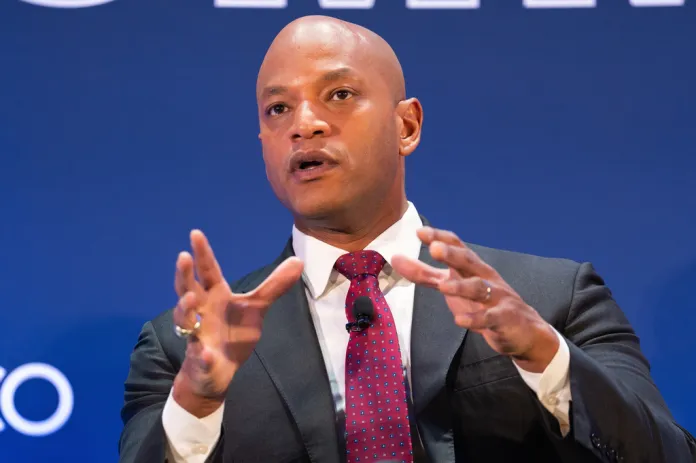
“While Wes Moore is focused on running for president, Dan Cox is focused on the people of Maryland — lowering taxes, balancing the budget, making our state more affordable, and keeping our communities safe,” the Maryland Republican Party said.
Moore’s influence will also be tested on the November ballot through a longtime redistricting effort known as Question 3.
MARYLAND’S ONLY HOUSE REPUBLICAN LOOKS TO LARRY HOGAN TO HELP SURVIVE REDISTRICTING
If approved by voters, the redistricting amendment to the state constitution would pave the way for Democrats to net one seat in 2028 by gerrymandering Maryland’s only House Republican, Harris, out of office. It’s a Moore-led endeavor he’s made a pillar of his reelection campaign, and one that, if successful, would put him on par with other potential 2028 contenders like Newsom who approved counter-redistricting pursuits in response to Texas Republicans.
“This is literally partisan gerrymandering right now, and it’s because of Texas and it’s because of those other states that have done it that he got into the mix, especially with having to compete against Gavin Newsom in California,” Beus Harris said.