
PITTSBURGH — The last time Marc Fogel saw Steve Witkoff, snow was falling at a Moscow airport, and Witkoff had just come from the Kremlin to take him home.
“Marc,” Witkoff told him, “it’s time to get on the plane.”
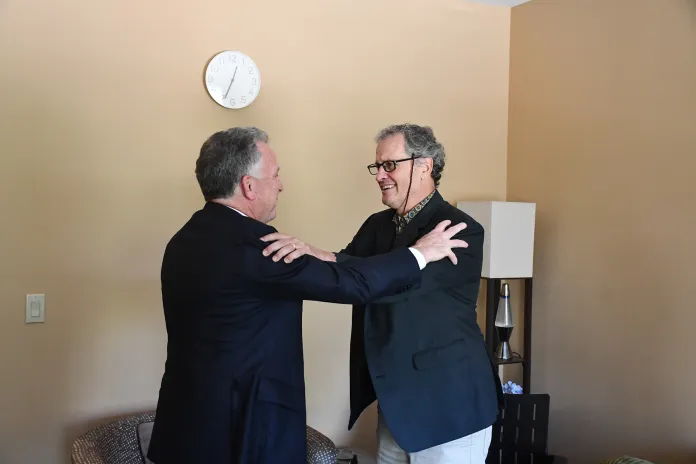
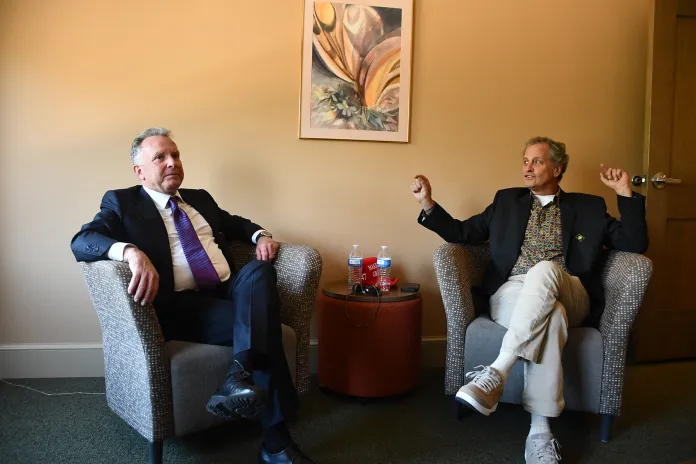
Twenty months later, on the second floor of the Jewish Community Center in Squirrel Hill, a short walk from the Tree of Life synagogue, where a gunman murdered 11 worshipers in 2018 in the deadliest attack on Jews in American history, the two men saw each other again. Neither one said anything at first. They just reached for each other.
It was not a handshake or the quick back-slap men of a certain age use to say hello without saying anything. Witkoff, President Donald Trump’s special envoy to the Middle East, and Fogel, the Western Pennsylvania schoolteacher he brought out of a Russian prison in February 2025, held on, let go, looked at each other, and held on again. Both were crying. Over the next hour, they would do it several more times: in the middle of a sentence, in the middle of a memory, whenever one of them got to the part neither could get through.
They have texted, Fogel said, “a hundred times.” Witkoff once warned him that if he didn’t check in at least once a month, “I’m going to come and pick you up.” But texting is not the same as being in a room with the man who walked into that airport.
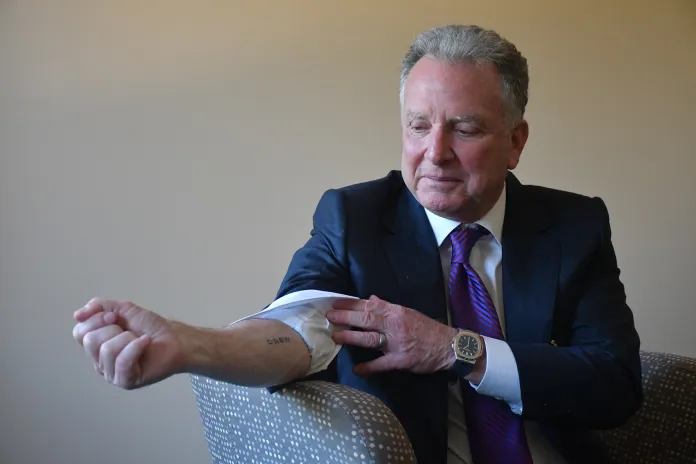
Fogel spent three and a half years in Russian custody. He had been teaching at an American school in Moscow when he was arrested at the airport in August 2021 while carrying a small amount of medically prescribed marijuana. He was sentenced to 14 years. Back home, his mother, now in her 90s, waited.
Witkoff insists the story is the president, not him. But sitting across from Fogel, he kept returning to a Yiddish word he heard growing up: beshert. Meant to be.
Before Witkoff arrived, Fogel sat alone and walked back through the last week he spent as a prisoner, the week nobody told him anything.
After roughly a year in Russian jails, he spent another two and a half years in a penal colony. Asked to describe the colony, he did not hesitate.
“Close your eyes. Think of Soviet Gulag, 1955,” he said. “I mean, we’re talking black and white.”
Eight days before he flew home, guards came for him. They put a bag over his head and loaded him into a freezing truck. The ride took eight hours. It was late at night when they pulled him out by the scruff of his neck and pushed him inside a building. He could tell he was in another prison. What stayed with him was that the floor was clean. After the colony, that alone was shocking.
They shoved him into a cell. He stayed there seven days, let out once for a five-minute shower, and was told nothing.
On the eighth day, the guards came back carrying the clothes he had been wearing when he was arrested more than three years earlier.
“We’re leaving in one hour,” they told him.
He did not let himself believe it. In Russia, he explained, a prisoner’s hopes get raised and crushed so many times that he learns not to trust them.
“There’s not this beam of light,” he said. “It’s hard to be hopeful in Russia. Hope is not a big word to those people. It really isn’t.”
The men who moved him wore balaclavas. Nobody looked him in the eye, and nobody spoke to him. That was fine with him. He had kept his Russian deliberately bad the whole time. “It was one of my weapons,” he said. He could keep people at a distance or simply say, “I don’t know what you’re saying. Get me a translator.”
They put him in a proper vehicle and took the mask off. Then someone finally told him where they were going.
“We’re going to the airport.”
He still did not know what would be waiting for him there.
Witkoff had come straight from the Kremlin. Fogel was waiting inside. Witkoff remembers walking in and seeing him “like it was yesterday.”
“I said, ‘Steve Witkoff, United States government, we’re bringing you home,’” Witkoff said. “‘Marc, it’s time to get on the plane.’”
Fogel finished the line for him, the way people do when they have each replayed a moment a thousand times. “He looked at me, and he said, ‘Marc, let’s get on the plane.’”
Nobody relaxed once they were aboard. The wings had to be de-iced, and the wait was agonizing. Even airborne, the Americans were, as Witkoff put it, “jittery.” He told Fogel to give it about 25 minutes until they cleared Russian airspace.
“It was 19,” Fogel said. “I know it was 19 minutes because I was watching the clock.”
At minute 19, the plane crossed into Estonian airspace, and something on board began to chime.
“Bells, whistles going off,” Fogel said. “And that’s not a good thing when you’re a prisoner.”
That time it was. Someone handed him a whiskey.
They had not told his family he was coming. That was deliberate, Witkoff said. If something went wrong at the last minute, he did not want a woman in her 90s to live through the hope and then the letdown.
So somewhere over the Baltic, they handed Fogel a phone, and he called his mother.
In prison, Fogel could call home only at set times. This call came at the wrong hour, and she did what any mother would.
“She says, ‘Who is this?’” Fogel said. “‘Why are you calling me now? Are you sick? Is there something wrong with you?’”
“Mom,” he told her, “I’m coming home.”
Witkoff and Fogel talked the whole nine hours home. “You would normally almost want to have a glass of wine and just sort of shut down,” Witkoff said. “We talked for nine hours.”
“I never shut up,” Fogel said, laughing through it.
They landed at Joint Base Andrews in Maryland in the cold, with snow on the ground. Fogel stepped off in little more than a T-shirt, an American flag around his shoulders, and a Steelers hat covering his head, with Secretary of State Marco Rubio on one side and national security adviser Mike Waltz on the other. By 2 a.m., Fogel was in the West Wing, where the president had stayed up to greet him.
Fogel’s freedom was not charity. Witkoff structured it as a test.
Even before Trump took office, Witkoff said, he asked the president-elect whether he could go to the outgoing Biden team for permission to begin talking about hostages, in Gaza and in Russia. National security adviser Jake Sullivan and Middle East envoy Brett McGurk agreed. “This is the beginning of these efforts being energized,” Witkoff said. “It’s almost as if the president anticipated that we were going to be doing these sorts of things.”
So when Kremlin aide Yuri Ushakov asked what Moscow would have to do to get Witkoff to the table, Witkoff gave him a name.
“You give me Marc Fogel, that shows me that you’ve got the juice with your guy and he can make decisions and get to a peace deal,” Witkoff said. “That’s how it went down.”
He and U.S. special envoy for peace Jared Kushner, he said, are “transactional people. So the only question is, can we get a victory somewhere, and how big is the victory?”
He credits Fogel with something few outsiders noticed: what he did after he got home. Fogel did not go on television and denounce his captors. He talked about going home. Witkoff believes that restraint helped clear the way for the people who came after him, among them the ballerina Ksenia Karelina.
Fogel has not stopped thinking about the ones still there. For three weeks, he shared a cell with Andre Khachatoorian, an American who, Fogel said, was changing planes in Moscow on his way to meet his future wife in Armenia, a pistol registered for that trip in his luggage, when he was coaxed out of the transit area and arrested. Fogel talks with Khachatoorian’s mother regularly.
“She is distraught,” he said, “and she is a wonderful lady.”
Witkoff leaned in. “We just got to make sure,” he said. By his count, about nine Americans are still held in Russia. “We’re getting everybody.”
For Witkoff, “everybody” has never meant only Russia. The same winter he was working to bring Fogel home, he was working for the hostages held in the tunnels beneath Gaza.
Wednesday is the third anniversary of Oct. 7, 2023, when Hamas gunmen poured across the border, killed about 1,200 people in Israel, and carried roughly 250 hostages into Gaza. On the second floor of a Jewish community center, a short walk from Tree of Life, nobody had to explain why the date mattered.
Witkoff said he does not remember where he was that day. He remembers what he saw later.
On his first trip to Israel, at the military’s Southern Command near Gaza, officers played him “the unvarnished film that no one had edited, no one had touched.” He saw evidence of gang rapes. People tied to trees and tortured. Families burned out of the interior rooms of their homes.
“They’re overwhelming stories,” Witkoff said.
He was part of nearly every hostage deal that followed, he said, beginning in the weeks between the 2024 election and the inauguration: the first release, the second, “the five girls,” and finally the last 20 living hostages, along with the bodies of those who had died in captivity.
Before the final round of talks to bring home the last Israeli hostages, Witkoff and Kushner flew to Washington for one purpose: to ask Trump whether they could sit down with Hamas, a meeting they knew the Israelis would not welcome.
The president looked at them, Witkoff said, almost puzzled.
“‘You’re asking me for permission to meet a terrorist organization if in fact they can be helpful in getting American citizens back home and other people and saving lives,’” Witkoff recalled him saying. “‘Steve, you didn’t need to come here to ask me that. You do what you have to do.’”
They flew to Sharm el Sheikh, Egypt, landed at 6 a.m., and negotiated until 9 that night. Late that night, Qatari officials came to say that Hamas leaders were ready to meet. Witkoff put on a blue suit.
In the room were the leaders of Hamas’s political wing, among them Khalil al Hayya, alongside intelligence chiefs from Qatar, Egypt, and Turkey. Witkoff knew that al Hayya, like him, had lost a son.
“I said, ‘Sir, we’re both members of that terrible club who have buried children,’” Witkoff said. “‘In that club, it doesn’t matter what was the cause of your child’s death. The death is a death.’” He told al Hayya he hoped al Hayya could find his son’s spirit with him every day, “as I do with mine,” he said of his son Andrew Witkoff, who died from an OxyContin overdose in 2011.
A Jewish man from New York and a Hamas leader, two fathers who had buried sons. Al Hayya hugged him.
The Hamas delegation asked for a few minutes and left. Ten minutes later, they came back, shook hands with Witkoff and Kushner, and said: “We have a deal.”
They got Trump on the phone. But Witkoff will not take the credit. “Hamas was afraid of him,” he said. “We went into these discussions with the leverage of having him in the background.” He searched for the word and settled on “omnipotence,” then on something simpler: “It’s so tangible.”
It is not false modesty, he insists. “I think it is disrespectful for anybody in the administration to think that they got elected,” he said.
He brings up, unprompted, a side of the Trump family that does not make the news. Witkoff, who calls himself “as Jewish as it gets,” bristles at the charge that Trump is antisemitic. When a group of working-class Orthodox Jews in Far Rockaway, Queens, asked the president’s father, Fred Trump, to sponsor their synagogue, Witkoff said he offered instead to build and donate it. A plaque bearing his name still hangs there.
“I say to the president sometimes, ‘How come you don’t tell those stories?’” Witkoff said. “He doesn’t even answer me.”
That is why, he said, other people have to tell them.
The president does not dwell on the last homecoming. He moves on to the next one. By the morning after Fogel landed, Witkoff said, the afterglow had already faded in the Oval Office, replaced by a stream of questions: “Who else is coming home? When are you going back? When is this going to happen?”
And yet Witkoff has seen what it means to him. In the West Wing at 2 a.m., with Fogel standing there in the snow-wet T-shirt, and again with the families of the Israeli hostages, he watched Donald Trump take in the enormity of saving lives.
“It’s hard to describe,” Witkoff said. “And for me to be at least even some small part of it, what an honor.”
He has seen the president become emotional, he said, and he told him so. It was with the families of the Israeli hostages after the last release. Afterward, Witkoff said, Trump came to him and said he had never had a more spiritual moment in his life, because the families were all there to tell him, “But for you.”
Witkoff is quick to share the credit. Israeli Prime Minister Benjamin Netanyahu “had something to do with it,” he said, because he kept pressing Hamas. But he believes the families knew who to thank.
“I am proud to serve you because of how invested you’ve become in the lives of these families and ensuring the hostages were brought back home,” Witkoff said he told Trump.
Witkoff did not grow up wealthy, and he came to public service late. Kushner “goaded me in,” he joked. Asked where his drive comes from, he talks about the rooms he has never forgotten. At a dinner for the families of fallen troops, a war widow holding her 2-year-old daughter thanked a wealthy donor and walked out. The donor wept, tore up his $1 million check, and wrote one for $5 million. At a Yizkor service, a man stood before the congregation, named the large sum he had given to charity that year, and asked forgiveness for not giving more, “because I could have and I should have.”
“I just think that the president is like that,” Witkoff said.
But his truest answer came by way of a rock concert.
Not long ago, he and his wife, Lauren Witkoff, went to see John Fogerty, who played with his two sons. One song stopped him: “Long As I Can See the Light,” the old Creedence Clearwater Revival song about leaving a light in the window so someone far away can find their way home.
“That song reminds me of my son, Andrew, who died, who I lost,” Steve Witkoff said. Andrew Witkoff died in 2011. He was 22. Steve Witkoff speaks openly in public about his son’s tragic death from an OxyContin overdose.
Then he turned to the man next to him.
“But it’s a little bit like you, Marc, right? Like the president keeping the light on for people like you.”
Fogel did not answer right away. He did not have to.
Near the end, someone gave him a photograph signed by the president, then a second one for his mother. He held them carefully, the way you hold something you did not expect to be given.
“She’ll love it,” he said.
For three and a half years, a woman in Western Pennsylvania kept a light on for her son, waiting for a phone call at the wrong hour. It finally came from somewhere over the Baltic: “Mom, I’m coming home.”
He is counting toward Oct. 17, the day he will have been home about half as long as he was gone. Some days, the lost time still ambushes him. At a family holiday dinner not long ago, his sons and their girlfriends were talking about a holiday he had missed, and he came apart. “It’s such a crushing sort of event that emerges in my world sometimes,” he said.
But he was home, a few blocks from where this city learned what hatred can do, sitting beside the man who had come to get him. Witkoff had put it plainly earlier: none of this, in the end, was about the years Fogel lost.
SALENA ZITO: THE NIGHT LINDEN AVENUE STOPPED FEELING SAFE
“This is about the rest of your life now,” he had told him. “That’s the story.”
When it was time to go, the two men reached for each other one more time and held on.