
Some of Richard Russo’s most memorable novels have depicted hard times in small towns. His 1986 debut, Mohawk, and 2007’s Bridge of Sighs both played out in fictional blue-collar backwaters in upstate New York, places where the leather industry had ground to a halt but citizens struggled on. For his career-defining, Pulitzer Prize-winning novel Empire Falls (2001), Russo created a new deteriorating town in Maine that was blighted by an abandoned textile mill and shirt factory, and home to Miles Roby, the resilient manager of a diner. At one point, Miles’s daughter summed up her dead-end surroundings when explaining why she was happy to attend church on her recent vacation but did not do so at home: “It was easier to believe in God, she said, or at least the possibility of God, on Martha’s Vineyard than it was in Empire Falls.”
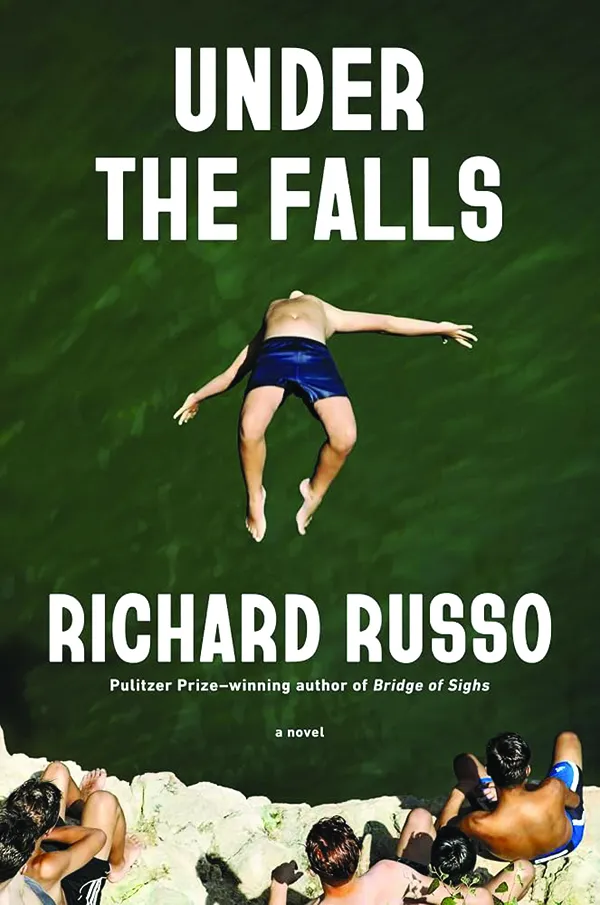
Another godforsaken town, this one again in the Rust Belt, serves as the setting for Russo’s latest novel. In Under the Falls — no relation to Empire Falls — the novelist takes his reader into the Adirondacks to Stone Mountain, “a place that doesn’t yield many good outcomes.” This is the case for the majority of the book’s characters, who attempt to eke out a living in a region beset by economic decline. And yet one man — Russo’s protagonist, Tyler Sinclair — did achieve a good outcome, albeit by leaving Stone Mountain far behind many years ago. But when this native son becomes a prodigal son, his homecoming reopens old wounds, unleashes fresh resentment, and even endangers his life.
Tyler turned his back on Stone Mountain when he was 18, leaving town abruptly, and, he believed, permanently, without saying goodbye to his best friends Curt, Freddi, and Tim “Doc” Dockery. He took with him only a duffel bag full of clothes and his guitar, but carried a great deal more emotional baggage: bitter memories of his abusive and alcoholic father; guilt over his illicit romance with Freddi, back then Curt’s girlfriend; and lingering trauma from a swimming stunt he was involved in, which rendered Doc paralyzed from the waist down. Determined to banish these painful reminders, Tyler followed his love of music to Nashville and eventually found fame and fortune as the front man of a hugely successful rock band named, appropriately, Stone Mountain.
“I made a clean getaway,” Tyler tells his manager, Jason. “Until today.” Now, for the first time in almost two decades, Tyler reluctantly returns to his hometown with his band to perform what will be both a comeback gig after the COVID-19 pandemic, “to work out the kinks,” and a benefit concert to raise medical funds for Doc. But Tyler quickly learns the hard way that this stop was a mistake. During his reunion with Doc, his old friend informs him that not everyone in Stone Island is thrilled to see him.
Some blame him for Doc’s tragic accident; others are angry with him for writing songs about the town and its inhabitants’ lives. “Where’s our cut? is how they look at it,” Doc says. The concert is interrupted by an announcement about a death that sends shockwaves through the audience. The mood sours further, and the show ends in a near riot. Things go from bad to worse when Tyler beats a retreat: Instead of making another clean getaway, he is pursued on a dark mountain road by a driver who rams the band’s limo over the edge and into a ravine.
Just as we begin to wonder where Russo can take Tyler from here, he introduces a new character to create a fresh perspective and forge a different direction. Deb, the newest and youngest recruit on Stone Mountain’s police force, is tasked with investigating the crash that killed two and left Tyler and his fellow bandmate (and girlfriend) Beth fighting for their lives. Until the survivors pull through and can give their version of events, Deb must work alone to piece together clues. She must also make sense of anomalies, some of them unwittingly thrown up by Curt, the town’s police chief and Tyler’s long-lost friend. As her suspicions grow and she entertains the possibility of foul play, she realizes she is up against a group of people scarred by the past, mired in deceit, afraid of exposure, and dead set on protecting themselves at all costs.
In his acknowledgments at the end of the book, Russo points out that Under the Falls began as a TV pilot script. This may account for some sensationalistic scenes, in particular the face-offs and showdowns that make up the novel’s feverish final act. What might have been explosive on the screen feels overwrought on the page.
However, Russo keeps his reader firmly on board. His cast consists of compellingly flawed individuals, most of them with something to hide. There is Curt, a man who has “cut a few ethical corners” in his time; his wife, Freddi, a woman scorned, whose grudge against Tyler appears to have hardened into hatred; and Doc, a colorful character who, accordingly, travels around in a bright orange hearse yet possesses a dark streak and an ability to stir in Tyler both guilt and fear.
A NOVELIST CONSIDERS WHAT WAR TAKES
It would be a stretch to classify Under the Falls as a thriller. It’s really just a deftly plotted, character-led drama punctuated by bursts of excitement at unexpected moments. Even so, Russo handles the police procedural elements with aplomb. As we read, we work alongside Deb and take stock of the many secrets and lies, rumors and cover-ups, denials and betrayals, all the while trying to get to the bottom of a range of tantalizing mysteries. What important matter did Curt’s teenage son have to discuss with Tyler before he left Stone Mountain? Why did the caller who reported the crash not leave her contact details? And who is running drugs in the town?
Stone Mountain is another of Russo’s expertly constructed provincial backdrops. Tyler maps its decay — its desolate campground, its derelict amusement park, its limited prospects — and shows how lives have been shaped by their beleaguered environment. As Tyler retraces his steps, he tells Beth, “Stone Mountain is the kind of place you might escape from once, if you’re lucky, but not twice.”
Malcolm Forbes has written for the Economist, the Wall Street Journal, and the Washington Post. He lives in Edinburgh.