
By the time Abraham Lincoln took the oath of office in March 1861, his election already seemed larger than mere politics. It confirmed the collapse of the one-party system, established the ascendancy of another, and precipitated the secession crisis that culminated in the Civil War. In retrospect, Lincoln’s rise can appear almost predestined — a national hero emerging at the moment the Union needed him.
Jonathan Earle’s He Has the People: Abraham Lincoln and the Election of 1860 rejects the idea that Lincoln was inevitable. His path to the White House depended on fractured parties, failed candidates, convention maneuvering, sectional paranoia, and political contingencies that could easily have produced a different president and an alternative national future.
“No one could have predicted what twists and turns would turn expectations and outcomes on their head,” Earle writes. “Even the seemingly inevitable loses inevitability. Emphasizing the contingency of events restores human agency, free will, and decision-making to a central place.” That principle organizes the book. Earle reconstructs the election from the perspective of Americans who did not know who would win or what the future would hold.
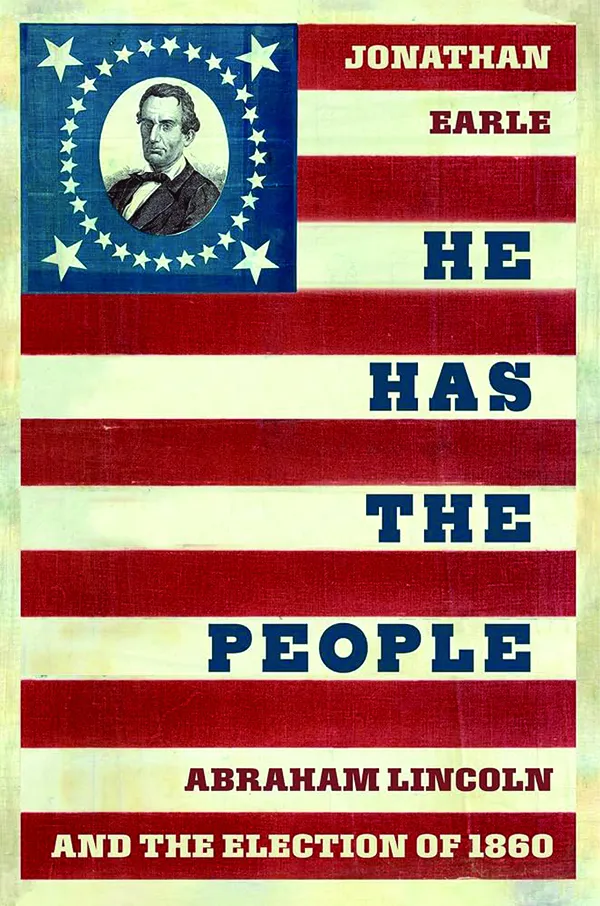
His guide through that uncertainty is not Lincoln but Murat Halstead, editor and part-owner of the Cincinnati Commercial. Halstead attended all seven major political conventions of 1860, reporting on the campaign as it unfolded. A Republican and committed Unionist, he nevertheless pursued an unusual journalistic ambition for the period by witnessing events firsthand and subjecting political figures on all sides to the same scrutiny. By placing Halstead at the center of the narrative, Earle makes He Has the People as much a study of emerging political journalism as of Lincoln’s rise and the coming Civil War.
Halstead first appears at the execution of John Brown in 1859, having slipped into Charles Town despite Virginia’s efforts to restrict access. No admirer of Brown, the Ohioan feared that fanatics in both the North and South were pushing the country toward civil war. But any journalist worth his salt knows the importance of seeing events in person, and Halstead was no different. His dispatch from the Old Dominion was reprinted across the North and established his reputation as a national correspondent. Over the year that followed, Halstead covered fights on Capitol Hill, the division of the Democratic Party, the formation of the Constitutional Union Party, and the Republican convention in Chicago.
Earle structures the narrative around Halstead’s reporting, allowing readers to encounter the political year through rumors, speeches, private maneuvering, premature reports, and constantly shifting expectations. His account of the prolonged battle to elect a speaker of the House shows that method at work. What might now seem like an obscure congressional struggle becomes a proxy for the coming presidential contest. Southern Democrats blocked Ohio Republican John Sherman because he had endorsed an antislavery book, while divisions within the Democratic Party prevented it from uniting behind a candidate.
The speakership fight revealed how thoroughly slavery had destabilized the existing political order. Republicans were growing stronger, Democrats were dividing, and former Whigs were searching for a political home. Those changes expanded some possibilities and foreclosed others, but no one yet knew what political alignment would come from all the factional infighting.
That instability followed Republicans into their convention in Chicago. New York Sen. William H. Seward arrived as the clear favorite, but his strength proved less secure than newspapers and supporters had suggested. Delegates weighed ideology, geography, electability, and the enemies each candidate had made.
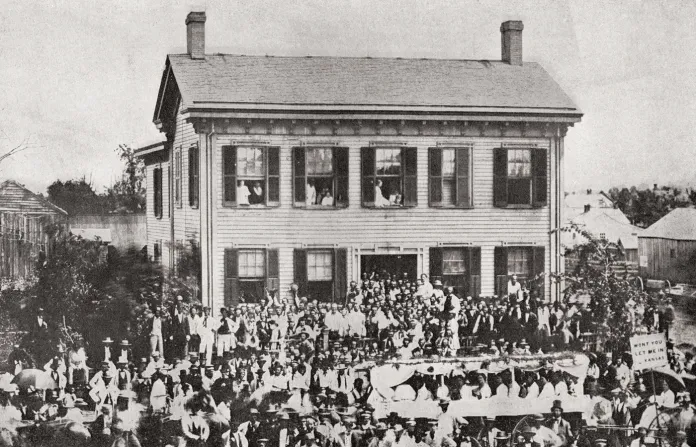
Lincoln benefited from careful organization and the failures of his rivals. He secured the support of Illinois delegates, while other candidates struggled to consolidate their own state delegations. He was sufficiently antislavery to satisfy Republicans but appeared less politically dangerous than Seward to delegates worried about carrying competitive states.
A rapidly expanding national press helped shape those calculations. Newspapers promoted favored candidates, exaggerated momentum, and sometimes reported anticipated outcomes as settled facts. Premature reports that Seward had secured the nomination show how expectation could be reported as fact before delegates had decided anything.
The growing influence of the press depended on technologies Halstead used more fully than most of his contemporaries. Railroads carried him from convention to convention, the telegraph transmitted his dispatches, and inexpensive printing placed his reporting before a mass electorate. Earle presents Halstead as a pioneer of firsthand political reporting, but he was no impartial observer. A committed Republican, he could be sarcastic, partisan, and personally brutal.
In He Has the People, Lincoln emerges as an unusually disciplined politician. His Cooper Union speech made him a serious presidential contender by presenting opposition to slavery’s expansion as consistent with the principles of the founders, an argument newspapers carried far beyond the hall to the rest of the country.
He brought the same restraint to the presidential campaign. While some rivals traveled and spoke, Lincoln remained largely in Springfield, limiting opportunities for error as surrogates and sympathetic newspapers shaped his public image. They targeted key constituencies, including German voters, while the Wide Awakes converted enthusiasm into organization. Republicans assembled a coalition of abolitionists, former Whigs, economic nationalists, and voters who opposed slavery’s expansion but were not necessarily committed to racial equality.
Lincoln’s opponents could not assemble an equally broad coalition. The Constitutional Union Party, led by John Bell, appealed to voters who hoped that moderation and loyalty to the Union could contain the sectional crisis. But while Republicans offered a position on the expansion of slavery, Bell’s party offered little beyond opposition to sectional conflict and to the Republicans themselves.
Northern Democratic candidate Stephen A. Douglas faced a different obstacle. His break with the Buchanan administration and Southern Democrats split the party between Northern and Southern tickets. By staying in the race rather than yielding to a united opposition ticket, he preserved the four-way contest that let Lincoln win the Electoral College without a majority of the popular vote.
Earle returns, again and again, to the uncertainty surrounding Lincoln’s rise. By the later chapters, nearly every alliance, convention vote, and political miscalculation might have changed the outcome. The repetition is deliberate. Lincoln did not master the chaos so much as navigate it, combining careful organization with an ability to capitalize as one rival after another faltered.
TRAVELING THE ROAD THAT LED TO OUR NATIONAL IDENTITY
Halstead’s reporting makes that argument concrete. Earle moves through the year as Americans experienced it. Rumors often raced ahead of the facts, shaping expectations before anyone knew what was true. Political actors made decisions with incomplete information and no assurance of success.
Lincoln’s victory depended not only on broad political forces and moral arguments but also on convention tallies, personal rivalries, rapid reporting, disciplined restraint, and a little bit of luck. Small decisions carried enormous weight because, through much of 1860, several different Americas remained possible. By recovering the uncertainty of 1860, Earle reminds us that history is neither automatic nor preordained. The future remains undetermined, and our choices still help decide what it will become.
Carl Paulus is a political historian from Michigan who formerly worked on Capitol Hill.