
HENDERSON, Nevada — When one tries to imagine a “family-friendly” neighborhood, the Las Vegas area might not come to mind. But “family-friendly” flowed from the mouth of almost everyone I met in Inspirada, Nevada, a planned community 20 minutes from the Strip.
Come here on a fall evening, when the desert sun is low and shadows grace the parks and the village squares, and you’ll see a little slice of heaven on Earth — particularly if you’re a parent.
Desi and Allison, aged about 30, sit at their table on the patio of Romano’s cafe on a Thursday night, while their two young sons ignore the pizza for now and instead play with some older girls on the nearby village lawn. Teenagers on scooters and bikes circle the far side of village square and zoom up and down the trail that runs through the adjacent park. A local musician sings Frank Sinatra songs, while inside Romano’s, a few families eat a quick casual dinner before heading to Adventura Park, a mile down the road, for a soccer game.
Over at Adventura, a half dozen soccer practices are going on simultaneously with a Little League game. While parents sit in the bleachers, the older siblings play pickup basketball at the adjacent courts, and the little ones climb the jungle-gym-fort nearby.
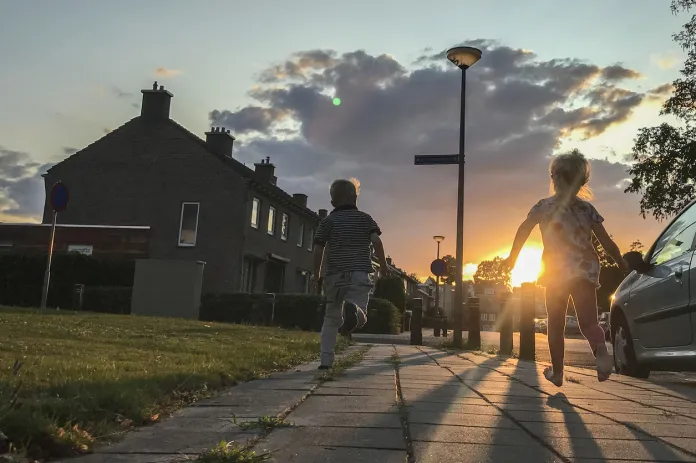
Walk through Inspirada, and you’ll see parents gathered on benches while their toddlers toddle around a playground. You’ll see totally unsupervised, liberated middle-schoolers roaming the neighborhood on foot, bikes, and scooters.
What made this all possible?
Part of it was architects and designers who put walkability first, but specifically walkability for children.
Just as crucially, the developers in Inspirada won exemptions from local zoning rules, and they built housing here — dense, single-family housing — that would be illegal in most of the rest of the county.
Packed into these 2.3 square miles are a dozen parks, miles of trails, two schools, 4,000 homes, 11,000 residents, and maybe the most important lesson for American policymakers today.
The biggest story of the past 30 years has been the crisis of belonging and the collapse of community cohesion. The biggest story of the next 30 years will be the disappearance of marriage and family formation. These are mostly cultural matters, rather than economic matters. It’s hard, or maybe impossible, to address them directly through public policy.
But to the extent the crises of community and family can be addressed by policy, it’s by making the built environment more family-friendly and more conducive to community. And the one undeniable economic cause of the baby bust is the high cost of owning a family home, which makes a dense, suburban place like Inspirada a true model.
“Family friendly,” said Jennifer, a mother, pushing her daughter in the swings at Capriola Park, after school on a Thursday.
“We have friends in other parts of Vegas,” say Jen and Richard, two parents picking up their children from school, “and their kids just stay inside all the time.” Jen and Richard, in contrast, set their children free, and childhood freedom is contagious.
Chantel is a high-schooler who works the cash register at Romano’s, and she has loved growing up here. “My family moved here when I was in fifth grade. Honestly, before that, my parents didn’t really let me out — they were too afraid. But you come here, and you see all the kids running around, and it makes you feel safe.”
Low crime is part of this. Henderson is by some measures the second-safest large city in America, and Inspirada is a relatively low-crime part of Henderson.
“I walk around at night, am not looking over my shoulder,” says Aaliyah, a young mother pushing her 3-year-old in a heavy-duty wagon. She’s lived here for about three years and is picking up her oldest at Ellis Elementary School. “You couldn’t do that everywhere, especially as a woman with kids.”
But child-walkability and bikability are at the core of childhood freedom here. Within most of Inspirada, there are no wide roads — every street is one lane in each direction. The larger thoroughfares through the neighborhood, the ones adults would drive to get from one end to the other, generally have grassy medians (or entire parks) in the middle, making it easier for pedestrians to cross easily.
Long blocks have pedestrian cut-throughs. Everywhere there are sidewalks, foot trails, or both. The family homes generally have parking in the back, down alleys, which allows for narrower roads (a shorter distance to cross) and more visibility (no children stepping out from behind a parked car).
The built environment sends the message: This place is for walking. You can see the effect on cars, which drive slower, and which defer generously to pedestrians of all ages — which is not the norm in much of America.
But there’s a very important way in which Inspirada is not walkable: adults cannot walk to work.
Except for Tony Romano, who walks to his cafe, basically nobody who lives here works here. They all have to drive to work. Adults also have to drive to the hardware store, and probably to Albertson’s supermarket. Frankly, most parents drive their children to elementary school because the average home is about a mile away.
That is, this place isn’t “walkable” by the standards of many urbanists, because the adults are still car-dependent. The key is that the children are not car-dependent, especially once they are old enough to scoot and ride around with their friends.
And the neighborhood events and customs have an obvious audience. Aaliyah gushes about the holidays in Inspirada. Everyone decorates for Halloween and Christmas. The Homeowners Association hosts a Halloween pumpkin patch. There’s a “Food-truck Friday” in the village square. “It’s all for the kids,” Aaliyah says. “They have a bounce house at the harvest festival.”
Parents and children are both liberated by all this. “When I grew up, my mom was like, ‘I don’t want to drive you,’” explains Allison, and so she was often stuck inside. Here, children have endless fun accessible without a ride. And that’s a treasure beyond value to parents — but that doesn’t mean Inspirada is unaffordable.
Inspirada was built about 20 years ago as a “master-planned community.” As such, it won exemptions from the county’s normal requirements for the minimum lot size and the minimum setback from the street. Thus, Inspirada is thoroughly suburban, but unusually dense. It’s not high-rise dense, though. It’s townhouses and small-yards dense. That is, it was planned for family-friendly density.
A typical three-bedroom, three-bathroom home in Inspirada is just about 2,000 square feet, comes with a small backyard and front porch, and lists for $515,000.
Is this expensive for a starter home? Yes, but not outrageously so. A house costing $515,000 is affordable for a household earning $115,000, which is just above the median income for a married couple in Las Vegas.
The children would be steps away from Adventura Park, and so they could play basketball and soccer with zero parental effort. Albertson’s supermarket and CVS are a five-minute drive. So are the elementary school and the charter school. A house like this gets bid up because it gives the parents and children such freedom and convenience.
If more neighborhoods were built like Inspirada — if the supply of family-friendly housing were higher — then homes like this would be even more affordable.
TIMOTHY P. CARNEY: THE PRO-FAMILY CASE FOR WALKABILITY
Of course, there’s one massive downside to Inspirada: It was built in the desert that is the Las Vegas area. The sun is enough to kill anyone’s appetite to walk around — hence the ubiquitous swimming pools and the shade canopies in every park.
Nevertheless, anyone who wants to see what an affordable walkable neighborhood looks like for families ought to come here and grab a slice at Romano’s on a fall evening.