
There have been countless comparisons between the late President Richard Nixon and President Donald Trump, due to their cunning, guile, and Machiavellian approaches to politics. Nixon himself, in a 1987 letter to Trump, a then-celebrity businessman, saw a political future for the younger man in response to a Phil Donahue Show television appearance.
But there’s another politician that Nixon also has a lot in common with, too: Vice President JD Vance.
Nixon, the nation’s 37th president who resigned in the wake of the Watergate scandal, first held national office as vice president in the 1950s. Like Vance today, Nixon under President Dwight D. Eisenhower was a young, ambitious VP in the shadow of an elderly commander in chief. Vance himself recently alluded to their similarities.
“Young senator, vice president, writes some bestselling books, is hated by the media,” Vance said at the Richard Nixon Presidential Library and Museum back in June. “It kind of sounds like JD Vance. I’ve always liked Richard Nixon.”
In fact, there are other striking similarities between the two.
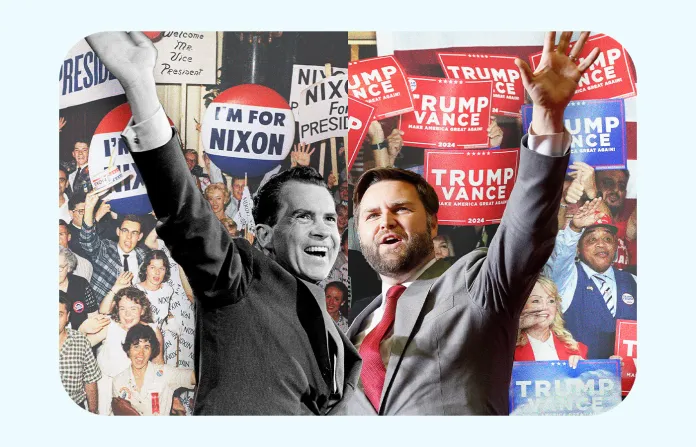
Both men were 40 years old when they became vice president — only five years older than the minimum age to hold the office. When Nixon ran for president in 1960, he was the understudy to Eisenhower, who at 70 was the oldest president in history to that point. By the 2028 election, when Vance is expected to mount his own run, Trump will have that distinction, at the age of 82 — a few months older than was his Democratic predecessor, former President Joe Biden, upon leaving office.
So 2028, like 1960, will be a moment of generational change for the Republican Party.
Both Eisenhower and Trump have expressed doubts about the capability of their understudies. At a 1960 news conference, Time magazine reporter Charles H. Mohr asked Eisenhower for an example of a major idea from Nixon that he had adopted.
“If you give me a week, I might think of one,” Eisenhower famously replied, chuckling. “I don’t remember.”
Trump has privately expressed doubts about whether Vance should be his heir apparent, the New York Times reported in May, including wondering whether Secretary of State Marco Rubio should be the GOP nominee in ’28. The story relayed a telling anecdote:
“At a dinner in the Rose Garden earlier this month, Mr. Trump quizzed his guests about who would be the better choice: ‘Who likes JD Vance?’ ‘Who likes Marco Rubio?’ He made it clear that he was not endorsing either man.”
Nixon and Vance overcame modest upbringings to earn law degrees from prestigious schools (Duke and Yale, respectively). They both served in the military — Nixon in World War II after completing his education, Vance in Iraq straight out of high school. Each relished taking on “elites” and tailored their politics to appeal to working-class voters.
An episode in the first season of the TV show Mad Men offers a revealing look at Nixon — and, by extension, Vance. As the show’s advertising agency, Sterling Cooper, works for Nixon’s 1960 presidential campaign, several of the admen gather in a darkened room to watch TV commercials from the presidential candidates. First is an upbeat one for the Democratic candidate, John F. Kennedy, followed by a dour commercial of Nixon sitting stiffly in front of a desk, hands clasped. The contrast couldn’t be clearer.
“I would like to talk to you for a moment about dollars and cents. Your dollars and cents,” Nixon says, and within a few seconds, Don Draper (Jon Hamm) has seen enough.
“Turn it off,” he says in a disgusted tone of voice. “An ad made by a public relations team. Message received and forgotten.”
Draper then explains how Nixon has a great story to tell. In the broad strokes, he could very well be talking about Vance nearly 70 years later (perhaps sans the Lincoln comparison).
“Nixon is from nothing,” Draper says. “A self-made man, the Abe Lincoln of California, who was vice president of the United States six years after getting out of the Navy. Kennedy? I see a silver spoon. Nixon? I see myself.”
For Vance to claim the White House in 2028, he’ll have to pull off a rare political achievement, one that eluded Nixon in 1960 — winning a presidential election as a sitting vice president. In fact, there have been several other sitting veeps that have failed at that task in modern times, including Hubert Humphrey in 1968, Al Gore in 2000, and Kamala Harris in 2024. The one exception in the last 150 years was Vice President George H.W. Bush in 1988 — the first sitting veep to win the presidency since Martin Van Buren in 1836, and the only one since.
That odd bit of American political history is known as the “Van Buren jinx,” but there’s more to it than bad luck. A sitting VP has to thread the needle between staying loyal to the president while charting his or her own course. Vance’s task will be complicated by a president unlikely to tolerate even the mildest attempt to put distance between the two.
There are important differences between Nixon and Vance. The current VP has a more conservative stance on social issues such as abortion. And Cold Warrior Nixon had a far more interventionist view on foreign policy than the current VP. As Vance wrote in the Catholic literary journal The Lamp in 2020, “I left for Iraq in 2005, a young idealist committed to spreading democracy and liberalism to the backward nations of the world. I returned in 2006, skeptical of the war and the ideology that underpinned it.”
But Nixon and Vance have a lot in common when it comes to political tactics, including being temperamentally suited for the No. 2 role of attack dog. In a 2024 column, George Will called Vance “a rhetorical brawler in the running mate tradition of Richard M. Nixon in 1952 and Spiro Agnew in 1968.” (Maryland Gov. Agnew was Nixon’s running mate that year and went on to be VP until October 1973, when he resigned after pleading no contest to tax evasion.)
Vance also shares Nixon’s zeal for trolling opponents. In 2021, when he was running for a Senate seat from Ohio that he would win the following year, Vance taunted Harris and fellow Democrats as “a bunch of childless cat ladies who are miserable at their own lives and the choices that they’ve made and so they want to make the rest of the country miserable, too.” In his new book, Communion: Finding My Way Back to Faith, he walked back the attack line, calling it a “boneheaded comment.”
BILL GATES SAYS AI COULD CAUSE ‘A BILLION DEATHS,’ RIPS ‘FULL SPEED AHEAD’ APPROACH
Likewise, in 1950, then-Rep. Nixon used his successful California Senate run to savagely mock a rival, reportedly calling House colleague Helen Gahagan Douglas, the Democratic Senate nominee, “pink right down to her underwear.” Nixon won the race, but it earned him his “Tricky Dick” nickname.
Two years later, Eisenhower chose Nixon as his running mate, just as Trump put Vance on the national ticket two years into his Senate term.
Frederic J. Frommer (@ffrommer) is a sports and politics historian who has written for the Washington Post, the New York Times, the Atlantic, and other national publications, and is working on a book on ’70s baseball.