
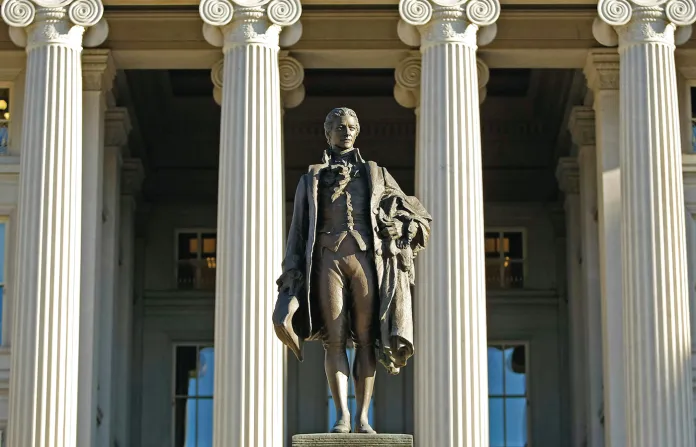
Since the founding era, Alexander Hamilton has had both committed defenders and passionate detractors. His detractors have dismissed him as elitist and antidemocratic; a mouthpiece for the rich and well-born, despite Hamilton’s own humble origins; and a militarist.
Today, conservatives and libertarians often dismiss him as an anti-free-trade protectionist and the forefather of national industrial policy, the idea that government can do a better job than markets at picking eventual winners and losers in the economy.
Others praise him for being foresighted regarding the role of the government in the economy. Hamilton’s financial and economic policies inspired the German economist and diplomat Friedrich List to write his National System of Political Economy, an attack on free trade and the British system of international trade, in 1841. List’s policy recommendations, along with Germany’s wars against Denmark, Austria, and France, were instrumental in unifying Germany under Otto von Bismarck.
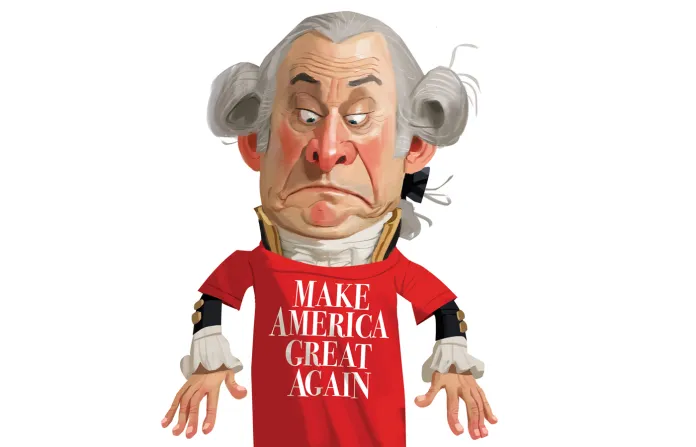
Today, Hamilton’s writings are invoked to support general protective tariffs and all-encompassing industrial planning and subsidies. Following in List’s footsteps, Vice President JD Vance invoked Hamilton in a July interview.
“American economic policy on the right is now much more Alexander Hamilton than it is Milton Friedman,” he said. “I do think, fundamentally, that Hamiltonian tradition is going to be what we see on the American Right and will dominate American conservative economic thinking for the future, which is not laissez-faire.”
Accordingly, Vance has called for a “Hamiltonian” suite of policies: tariffs and subsidies to protect and build domestic industries, which he claimed worked before to build America.
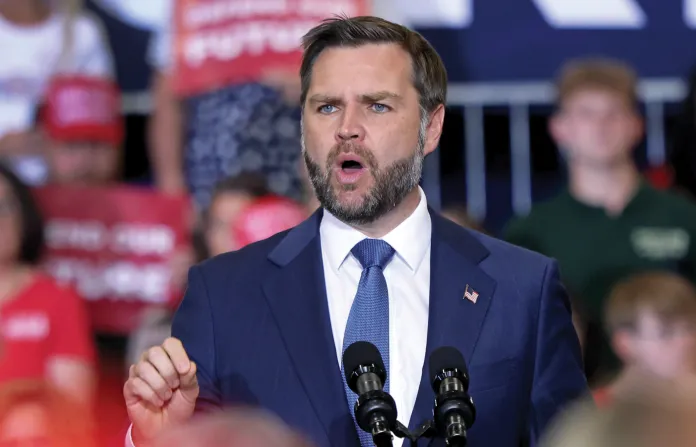
However, both List and Vance are wrong. Although Hamilton was no advocate of laissez-faire, neither was he a tariff-and-subsidy nationalist. Historical context matters. Hamilton sought to address the problems that the young republic faced: how to secure the liberty and prosperity of Americans in a world dominated by two powers, especially Britain, that desired to keep the United States weak and dependent on the Old World.
There is no question that Hamilton’s policies contributed to the security and prosperity of the U.S., but not in the way that the vice president has argued.
Hamilton’s contributions to American republicanism
In my own writings on Hamilton, I have argued that he should be honored for the critical role he played in three important areas: constitutional government, political economy and public finance, and national defense. Here, I focus on political economy and its interactions with national security.
As the republic’s first treasury secretary, Hamilton was instrumental in establishing the fiscal foundation of American prosperity and security. After his confirmation in September 1789, he immediately set to work to establish America’s credit by resolving the problem of the country’s outstanding debt and establishing the foundation for a sound economy.
Over his tenure as treasury secretary, Hamilton presented three important reports to the new Congress on behalf of the Washington administration. His Report on the Public Credit provided for funding the national and foreign debts of the U.S. and for the federal assumption of the states’ Revolutionary War debts.
Next, he sought to establish a national bank as a means for exercising the government’s powers in the event of an emergency such as war. His Report on a National Bank was delivered in December 1790, and a bill chartering such a bank passed through Congress fairly quickly. James Madison questioned the constitutionality of a national bank, but Hamilton made a powerful argument for the bank’s constitutionality, based on the “implied powers” of the Constitution, and President George Washington signed the bank bill into law in early 1791.
Finally, he delivered his third great project, a Report on the Subject of Manufactures, to Congress at the end of that year. It is this report that has been the basis of most of the recent misunderstandings regarding Hamilton’s position on trade and tariffs.
Trade and tariffs
While Hamilton favored tariffs as the most practical way of raising government revenue in the 1790s, he did not espouse state-directed economic development, which would have entailed raising those tariffs to truly protective levels. As the Duke economist Michael Munger argues in a Sept. 2 essay for Civitas Outlook, “The Real Alexander Hamilton,” the reality was that the new government was in debt, making it necessary to raise revenue. By far the most reliable and productive source of revenue was a tax on imported goods. These tariffs could not be “protectionist”: a revenue tax must be low enough to encourage enough imports to supply the needed funding. Indeed, tariffs should be lowered if doing that would expand revenue. “Protectionism,” however, raises tariffs above the revenue-maximizing rate, which is at odds with what Hamilton sought to achieve.
Out of concern for national security, Hamilton did advocate blocking or restricting imports from England and providing “bounties,” subsidies, to domestic industries that would reduce American reliance on English goods. But those fell far short of the general protective tariffs that some in the Trump administration call for.
In 1791, the federal government had almost no tax base besides the customs house. Given the lack of national capacity and the encumbrances of federalism, tariffs were the only administratively workable tax the young federal government had. That fiscal, rather than protectionist, purpose is visible in the report’s own language.
Hamilton concedes in the report that “protecting duties,” import duties on goods that compete with domestic manufactures, function as an incidental benefit to domestic producers. But he is quite clear about which purpose comes first: Duties are levied for revenue, and encouragement of manufactures is the byproduct, not the purpose.
When Hamilton addresses the policy tool that would most resemble modern protectionism, prohibiting imports, he restricts it sharply, writing that this is “only fit to be employed when a manufacturer has made such a progress and is in so many hands as to insure a due competition, and an adequate supply on reasonable terms.”
Hamilton sought to fine-tune rates to raise revenue, not block imports. In fact, domestic manufacturers who wanted real shelter from British competition were disappointed, and the Federalist Party paid a political price for avoiding using tariffs as protection. The modest duties caused manufacturers who desired more protection to shift their political support away from Hamilton’s Federalist Party and toward Thomas Jefferson’s Democratic-Republican Party, which favored tougher measures to reduce imports from Britain, the leading trading partner of the U.S.
The need for revenue meant tariffs were too low to afford protection, because a tariff produces revenue only when imports actually enter the country. As an economist cited by Munger points out, Hamilton “was skeptical of high protective tariffs because they sheltered inefficient and efficient producers alike, led to high prices for consumers, and gave rise to smuggling, which cut into government revenue.”
Subsidies and industrial policy
The second element of Hamilton’s grand plan was to stimulate the growth of domestic manufactures. Rejecting the common assumption that America could prosper with only an agricultural base, he argued that the new nation should concentrate on developing its small-business entrepreneurs. But his strategy was not to assist domestic industry through state control of the market. Hamilton was neither a mercantilist nor a protectionist. He envisioned the role of government as using limited bounties or subsidies, contingent on a surplus of revenue, to help infant American industries overcome barriers to entry erected by the existing terms of trade.
His advocacy of limited tariffs was not to advantage particular manufacturers but to yield customs revenues. In general, Hamilton maintained that trade was directed by its own natural rules and was, for the most part, best left alone. He considered it the role of government to create a stable framework that would allow the free market to prosper.
Far from calling for anything like an open-ended industrial policy endorsed by contemporary economic nationalists, Hamilton confined bounties to a narrow and temporary purpose — overcoming the specific disadvantages of new enterprises competing against foreign producers who were themselves subsidized. He was explicit that the justification expired at some point: “The continuance of bounties on manufactures long established must almost always be of questionable policy,” because their persistence would signal “that there were natural and inherent impediments to success” rather than a genuine transitional need.
A close reading of the Report on Manufactures makes it clear that Hamilton’s main concerns were national and financial security. Dependence on a dominant foreign power was above all a security issue, not a general-purpose brief for economic nationalism. Indeed, Hamilton wrote the report in response to Congress’s explicit charge to consider “the means of promoting such as will tend to render the United States, independent on foreign nations, for military and other materials.” His stated criteria for prioritizing industries for encouragement focused on “the capacity of the Country to furnish the raw material … the facility of execution … the extensiveness of the uses, to which the article can be applied — its subserviency to other interests, particularly the great one of national defence.”
What Hamilton wrought
Nonetheless, if we examine Hamilton’s writings on finance and political economy beyond questions of tariffs and trade, it seems clear that he played an important role in laying the foundation for America’s young market economy by encouraging the entrepreneurship that would be at the forefront of America’s economic growth.
As the first treasury secretary, Hamilton set the conditions for the U.S.’s future prosperity and economic success by establishing the nation’s credit, which provided an incentive for individuals and nations alike to invest in America.
In 1790, the U.S. faced what seemed to be insuperable barriers to financial stability. The new nation owed vast sums to both its citizens and foreign creditors. It was behind in its payment of both principal and interest and lacked the means to raise the necessary revenues. As a result, the credit of the U.S. was held in low esteem, which meant that no one would be willing to lend money to America unless a substantial “risk premium” was added. The American economy was weak and its financial future unclear, making large-scale investment and long-term prosperity unlikely.
Some called for the repudiation of the domestic portion of the debt. Some called for a scaled-down version of repudiation — “discrimination” between original holders and present holders of debt, which would punish “speculators.” Others demanded that the government pay its debt precisely according to the terms set down.
Hamilton proposed that the federal government “assume” the debts of the previous government, as well as the war debts of the individual states, and pay them over time. Such a course would lead to the eventual retirement of the debt in an orderly manner and in such a way that it would be “monetized,” making significant additional capital available for new investment.
“The proper funding of the present debt [would] render it a national blessing,” Hamilton said. Allowing for the regular payment of interest while keeping the principal more or less intact would serve as the basis for a uniform and elastic currency. This would make future credit available as quickly as possible, facilitating economic growth and stability. Hamilton knew that a creditworthy America would generate vast quantities of capital from both domestic and foreign investors. Credit, as the word itself indicates, depends on trust and faith, which must be earned in the marketplace. To earn credit, a country must show that it will honor long-term commitments and keep its financial obligations — both necessary for stable economic transactions.
Hamilton’s financial plan also reinforced another of his goals: shoring up law-abidingness and republican virtue. By emphasizing that the country must pay its own debt, he was reminding citizens of the moral importance of paying theirs. And the assumption of the states’ debts by the national government had the additional benefit of strengthening ties to the new government, and thereby further cementing the union. Hamilton believed that the establishment of justice and the creation of a law-abiding and virtuous people required habituation to virtue and that paying one’s debts, both private and public, played an important role in achieving such a habituation. As he wrote in Federalist No. 72, “the best security for the fidelity of mankind is to make their interests coincide with their duty.”
Hamilton’s goal was nothing less than to affect the very nature of the American economy by arousing a dynamic liberty of industriousness, enterprise, and innovation. He envisioned a nation in which citizens of differing aptitudes could achieve happiness, and he saw commerce as a positive good that would make citizens more fully human and would perfect human nature by stimulating the intellect, the most characteristic possession of man. Manufactures would give “greater scope for the diversity of talents and dispositions, which discriminate men from each other.”
In his Report on Manufactures, Hamilton argues that a diverse economy develops society:
The spirit of enterprise … must be less in a nation of mere cultivators, than in a nation of cultivators and merchants; less in a nation of cultivators and merchants than in a nation of cultivators, artificers, and merchants. … Every new scene which is opened to the busy nature of man to rouse and exert itself, is the addition of a new energy to the general stock of effort.
Rather than basing rewards based on conventional distinctions such as birth or wealth, the U.S. would distribute them in accordance with ability and republican virtue. To do this, it was necessary to create a free nation, a commercial republic, that rewarded merit and ambition.
VANCE AND THE GOP’S HAMILTONIAN TURN
Hamilton understood that commerce and a market economy provide prosperity and growth without which, as history has shown, there can be no free government. Prosperity is necessary to create the military and naval power necessary to sustain a regime capable of protecting the natural rights of its citizens.
He also knew that liberty, and the economic diversity and human excellence that would flourish as a result, depended on a government strong enough to protect it and confident enough to allow each individual to flourish. Such broad issues as the relationship between commerce and republican virtue, not narrow questions such as tariffs and industrial policy, are Hamilton’s real contributions to America’s security and prosperity.
Dr. Mackubin Owens is a retired Marine and former Naval War College professor.