
When Roy Cohn died of AIDS in 1986, Donald Trump was among the few to attend his burial at Union Field Cemetery in Queens. He also attended Cohn’s public memorial later that year in Manhattan, along with Rupert Murdoch, George Steinbrenner, Barbara Walters, and William F. Buckley. Apart from his legions of well-connected friends and a torrent of media coverage, Cohn left behind few physical traces of his life. There were no private papers, no correspondence, and no children. He did, however, leave behind $7 million in unpaid taxes, a sum which the IRS gleefully extracted from his estate after negotiating with Cohn’s executors.
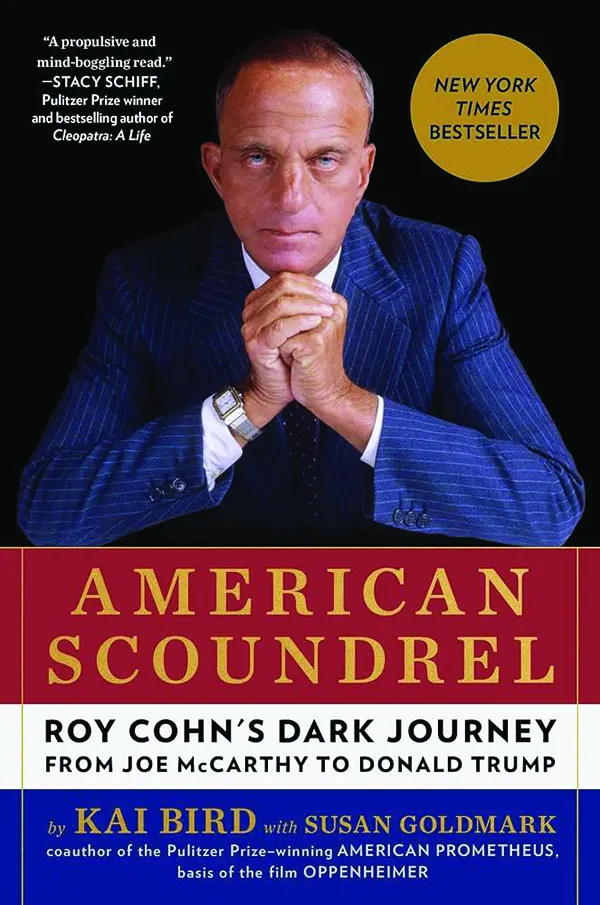
In American Scoundrel: Roy Cohn’s Dark Journey from Joe McCarthy to Donald Trump, veteran biographer Kai Bird takes fresh aim at Cohn, who has lingered in the popular imagination in the four decades since his death. The book, coauthored with Susan Goldmark, is the first in-depth look at his life since the outset of the Trump era. Apart from a few eye-roll-inducing jabs aimed at the incumbent commander in chief scattered throughout, as well as a rather conventional and tepid interpretation of the McCarthy era, this is a captivating book. Bird, in revealing the elaborate and dark contours of Cohn’s life, has done the reader a great service, if not quite for the reason he thinks.
Any exhumation of Cohn in the year 2026 invites the most obvious question: What’s the purpose if not to indict “his most consequential client”? Cohn first encountered Trump, then an ambitious 27-year-old, in 1973, at the members-only Le Club on East 55th Street. It was a popular gathering place for the Manhattanite nouveau riche — “the sort of place,” Trump once said, “where you were likely to see a wealthy 75-year-old guy walk in with three blondes from Sweden.” At the time, Trump was living in a rent-controlled studio apartment on East 75th Street, eager to expand the family business from Queens to Manhattan. They quickly joined forces.
Together, the pair attempted to fend off a civil rights suit from the Justice Department over allegations that the Trumps were discriminating against black renters. Cohn’s strategy was to attack. Instead of settling the suit, they countersued for defamation, seeking $100 million in damages. They ultimately lost and settled anyway, but the point was to always fight back.
Bird is at his strongest when he tries to be a Roy Cohn biographer, capturing his subject in all his wit and depravity, rather than a Donald Trump critic. While the latter bent is sometimes interesting, and the two men are indeed quite intertwined, the likelihood is that Trump valued Cohn for the same reason others did: He was brilliant, extremely useful, and very charming. It seems incongruous to use one man, 40 years dead, to explain contemporary American politics.
Roy Marcus Cohn was born in Manhattan in 1927, the only child of Albert, an ambitious judge embedded in the local Democratic Party machine, and Dora, the daughter of Joseph Marcus, the wealthy founder of Bank of United States. As a boy, he was deeply affected when his uncle Bernie went to prison for financial fraud, something Cohn blamed on “anti-Semites and Jewish Communists.”
Early in life, Cohn developed a knack for cultivating people. While attending the elite Horace Mann School, Cohn became lifelong friends with S.I. Newhouse, of Conde Nast, and Generoso Pope Jr., the son of a mob-connected businessman whose influence was “critical” to Roy’s development. He would make friends throughout his life, in spite of habits such as eating off other people’s plates in restaurants and never paying his bills. “Roy Cohn had a remarkable ability to charm his adversaries,” the book says of his spell-like charisma.
Through his family and friends, the young Roy Cohn had access to an incipient network of New York City elites. This network proved vital for his career advancement. Fresh out of Columbia Law School, he became an assistant United States attorney at 21 thanks to his father’s connections. When Pope needed money to buy the National Enquirer newspaper in 1952, half of the money came from mob kingpin Frank Costello, the other half from Cohn, already earning an impressive income.
In the eyes of America’s liberal establishment, Cohn’s greatest sins took place at the bookends of his life. In the early days of his legal career, Cohn helped secure the espionage convictions of Julius and Ethel Rosenberg. “I would have pulled the lever myself,” Cohn later recalled of their electrocutions.
After a stint at the Department of Justice, Cohn was hired as chief counsel to Wisconsin Sen. Joseph McCarthy (leapfrogging a rival, the young Robert F. Kennedy), where the “boy Rasputin” wielded significant power at the pinnacle of the Red Scare. As in most accounts, this period is dismissed as opportunistic and paranoid. “The number of actual communists was minuscule,” the authors insist.
What Cohn did or did not teach Trump toward the end of his life is hard to measure, but in Cohn’s mantra of “never waste any time on regrets, never show any doubts, and never ever apologize,” one can easily recognize his protege.
Bird and Goldmark infuse this otherwise instructive work with a number of shallow observations meant to emphasize similarities between Trump, Cohn, and McCarthy. “There’s nothing particularly original about Trump’s macho instincts in foreign policy. He absorbed it from Roy Cohn,” the book goads the reader at one point. American Scoundrel is at its strongest in its authors’ detailed account of Cohn’s actual sins, which were extensive. Weaved between tales of political intrigue and eccentricity are darker stories, which suggest that Cohn may have been truly psychopathic and evil, not merely a corrupt lawyer who hated communists.
‘TREASURED ISLAND’ IS A DEFINITIVE LOOK AT THE ELITE ISLAND OF ST. BARTH
In these pages, Cohn is revealed to be a sex addict whose law offices came to resemble “a gay brothel” by night. Bird advances the theory, bolstered by original testimony, that he may also have been a pedophile who partook in the abuse of boys trafficked from Northern Ireland’s Kincora Boys’ Home. Then there’s his boat, the Defiance. After acquiring the 97-foot pleasure yacht in 1967, Cohn frequently loaned it to friends such as Cardinal Francis Spellman and hosted meetings with politicians “to discuss upcoming judicial nominations.” The yacht sank off the coast of Florida in 1973, claiming the life of a young male crew member in what appears to have been a case of insurance fraud.
In 1975, as the 86-year-old liquor baron Lew Rosenstiel lay dying in Miami Beach, Cohn attempted to hijack a vast fortune by forcing his senile friend to sign a draft codicil to his will. When Rosenstiel’s daughter intervened, Cohn sent an investigator to find kompromat on her. He even got a former assistant FBI director to deliver false testimony about Lew’s condition. In the end, his plot failed. But the display of cunning, perfidy, and a weaponized Rolodex is the key to understanding Cohn’s formidable power.
Carson Becker is an American writer.