
President Donald Trump’s state dinner with Chinese President Xi Jinping continues a time-honored tradition, one with its fair share of memorable moments.
State dinners allow diplomacy to take place in a more informal environment, one that likewise opens the door for some more unguarded moments.
Here are four notable state dinner incidents across the years.
1. George HW Bush throws up on Japanese prime minister
By far the most memorable entry, the Jan. 8, 1992, state dinner hosted by Japanese Prime Minister Kiichi Miyazawa at his residence in Tokyo became a global cultural phenomenon.
Bush was nearing the end of a 12-day trip through Asia, a long-haul journey involving his moving through 16 time zones in 10 days. By the time he landed in Japan, he began complaining to his doctor that he felt unwell, especially after playing a tennis match against the emperor and crown prince. Against the advice of his doctor, he decided to go through with the state dinner.
The state dinner, attended by 135 diplomats, was uneventful until around 8:20 p.m., when the president suddenly turned pale, lurched forward, and vomited on Miyazawa’s lap before fainting. As the Secret Service scrambled to respond, first lady Barbara Bush tried to cover his face with a napkin to shield him from the cameras.
Bush came to shortly after, even gathering the strength to joke to his physician, saying, “Roll me under the table until the dinner’s over.” He was able to get up on his own volition, apologize, and leave the dinner. His wife gave remarks in his place.
Doctors said the president suffered from a case of gastroenteritis and that the event was unrelated to any previous health problems. He was in good enough shape to give a press conference the following day with Emperor Akihito.
Japanese media hesitated to report on the incident out of respect for Bush, but the floodgates opened after video of the incident leaked to U.S. media. U.S. comedians unleashed on the president, culminating in a memorable Saturday Night Live sketch filmed in the style of a John F. Kennedy assassination mockumentary, with comedian Dana Carvey.
The incident even went so far as to enter Bush into the Japanese language — the term Bushu-suru, roughly, “do the Bush thing,” became a popular joke staple in Japanese slang.
The moment fared poorly for Bush in the elections later that year, feeding into the image that he was older and in poor health, contrasting heavily with the younger, virile Bill Clinton.
2. Silvio Berlusconi breaks lectern
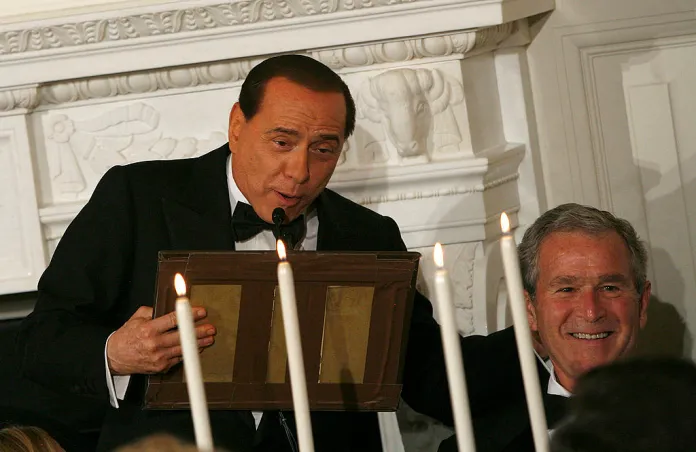
On Oct. 13, 2008, Italian Prime Minister Silvio Berlusconi dined with President George W. Bush shortly after returning to the premiership, which he previously held from June 2001 to May 2006. U.S.-Italian relations had flourished with the two in power, buoyed by their notably close personal friendship. Berlusconi commemorated their friendship in a speech, which he topped off with the warm remark, “George, we’ll remain friends forever.”
He then went in for a hug to cement their friendship. Instead, he tripped over the microphone cord, grabbing onto the podium to save himself from an embarrassing fall. The lectern ended up sacrificing itself for Berlusconi’s balance, breaking into pieces and mostly tumbling to the ground.
In a Looney Tunes-esque moment, Berlusconi was left holding the top of the lectern, without a base. Without missing a beat, the Italian prime minister kept speaking as usual, holding the top of the lectern in its usual place while speaking through the still-attached microphone.
“This is what too much love can do,” he joked, according to a recounting by Time magazine.
3. 2009 White House crashers
President Barack Obama’s 2009 White House dinner hosting Indian Prime Minister Manmohan Singh became the subject of one of the greatest reality TV scandals of all time, when Michaele and Tareq Salahi, cast members for The Real Housewives of D.C., managed to attend the event.
Michaele Salahi, the wife of a wealthy vintner and a social climber whose major biographical details are disputed, was being filmed as a cast member for the Washington installment of Bravo’s Real Housewives franchise. On Nov. 24, 2009, she and her husband allegedly told Bravo that they had been invited to the dinner and were likewise filmed preparing, then being waved through by someone with a clipboard after being briefly questioned.
Michaele Salahi, who stuck out with an elaborate gold-embroidered Indian-style dress at an event when most wore black or navy blue, even claimed to the cameras that she consulted with White House social secretary Desiree Rogers, who said the dress was “a great idea.”
The two were photographed meeting with Obama, Vice President Joe Biden, and chief of staff Rahm Emanuel. The White House only realized the error when the couple posted their photos of the event to Facebook.
The security breach led to a firestorm of bipartisan outrage, triggering several investigations, including one from Congress. The consensus on how the couple was able to breach one of the most secure places on the planet was pinned on human error. A Secret Service agent, persuaded by their insistence and manner, and not wanting to hold up the line, waved the two through, assuming their identities would be checked and confirmed at the next checkpoint. The next agent apparently made the same assumption in reverse.
The Salahis continue to insist they were invited by the White House but have refused to produce evidence of the invitation. They refused to testify under oath to Congress.
Unfortunately for the Salahis, the stunt didn’t go over well with the public. Comedians and the media mocked the couple as high-society wannabes, and the backlash was so severe that The Real Housewives of D.C. was canceled after just one season, with the incident cited as the reason.
The Salahis largely disappeared from the public consciousness after the series was canceled, only reemerging in 2012, when they divorced following Michaele’s running away with Journey guitarist Neal Schon. In the rare times they’ve emerged in the media or popular culture, they’re almost always referred to as the “White House crashers.”
4. Stalin’s joke lands flat
Undoubtedly the most politically impactful entry on the list occurred on Nov. 29, 1943, at a state dinner hosted by Soviet dictator Josef Stalin at the Soviet Embassy in Tehran, held for President Franklin Roosevelt and British Prime Minister Winston Churchill.
The stakes could hardly have been higher, serving as the first in-person meeting of the three leaders of the 20th century’s most consequential alliance. Roosevelt and Churchill were already well-acquainted, but the paranoid Stalin, an enemy of both until Nazi Germany’s surprise invasion on June 22, 1941, threw them into an unlikely alliance.
Unfortunately for Churchill, Roosevelt went into the dinner trying to win over Stalin and believed he could only do so at the British premier’s expense. Roosevelt and Stalin engaged in the vigorous teasing of Churchill, which he didn’t appreciate.
According to accounts from participants and declassified State Department documents, the zenith of this teasing came in the form of apparent dry humor from Stalin, who began talking about his “plan” for the mass murder of Germany’s officer corps.
By Churchill’s own account, Stalin “entered in a genial manner upon a serious and even deadly aspect of the punishment to be inflicted upon the Germans. The German General Staff, he said, must be liquidated. The whole force of Hitler’s mighty armies depended upon about 50,000 officers and technicians. If these were rounded up and shot at the end of the war, German military strength would be extirpated.”
In response, Churchill flew into a rage, decrying the “cold-blooded execution of soldiers who had fought for their country,” according to the State Department’s minutes.
Roosevelt, getting in on the joke, said he would act as mediator, proposing the execution of just 49,000 as a compromise.
Churchill got up and walked out of the room in disgust, saying he wouldn’t be a party to such an atrocity. Stalin went and personally fetched him, assuring the prime minister that he was only joking.
UKRAINE LAUNCHES OVER 1,000 DRONES AT RUSSIA ON FINAL DAY OF DUMA ELECTIONS
Though Churchill returned to the dinner after Stalin’s assurances, the malicious teasing of Churchill went on for the rest of the event. The significance of Stalin and Roosevelt’s behavior at the state dinner helped shape the rest of the 20th century — the trust between the United States and the United Kingdom had been irrevocably pierced, and Churchill, who had gone into the meeting expecting a united democratic front against the autocratic Soviets, felt betrayed. The soured relationship between Roosevelt and Churchill steered the two allies in increasingly divergent directions, putting the U.K. in a clear subservient position to the U.S. as the war went on, and pushing the U.S. position on issues such as decolonization and the fate of Eastern Europe.
Lady Soames, Churchill’s youngest daughter, later reflected on Roosevelt and Churchill’s relationship, saying, “I think of the French proverb, ‘In love there is always one who kisses and one who turns the cheek.’ And Papa was always kissing, and the president was always turning the cheek. Papa was very hurt by it, I think.”