
The Chinese Communist Party has chalked up a major win for its Belt and Road Initiative, opening a massive shipping canal that will connect swaths of the country to trade routes in Southeast Asia.
Beijing announced the official opening of the Pinglu Canal on Wednesday, connecting the Xijiang River with the Gulf of Tonkin in the South China Sea. The 83-mile waterway will cut hundreds of miles off traditional shipping routes and slash logistical costs.
“The new artery carries particular significance for China’s southwest, which has long lagged behind the more prosperous eastern coast and faced higher costs getting goods to seaports,” the Chinese government said in a statement celebrating the opening. “Coal, ore, grain, new-energy materials and auto parts from the region can now take a more direct route to overseas markets.”
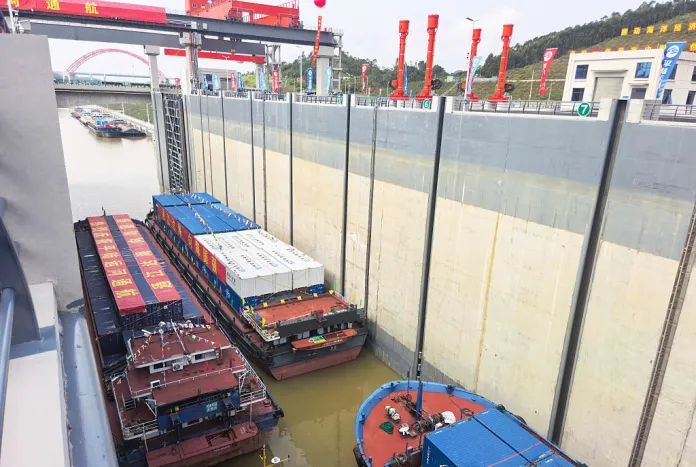
It additionally claimed that the impact of the canal “could extend beyond the movement of goods, spurring new cross-border investment and deepening regional supply-chain integration.”
The canal has been under construction since late 2022 and is estimated to have cost approximately $10.1 billion dollars to finish. It reportedly has the capacity to accommodate vessels weighing up to 5,000 tons.
It’s the first canal of its kind built in China since 1949 and is touted as a feather in the CCP’s cap as it continues to build out its New International Land-Sea Trade Corridor — a massive infrastructure project aimed at expanding Chinese trade through new passages and shipping infrastructure.
The project is particularly focused on building out shipping routes to Europe and the Southeast. The Association of Southeast Asian Nations is China’s largest trading partner.
The Land-Sea Trade Corridor is only one facet of President Xi Jinping’s grand Belt and Road Initiative, an international finance and construction project aimed at exporting Chinese infrastructure across the globe through ports, railways, canals, pipelines, highways, and border crossings.
The scope of the BRI is overwhelming, with approximately 150 countries signed on to at least one project.
The United States and its allies have for years cautioned against cooperation with the BRI, characterizing it as a dangerous expansion of Chinese soft power. Additionally, the electrical and digital infrastructure provided by Chinese companies is subject to control from the CCP.
XI JINPING CASTS CHINA AS A PEACEMAKER AT BRICS SUMMIT INCLUDING IRAN AND UAE
While impoverished nations were initially enthusiastic about participation, the debt accrued from Chinese projects in places like Africa has at times reached crisis levels.
The Center for Global Development has characterized the current trajectory of the BRI as China’s “transition from financier to debt collector.”