
The governments of Scotland, Wales, and Northern Ireland might have overpromised and underdelivered on their recent independence push, signing a memorandum with bellicose language but few concrete promises for withdrawal from the United Kingdom.
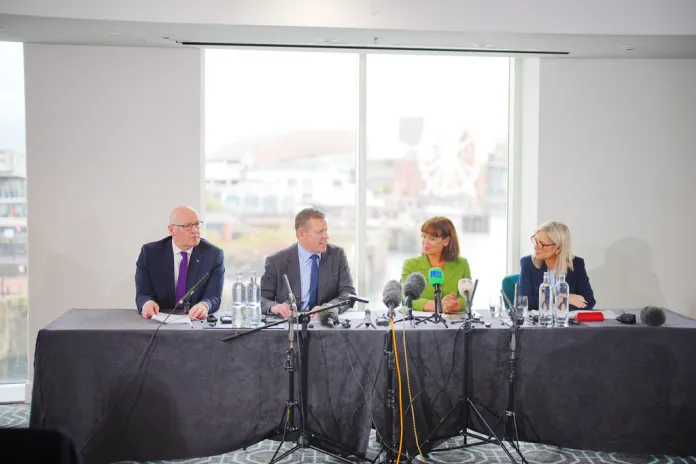
Scottish First Minister John Swinney, Welsh First Minister Rhun ap Iorwerth, Northern Irish First Minister Michelle O’Neill, and Sinn Fein leader Mary Lou McDonald signed the joint memorandum on Monday, demanding the British government prepare for a mass exodus of devolved governments from the U.K.
“For the first time ever, there are First Ministers in Scotland, in Wales and in the North of Ireland who are all committed to independence from the United Kingdom,” the memorandum reads. “For people watching across these islands — for people watching around the world — there could be no clearer sign that Westminster’s time is coming to an end.”
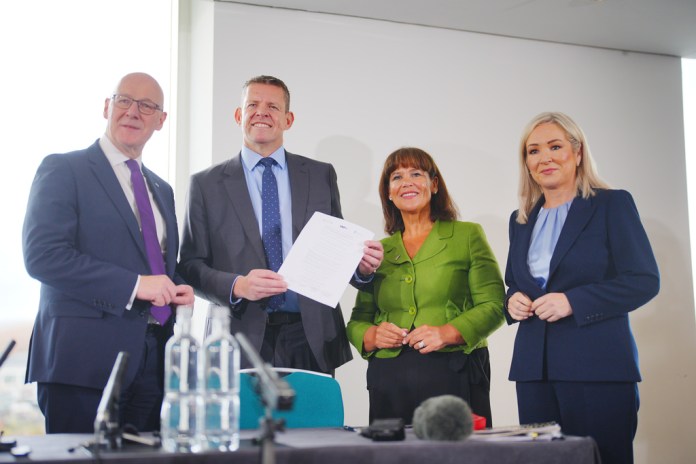
“Momentum is behind our movements; we believe that constitutional change is coming,” the memorandum continues. “Our nations have the right to self-determination: No Westminster government has the right to block democracy or undermine the principle that our people will decide their own future.”
The bulk of the commitments in the document, however, had little to do with cooperation toward exiting the U.K.
The leaders, explicitly representing their own political parties rather than their respective nations, instead committed to work together on tasks such as “sharing ideas and experience on how to build productive, prosperous economies that create good jobs.”
They agreed to “expanding our own energy resources, particularly our vast resources of renewable energy,” and working together to “rebuild and strengthen those European relationships” hurt by Brexit.
Signers warned the British government to “prepare for, plan and facilitate constitutional change” in each nation, but provided no explicit goal or path to independence — acknowledging that each nation has “different constitutional positions” and “will determine its own future in its own way and in its own time.”
This opacity might be due to conflicting visions among the ministers.
The prospect of withdrawing from the U.K. is relatively unpopular in Wales. A poll from last week showed less than a third of Welsh voters would vote to leave. Ap Iorwerth’s party, Plaid Cymru, previously ruled out a referendum for independence until the next Senedd elections scheduled for 2030. That was a pivot from 2021, when it had promised an independence vote within five years.
Scotland has the most precedent for an independence referendum, having held one in 2014. That initiative failed with more than 55% voting to remain in the U.K. A poll conducted in August for the National, a Scottish newspaper, found that in a hypothetical vote for independence, 48% of respondents said they would vote “yes,” 45% said they would vote “no,” and 7% said they didn’t know.
A poll published in May by the Institute of Irish Studies found that 61.4% of Northern Irish citizens would vote to stay in the U.K. compared to 28.3% who would favor withdrawal and 10.3% who said they didn’t know.
The Scottish and Welsh first ministers separately met at the Welsh government offices in Cathays Park on Monday to sign a “landmark” document dubbed the Cardiff Agreement.
The text of this document was even more watered down, stating only that “Scotland and Wales are led by governments who believe in the potential we have to thrive as independent nations,” merely promising to “press the case for greater fairness for Wales and Scotland.”
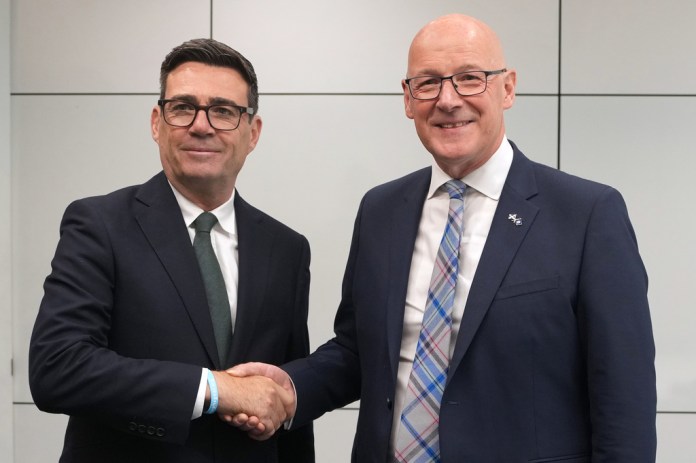
British Prime Minister Andy Burnham’s office responded to the first ministers’ stunt by affirming that the premier “believes strongly in the Union” and is “committed to delivering change across all four nations of the United Kingdom.”
“The United Kingdom is at its best when people come together around our shared values and problem-solving, rather than division, and the prime minister will continue to ease pressures on household finances, and delivering greater economic security, rather than engaging in constitutional debates or further referendums,” a spokesman for the prime minister said.
President Donald Trump, perhaps unintentionally, poured fuel on the fire when he said it would be “fantastic” for Ireland and Northern Ireland to be reunified during a meeting with Irish Taoiseach Micheal Martin in Dublin.
“I don’t want to cause any problems, but I will tell you, I’d love to see it unified,” Trump said Saturday. “It’s going to happen eventually.”
“Now the U.K. would have something to say about it, obviously, but I think it would be a great thing,” he added. “I mean, how can it be bad?”
The remarks drew condemnation from across the British political spectrum, with members of Parliament and party leaders rebuking the U.S. president for unnecessarily weighing in on the contentious issue.