
About 15 years before he made any feature films, the future leading French director Eric Rohmer (1920-2010) tried to become a novelist. His timing could not have been worse. It was August 1944, during the Liberation of Paris. “The bullets were still flying,” Rohmer recalled, and he dared not look out his window, for fear of catching a stray. So he stayed at his desk. “Is it even possible to write about what’s unfolding at present?” he asked himself. “No, it’s not — you need to take a step back.”
Rohmer stepped back exactly five years, concentrating his mind on August 1939, just a few weeks before Germany invaded Poland. But his subject was not obviously political. Instead, he produced a story about star-crossed lovers on vacation, seemingly oblivious to the fact that their world is about to collapse. Élisabeth was published in 1946 under the pseudonym Gilbert Cordier. (Rohmer loved pseudonyms: His real name was Maurice Henri Joseph Scherer.) The novel found no audience in a France still reeling from the Second World War. It quickly fell out of circulation.
Élisabeth probably would have been forgotten entirely were it not for Rohmer’s subsequent movie career. In the late 1950s, as editor of Cahiers du Cinéma, he fostered an approach to film that matured into the nouvelle vague. Many of Rohmer’s colleagues at the magazine, most prominent among them Jean-Luc Godard and Francois Truffaut, were the first stars of the New Wave. Rohmer himself did not become a full-time filmmaker until a few years later, when he embarked on Six Moral Tales, the series that remains his best-known work. And of all the New Wave directors, he has proved the most durable. Godard, Truffaut, Jacques Rivette, Claude Chabrol, and the rest are respected. Rohmer alone is beloved.
The director’s recent popularity is particularly pronounced among anglophones, a fact Rohmer might have found amusing since he spoke no English. His appeal lies in his practiced naturalism. Rohmer’s characters are typically young, unconcerned about money, and dressed with effortless elegance. They are a talky bunch, often on holiday, and anxious to answer the big moral questions about life. And they are usually wrong — petty, selfish, self-deceiving. They are only saved from themselves by chance, or, perhaps, grace. (Rohmer was a practicing Catholic.) In his most popular film, the Six Moral Tales entry My Night at Maud’s (1969), a young man performs a parody of chastity by lying in bed all night with an older woman, but doing nothing more. This is typical Rohmerian humor. The pursuit of pleasure is checked by the imposition of morals, and misdeeds are executed by half-measures. Indecision wins the day.
All of Rohmer’s films, even those not bearing the title, are moral tales, though his later series, Comedies and Proverbs (1981–1987) and Tales of the Four Seasons (1990–1998), are much more subtle than the first six. The director rarely analyzed his own art, but in a 1971 interview with Sight and Sound, he explained his approach. “What I call a conte moral is not a tale with a moral, but a story which deals less with what people do than what is going on in their minds, while they are doing it,” he said. “The people in my films are not expressing abstract ideas — there is no ‘ideology’ in them, or very little — but revealing what they think about relationships between men and women, about friendship, love, desire, their conception of life, happiness … boredom, work, leisure.” Of course, this had all been done before. But Rohmer was doing it in a new way. Film had grown out of the theater, and the director was consciously pushing it beyond its traditional constraints, attempting to integrate its visual elements with more cerebral conceits. “You could say that my work is closer to the novel,” he said.
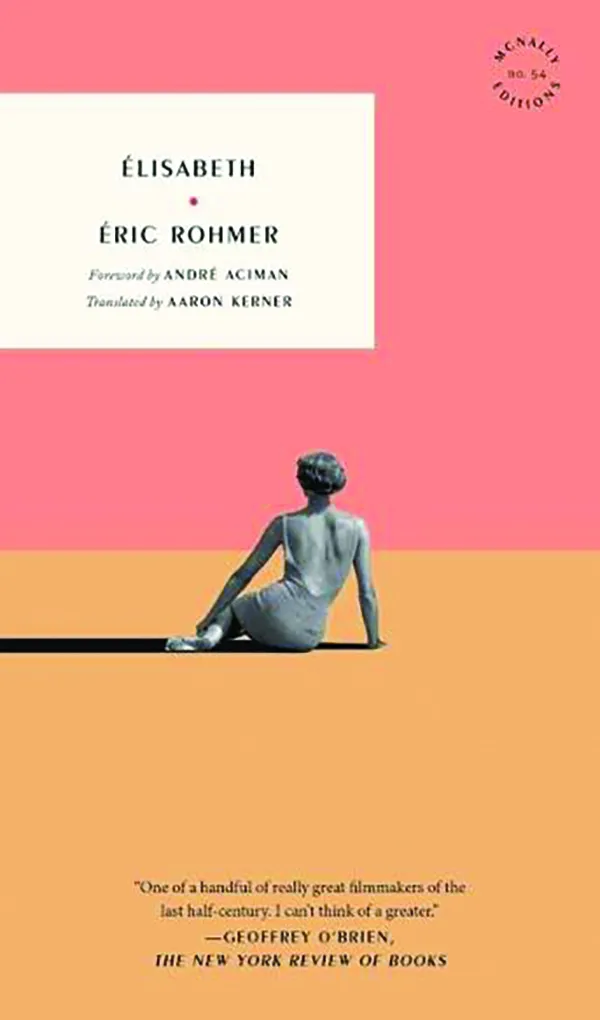
What, then, about Rohmer’s actual novel? Élisabeth was republished in France at the turn of this century, and on the strength of its author’s famous films, has remained in print. This summer, McNally Editions brought out the first English edition. Translated by Aaron Kerner, the book operates like so many of Rohmer’s films: Two cousins, Michel and Bernard, are on vacation east of Paris, on the banks of the Marne. Both have girl trouble: Michel is likely to marry Irene, a woman whom he says he loves, but whom he knows is only the object of his pity, as he watches her “out of the corner of his eye, waiting for that expression, for one of those expressions, that he hated more than anything in the world.” And Bernard is a teenager who gradually — and then all of a sudden — falls in love with his cousin Claire. (He reads like an early version of Fabrice Luchini’s excitable character in 1970’s Claire’s Knee.) Presiding over this circus of mishap is Elisabeth, the family matriarch, who moves through the story with a resigned languor.
Through the character of Elisabeth, the reader is given the only glimpse of the storm gathering on the borders of France. While in the waiting room at the dentist’s office, she flips through old periodicals. One features a report on traffic accidents in the United States. Another offers toothbrushing advice. And a third contains an “interview with M. Ribbentrop,” of the infamous Molotov–Ribbentrop Pact. But it is only a moment, and she hardly reacts. At no other point does reality irrupt into the family’s idyll. People swim in the river, pick plums in their orchards, and complain of the stifling heat. Rohmer ends the novel with Claire reading a book in the garden on a peaceful summer afternoon: “From time to time there’s the sound of water and metal from the direction of the kitchen. The wind picks up and a few more leaves fall to earth. What can be seen of the sky is absolutely blue.” The attentive reader understands that it will be the last afternoon of this sort for many years to come.
HOW THE FACE OF TERRORISM CHANGED IN THE 1970s
Rohmer never considered adapting Élisabeth for the screen. He didn’t believe it would translate. Its setting was far too literary, its effects far too understated. But the novel’s failure did not discourage him. Over the next few years, he tried again, this time with a series of six short stories different in tone and style from Élisabeth. His editor rejected them, finding the work too old-fashioned (“too nineteenth century for his taste — perhaps too eighteenth century, I can’t recall”). Eventually, Rohmer gave up on literature entirely. “I felt that its time had passed, that cinema had supplanted it,” he said in an interview when Élisabeth was republished in French. But he was still attached to the short stories. He took another look. They weren’t so bad. They just weren’t meant for the page. His short stories became the films that would constitute the Six Moral Tales.
“I opened a path that I would follow through two further cycles of films, the Comedies and Proverbs and the Tales of the Four Seasons,” he said. “In the end, it was a fundamentally literary enterprise, one far removed from any real cinematic influence, that would provide the nourishment for my early films.”
Nic Rowan is managing editor of The Lamp.