
I should have loved this book. I’m an English major with no formal scientific training, but that hasn’t stopped me from devouring hordes of books, lectures, and podcasts on everything from quantum physics to the evolution of birds. And yet, reading entomologist James C. Nieh’s The Language of Bees, I found myself flipping to the back to check the remaining page count in the very early going.
The problem isn’t the topic; it’s the writing. Allow me to quote an early section at length. Nieh writes:
“Consider vision, a way to collect and use a tiny portion of the electromagnetic spectrum, visible light, that illuminates our world. Within their earthen nest that first night in Chiapas, the bumble bees would have little light and thus could not fly or focus their attacks on the researchers trying to dig out their home … but after emerging during the day they would see the brightly colored flowers on nearby graves and use this vision for navigation and foraging. Navigation is an important function of bee vision and, returning to the theme of the Umwelt, vision helps bees to obtain information on color, shape, and size to perceive distance.”
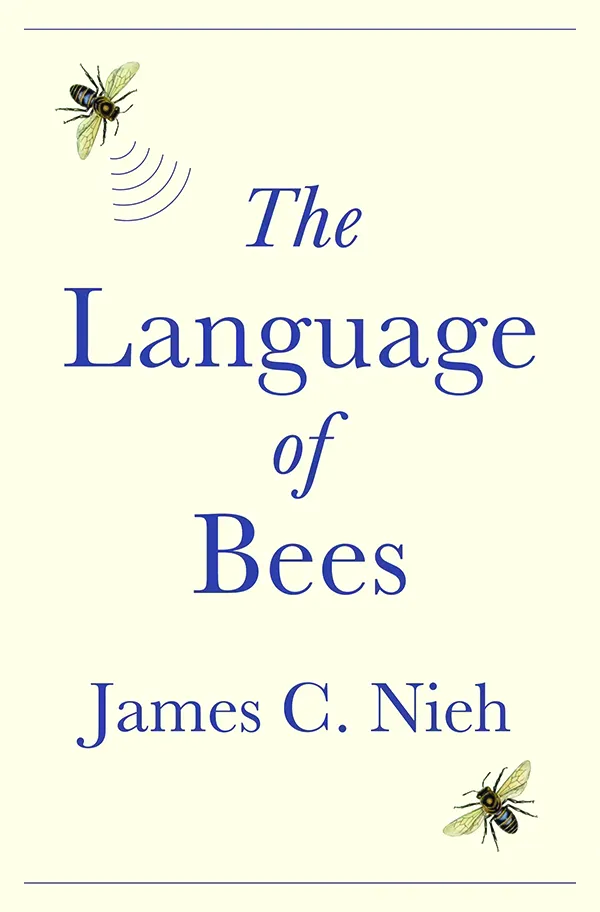
I would humbly suggest that, after reading this rather tedious passage, the reader has learned nothing new. Were you unaware, for instance, that visible light “illuminates our world” or that seeing helps animals “obtain information on color, shape, and size”? There is simply too much redundant language and obvious information to hold our attention. As I continued, I found myself thinking that this poorly written but well-researched book would have made a good 50-page essay … or 30-page essay … or 10-minute YouTube video.
Still, there is gold among the dross, if only because bees are such fascinating creatures. The one novel piece of information in the above quote is the concept of umwelt. The term, coined by 19th-century biologist Jakob von Uexkull, describes the “different sensory worlds” of animals, which consist of what the animal “can perceive, the environmental stimuli to which it responds, and the appropriate responses to these stimuli.” In his essay “What Is It Like to Be a Bat?,” philosopher Thomas Nagel uses the example of echolocation to explore an umwelt beyond human comprehension. He should have used bees. Nearly every passage I highlighted in Nieh’s book relates to their weird and wonderful senses.
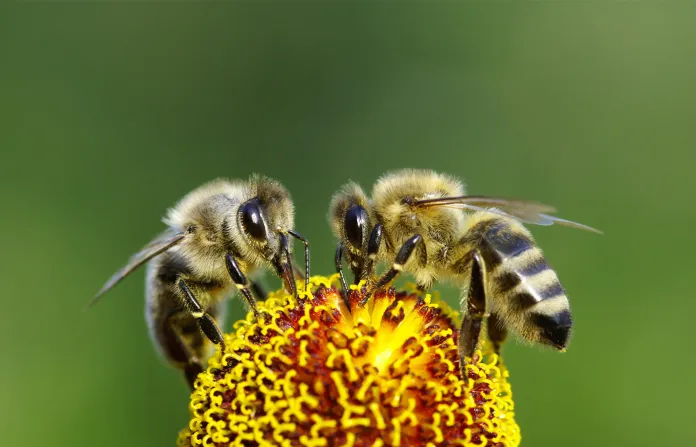
For example, they are, like us, trichromats, meaning they have three color-processing cones. The similarities end there. Their eyes are compound, of course, but they have three “simple” eyes perched atop their heads like a tiara which they use to orient themselves to the sun. They smell using their antennae. And they hear, though not with ears. Bees experience sound, insofar as “sound” means “a vibration in a medium,” but only through their antennae, which molecules physically bend and sway. Because of this, they can detect sound waves in anything that vibrates, including the nest itself.
Then things get really weird. Bees can sense electric fields, a fact that has only recently been discovered. “As bees fly, they accumulate a positive electric charge from the friction between their bodies and the air,” Nieh writes. “As a result, bees can carry charges that interact with the environment and with other bees.” This takes place in tiny hairs covering their bodies, and “when bees encounter floral electric fields, these hairs deflect in response, generating neural signals that enhance their perception of the flower.” I must say, I would pay good money to be able to experience a flower via sight, smell, and electrical charge.
But the title is The Language of Bees, not The Experience of Bees, and the majority of the book is dedicated to communication. These highly social insects relay information through more ways than you’d imagine, including body temperature; body vibration, adorably labeled “abdominal drumming;” the frequency and duration of sound pulses; and, most famously, “dancing.” It’s the latter in which Nieh has the most expertise, and if his skills as a writer are lacking, his skills as a scientist are impressive. The amount of information in a bee’s dance is astonishing. Based on movement, duration, angle, and more, bees can communicate the distance, height, amount, and quality of a food source. They can even adjust their dance to account for levels of uncertainty. If they want their hivemates to head straight to a flower, the dance will be tight and controlled. If they want them to explore a larger area, the dance will be looser and more varied.
Yet Nieh’s scientific fastidiousness gets in the way of his own ability to express his ideas clearly and concisely. At one point, he wants to determine whether bees communicate by leaving odorous footprints on flowers. The descriptions of his experiment begin on page 72. The conclusion comes on page 78. In between are paragraphs such as the following:
“I often marked each bee with unique paint patterns on her thorax and abdomen while she was visiting the feeder. To keep track of how many bees were visiting, I used Tom Seeley’s method to record if a given bee had visited with a 15-minute (min) interval. This regular census was essential during training to ensure that the same bees followed the feeder as I moved it. If too many failed to appear at the new location, I returned the feeder to its prior spot and hoped that they would resume searching.”
I’ll spare you the other six pages of research methods and cut to the chase: Yes, some species leave tiny scented footprints when they land on flowers.
THE TRUE STORY OF REBEL GAMBLERS
Again, this level of detail is the hallmark of a good scientist —Neih is a professor at the University of California, San Diego, and a fellow of the Royal Entomological Society — but wow, these sections drag on. It’s a slim tome, but I still found myself reading faster and faster, looking for the fun facts among the methodologies. At one point, Nieh writes that he “trained the bees to a feeder positioned 116 m away.” I had to laugh: It’s a good thing he lets us know it wasn’t 115 or 117 meters away.
There are other interesting facts. The section on warfare is particularly good. We learn that bees can ward off predators through “shimmering displays, waves of motion created by the coordinated flipping of hundreds of abdomens across the exposed nest surface.” If that doesn’t work, they might instead begin hissing, at a frequency humans can sometimes hear, or even mob an offending wasp and form a “heat ball,” vibrating until the intruder is cooked to death in his own exoskeleton. Those truly obsessed with entomology, or the research methods underpinning entomology, may have a great time with this book, but as for me, I just headed over to YouTube: There’s a 2005 David Attenborough special titled Life in the Undergrowth with a fascinating section on Asiatic honey bees.
Alexander Kaplan is a writer based in Richmond, Virginia.