
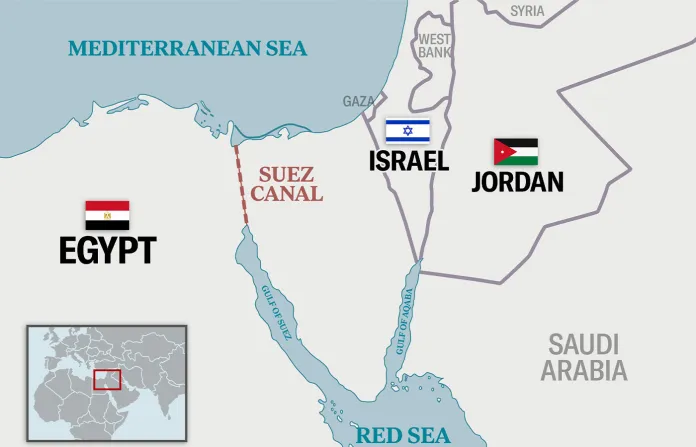
If Congress decides to reduce or completely phase out United States military assistance to Israel, as many on Capitol Hill are demanding, Egypt and Jordan could be next.
The vast majority of the $90 billion in U.S. military and economic/development aid that the U.S. has given Egypt since 1946 emerged from the 1979 Egyptian-Israeli peace treaty. U.S. support for Jordan increased substantially after its 1994 peace treaty with Israel.
Both countries have since become important U.S. strategic partners in their own right.
In fiscal 2025, Israel received $3.3 billion in Foreign Military Financing, $500 million for missile-defense programs, and an additional $4 billion in emergency military assistance. Egypt received $1.3 billion in FMF, while Jordan received $425 million in FMF, plus $1.2 billion in non-military economic assistance.
This support, which has helped stabilize the Middle East by incentivizing Egypt and Jordan to maintain strong and peaceful ties with both the U.S. and Israel, could be on the chopping block if those clamoring to further rein in America’s enormous foreign aid expenditures are successful.
Opposing aid to issue has become a litmus test on the political Left. On July 15, 103 House Democrats voted to cut off the $3.3 billion in annual military aid to Israel by supporting an amendment introduced by Rep. Thomas Massie (R-KY). The proposal split the party, with 98 House Democrats voting to keep Israel aid in place.
The amendment was defeated 314 to 104, with all Republicans besides Massie voting against. Yet the episode served as a political warning shot about the future of American military aid to Israel if Democrats win control of the House and/or Senate in the 2026 midterm elections and the presidency in 2028.
According to a Pew Research Center analysis of federal data, federal agencies provided $47.3 billion in foreign aid in fiscal 2025, about $26 billion less than in fiscal 2024.
“U.S. assistance to foreign countries fell to its lowest level in more than two decades in FY2025,” when adjusted for inflation, “and it’s on track to be even lower this fiscal year,” the center said.
Daniel Shapiro, a former U.S. ambassador to Israel and now a distinguished fellow at the Atlantic Council, said phasing out aid to Israel could have an unanticipated domino effect.
If, as many expect, the U.S. reduces or cancels military support to Israel when the existing U.S.-Israel memorandum of understanding expires in 2028, “there will be little appetite in Congress for continuing to provide big aid packages to Egypt and Jordan,” Shapiro said. “What few of the advocates in this debate seem to have time for is grappling with and preparing for the second- and third-order effects of that policy change.”
Before changing the status quo, Shapiro urged U.S. policymakers to consider the following questions:
- Who will Jordan and Egypt turn to for assistance?
- Will it create openings for the U.S.’s competitors or enhance threats from adversaries?
- How will it affect the countries’ ability or willingness to play a role in achieving an Israeli/Palestinian resolution?
- How will it impact U.S. influence in the Middle East and its ability to protect U.S. interests?
Jordan: The dangers of cutting aid
Jordan, which has received nearly $34 billion of American aid in the past 75 years, would be particularly vulnerable to a sudden reduction in U.S. assistance, experts say. The United States has supported Jordan, a small, arid country bordered by Israel, Syria, Iraq, and Saudi Arabia, since 1951, as the kingdom has dealt with wars, Islamic terrorism, and the influx of millions of refugees.
The U.S. military relationship with Jordan has strengthened over the decades, said Ben Fishman, a senior fellow at the Washington Institute.
“Jordan is a steadfast ally and partner,” Fishman said. Crucially, the Hashemite Kingdom allows U.S. forces to operate from its territory — bases that Iran targeted several times again in late August and early September. Jordan coordinates with the U.S. and Israel against Iranian drones and missiles and routinely intercepts weapons and drugs smuggled from Syria.
“The close U.S.-Jordan relationship contributes not only to Jordan’s security but to mutual security” in the region, Fishman said. “Maintaining Jordan’s stability is in the U.S. interest. That’s not going to change.”
Egypt: A regional powerhouse
Egypt is a nation of 120 million citizens, a powerful regional player with considerable clout in the Arab world. The late President Anwar Sadat’s decision to recognize Israel and end hostilities with its northern neighbor was a bold diplomatic precedent. It was a historic decision for which Sadat paid with his life — he was assassinated in 1981 by extremist soldiers during an annual military parade in Cairo.
Egypt’s control of the Suez Canal is vital to international shipping, and its government permits U.S. military aircraft to use its airspace under their military partnership. That partnership requires Egypt to use the money it receives from the U.S. to buy and service weapons systems from American arms manufacturers.
“The Egypt-U.S. military relationship is anchored in military hardware,” Fishman said. “When Egypt purchases an American weapons system, it is also purchasing maintenance and software and a relationship with the U.S. industrial base.”
This relationship has fostered close ties between the two militaries.
While there may be a case for the U.S. to reduce the amount of FMF it provides to Egypt, Fishman said, “Will doing so drive the Egyptians to buy weapons from Europe or Russia?”
Shapiro has similar concerns.
“Egypt will not stop seeking to arm itself. It will readily turn to Russian, Chinese, maybe North Korean military systems,” he warned. “We’d be opening the door to our competitors to plant their flag in the region. Our influence would likely decline.”
Which is not to say that the U.S. administration has unlimited leverage over Egypt. After the Oct. 7, 2023, Hamas attacks on Israel that killed more than 1,200 people and took 251 hostages, and Israel’s defensive military response in Gaza, President Abdel Fattah el Sisi has flatly refused to allow large numbers of Palestinian refugees in Gaza to resettle in Egypt. While doing so might have saved countless Palestinian lives, Sisi did not want to appear to be supporting President Donald Trump’s controversial proposal to relocate Gazans and build “the Riviera of the Middle East.”
Would Egypt or Jordan abandon their peace treaties with Israel?
Hady Amr, a former deputy assistant secretary of state for Near Eastern affairs and now a nonresident senior fellow at the Brookings Institution, thinks Egypt and Jordan will honor their agreements with Israel because those agreements “serve the mutual interests” of those governments.
“I would argue that the foreign assistance packages should be evaluated on a country-by-country basis,” based on their actual needs and U.S. military interests in the region, Amr said. While Israel is far wealthier than Jordan and Egypt, cutting assistance to any of these governments “will reduce American leverage over them.”
Totally defunding Jordan and Egypt “would certainly destabilize the region, leading to instability for their own populations as well,” Amr concluded.
SEAN DURNS: A HISTORY OF COMMUNISM WITH AN EYE ON THE VICTIMS
Shapiro concurs.
“I’m not arguing that the withdrawal of aid would mean the collapse of the peace treaties because they serve the interests of Egypt and Jordan as much as they do Israel,” Shapiro said. “But they have taken hold in a certain context and political structure. Once you start removing bricks from the structure, you don’t know the result.”
Michele Chabin (@MicheleChabin1) is a journalist whose work has appeared in Cosmopolitan, the Forward, Religion News Service, Science, USA Today, U.S. News & World Report, and the Washington Post.