
Dr. Amy Acton, the Democratic nominee for Ohio governor, was emotionally volatile and sometimes absent at daily strategizing sessions during the pandemic while serving as the state’s top health official responsible for leading Ohio’s COVID-19 response, according to sources who worked with her in the state government.
In interviews with the Washington Examiner, five current and former state government workers, including staffers from the Ohio Health Department, governor’s office, and a career civil servant, described Acton’s conduct in the workplace as erratic and said she was prone to emotional episodes, to the point that she was once allegedly found “curled up” into a ball on the floor before one of the emergency response meetings and seen crying in the bathroom in another incident described by someone who worked with her.
Taken together, their COVID-era recollections paint a picture of an emotionally reactive leader who struggled to handle the demands of the job, even in the time preceding the pandemic.
Acton campaign spokeswoman Addie Bullock categorically denied the series of claims.
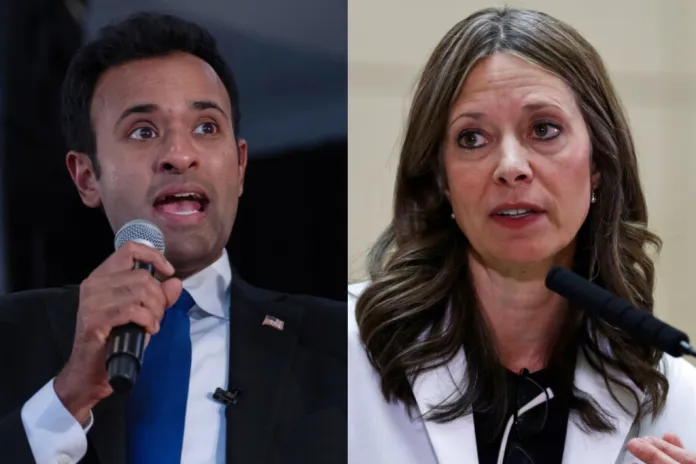
“These are disgusting lies and desperate mischaracterizations of how Dr. Acton and Governor [Mike] DeWine put public health over politics to keep Ohioans safe, which is a foreign concept for someone like billionaire Vivek Ramaswamy who made hundreds of millions of dollars scamming seniors with an Alzheimer’s drug that didn’t work,” Bullock told the Washington Examiner.
RAMASWAMY AND ACTON TURN PAST BAGGAGE INTO AMMUNITION IN OHIO GOVERNOR’S RACE
“Vivek Ramaswamy is a scam artist who calls the residents of his own state ‘lazy’ and says they’re ‘whiners’, and has no plan to deal with the affordability crisis in Ohio because he doesn’t care about anyone other than himself,” Bullock said. Ramaswamy is Acton’s Republican opponent in the tight gubernatorial race.
‘Where’s Amy?’
Acton served a brief stint as the director of the Ohio Department of Health under Gov. Mike DeWine (R-OH) from February 2019 to June 2020, during which she was in charge of the statewide response to the coronavirus outbreak.
Staffers from the governor’s office at the time said she missed several morning meetings where dozens of advisers from various departments discussed daily coronavirus case numbers, helped decide shutdown orders, and prepared the whole-of-government response for the day ahead of the press conference that afternoon.
These morning meetings, which transitioned to conference calls after state employees started working remotely, began anytime between 6:45 a.m. and 8 a.m. because DeWine was an early riser.
One former senior staffer from “the 30th floor,” shorthand for the Ohio governor’s office located within the Riffe Tower, recalled on multiple occasions DeWine asking, “Amy, what do you think? Does anybody know where Amy is?”
“And then somebody would say that they’re texting her or they’re calling her,” the former staffer said. “So then staff would be scrambling to try to find where Dr. Acton was, and some other person from the Department of Health would have to fill in.”
A former executive staffer within DeWine’s administration also recalled “plenty of times” when the governor would inquire, “Where’s Amy?” at the beginning of the calls. “She either would or would not get on, and someone would have to go chase her down.”

On the calls, government officials went over the latest infection counts, how many hospital beds were available at the major state hospitals, and other fact-gathering work that culminated in DeWine and Acton delivering updates to the public at each day’s press conference.
Most of the communications staff on the 30th floor were reassigned to put together a near-daily news conference conducted in the style of a fireside chat, which state residents tuning in as part of their daily ritual affectionately dubbed “Wine with DeWine” and “Snacking with Acton.”
The beloved press conferences soon became a spectacle, requiring a grueling amount of preparatory work. At one point, DeWine and Acton were holding briefings daily, continuing throughout the weekend. Staff accordingly had to work seven days a week to produce the press conferences and prepare their remarks.
A couple of times, DeWine was preparing to go live at the press conferences and the governor would be asking about Acton’s whereabouts as he finalized his notes, recalled the senior staffer who was involved in the daily press conference preparations.
“We were all sitting there ready to take a camera live and we weren’t quite sure if she was going to come walking through the door or not,” the former staffer said. “Nobody knew. And so then he would start the press conference and say, ‘Good afternoon. Dr. Acton is enjoying a well-deserved day off. We’re going to go ahead and get started.’ And then he would just do the press conference on his own. Sometimes the lieutenant governor would be there.”
On May 19, 2020, the day DeWine lifted Acton’s original stay-at-home order in an effort to reopen the economy, she was notably absent. DeWine, joined instead by then-Lt. Gov. Jon Husted, told local reporters that Acton was not feeling well.
Several sources who worked with Acton said she was sensitive to criticism and resistant to opposing viewpoints. They said the internal conversations leading up to Acton’s resignation turned heated over staffers advocating the state lift restrictions on businesses and allow schools to resume in-person learning.
“Dr. Acton constantly was 100% opposed to any change in restrictions,” one of the former staffers from the governor’s office said. “It was making the morning meetings quite tense and uncomfortable for people to be in because there was a lot of arguing happening. There were factions of people that wanted there to be a pathway to reopening.”
That ex-staffer wondered whether Acton skipped meetings out of frustration with DeWine going against her guidance. “At the time, I didn’t know if it was because she was so frustrated that the governor was taking advice that was counter to her advice, which was keep the state on full lockdown until the virus has been eradicated.”
The same source said Acton exhibited “borderline unprofessional behavior” when they debated reopening the state, becoming “very emotional [with] long emotional pleas to the governor to not take this advice,” even if it meant simply easing some restrictions rather than a full return to pre-pandemic operations. “She did not want to hear that conversation at all. She didn’t even want people making that case to the governor.”
Acton, one of the shortest-serving Cabinet members of DeWine’s first term, ultimately resigned amid immense political backlash over her emergency health orders, including anti-lockdown protests outside her home and the Republican-controlled Ohio House passing a bill to strip Acton of her emergency powers.
In her announcement speech on June 11, 2020, she alluded to the enormous strain of the job, mentioning working “long and hard days.” But in an interview years later, her first interview since she declared a run for governor, Acton said she quit primarily due to a disagreement over the reopening of Ohio’s county fairs, an important part of the Midwest state’s culture.
Acton said she objected to signing off on that order, her “final straw,” believing that doing so was not supported by the science.
“There was a real pressure on the governor and on me to sign orders,” Acton said. “And this one order in particular was the final straw for me. It was to open the fairs. We were just, if you remember, beginning to open businesses and finally stabilizing our hospitals. And there was pressure for fairs to be opened in a way that there was no science for.”
Figurehead or the Fauci of Ohio?
Acton’s campaign disputed that she had heated disagreements with DeWine, saying that Acton and the GOP governor together jointly took a crisis management approach that prioritized the public’s safety.
DeWine himself has taken sole responsibility for the highly criticized COVID closures, insisting that Acton specifically cannot be held accountable for actions the state took during the pandemic.
“The decisions that were made during COVID, they were my decisions, so no one should blame someone else if they don’t like it,” DeWine said. “The buck stops with me.”
DeWine, who has endorsed Ramaswamy, even denounced an ad from the Ramaswamy campaign attacking Acton for ordering the closure of the polls on the eve of the 2020 primary election.
Acton issued the order, but DeWine said he ordered Acton to sign the directive.
“In government this happens all the time,” DeWine told NBC4 Columbus. “Do you think a member of the president’s Cabinet would issue this kind of order without his approval? I told her to issue the health order. The decision was mine.”
DeWine said he made the call because he genuinely believed “if I did not make that decision people were going to die,” referring to immunocompromised older residents and poll workers.
When Acton stepped down as health director but remained on for a brief period as DeWine’s chief health adviser, the governor called Acton’s counsel “superb” and said that he believed “many lives were saved because of her wise advice.”
In response to a Washington Examiner inquiry about Acton’s alleged conduct, a spokesperson for DeWine’s office reiterated that the governor has made numerous statements on the issues raised and does not have any new comments.
WHAT TO KNOW ABOUT THE RAMASWAMY VS. ACTON MATCHUP FOR OHIO GOVERNOR
Some of the former DeWine staffers said that the governor tended to have an array of voices hop on the conference calls, in part because he valued diverse opinions, but also, they suspected there was a need to bring in “actual” medical and health policy experts, as Acton was not a practicing physician at the time nor had she previously held a government position.
“It wasn’t just Amy working with her team and being the point of contact,” one ex-staffer said. “There was a need to sort of buttress the support to actually get the work done.”
In March 2020, Acton had to clarify her statement that at least 1% of the state’s population, or more than 100,000 Ohioans, was currently carrying the coronavirus. “I am not saying there are absolutely for certain 100,000 people [infected],” Acton said at a press conference the following day. As for how she arrived at the alarming figure that some public health experts determined was shockingly high, Acton said she was “guesstimating” community spread.
‘She seemed out of her element daily’
Others who spoke with the Washington Examiner felt that Acton did not understand the governmental process behind policymaking and seemed to have been out of her depth as an academic coming from the nonprofit sector.
“My initial impression was she seemed like a good fit,” an ex-health department staffer said, “but very quickly it started to become clear that she really didn’t have any idea what she was getting into.”
Acton lacked a government background beforehand. Prior to her appointed position, Acton worked as a grants manager at the Columbus Foundation and would return to the charity in August 2020 after leaving her less than two-month advisory post in DeWine’s office. Before that, she was an assistant professor at Ohio State University’s College of Public Health and the director of Project LOVE (Love Our Kids, Vaccinate Early).
“She may have understood the environmental science behind harmful algae blooms,” said the former staffer from the health department who has spent many years in public service. “But implementing a policy change and the processes that you have to adopt and where decisions get made and how you have to adhere to legislative mandates, all that was somewhat of a new challenge.”
Noting the size of the Ohio Health Department, an agency comprising over 1,000 employees, and the body of work the department handles, the source said that people were looking for leadership during the transitional period between administrations.
Agency staff were optimistic when they first met her, the ex-staffer said of Acton’s early onboarding days. She was quite personable in the time she captivated her audience, the former staffer said, but then they found out there was “no substance” behind her words. “When you had to talk to her about policy and making decisions and how to organize the work and who do you want to charge and how do you want to do this, we couldn’t move forward.”
But another staffer from the Ohio Health Department passionately defended Acton and pushed back against what they said were complete fabrications.
“As a former staffer for Dr. Amy Acton, I am absolutely disgusted by these blatant lies and attacks,” the former senior health department staffer told the Washington Examiner. “These bizarre accusations could not be further from the truth that I witnessed firsthand working closely with Dr. Acton. I am proud of what we accomplished together while working in the DeWine administration to put public health over politics and ensure we put the needs of Ohioans first.”
On the public-facing front, Acton was seen as a confident and knowledgeable authority figure, always wearing a pressed white lab coat.
A career civil servant within the Ohio government said Acton stored 10 professionally cleaned lab coats inside her office, delivered directly to her, to don at any time, despite not being a practicing physician.
“I always thought it was odd that someone who essentially was a business person insisted on having 10 freshly starched lab coats, full-length completely covered lab coats, in her office, super starched at all times, ready to go,” the career civil servant said.
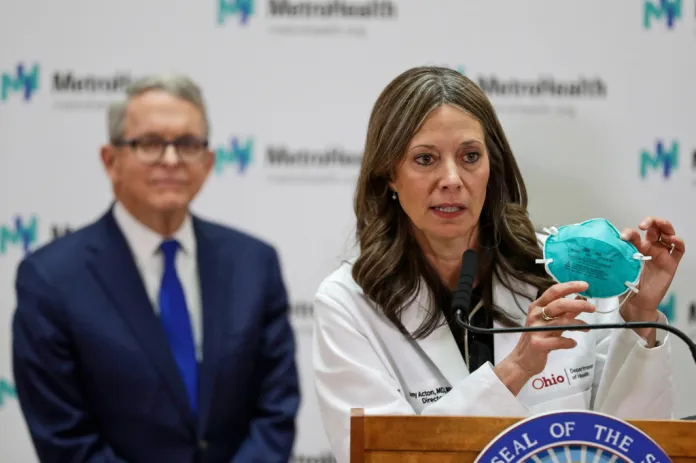
Acton, a licensed physician since 1994, although she did not actively treat patients, has explained that she wore the white coat at press briefings to acknowledge healthcare workers on the front lines of the pandemic. She saw the physician’s jacket as “a symbol” representing the medical community that also communicated her own medical credentials. To viewers, the white lab coat visually connected Acton to front-line healthcare workers while conveying the authority of a clinical doctor.
“I am the doctor for 11.7 million people,” Acton said at a March 2020 press conference.
Acton had often been teary-eyed on TV, her voice cracking as she answered how she was holding up behind the scenes. In her pandemic messaging, she employed an emotionally evocative rhetorical style that portrayed the virus as a grave and frightening threat, telling Ohioans, “We are at war with an unseen enemy that is a virus” and “The coronavirus is among us.” At times, she instilled a sense of fear and urgency in her televised speeches. “Today is the day we have to batten down those hatches,” Acton beseeched. “There is no time left.”
The career civil servant, whose time in state government has spanned Republican and Democratic administrations, allegedly observed Acton constantly crying on the job, including outside of the daily broadcasts as they passed in the hallways.
“Every time I saw her in the halls, she was either crying, in tears, on the verge of, or looking like she had just gotten done crying,” the longtime civil servant said. “She always had that look on her face that she always had on TV, you saw with the tears.”
A former administration staffer claimed they found Acton huddled knees-to-chest on the hallway floor before one of the daily planning meetings and that she had to be coaxed out of a fetal-like position.
“Hey, we need you in the room now,” the staffer remembered rallying Acton out of the self-soothing state. “We gotta go.”
The source said that Acton, who had allegedly isolated herself from the others, slowly made her way to the meeting room after the gentle nudge.
“It was a super intense time. I think we were all stressed.” But, the ex-staffer added, “We got to get our s*** together. We had things to do. We don’t have time just to sit here and do whatever the hell you’re doing.”
“In the governor’s office,” another former staffer said, “it always talked about that she was struggling to keep up with the work and to handle the pressure, so she would disappear.”
Many of the former staffers also gave her grace, given that Acton was navigating a volatile and novel situation as the point person guiding Ohio through an unprecedented pandemic.
However, the former staffer in the Ohio Health Department said that Acton had difficulty managing her main responsibilities prior to the pandemic.
The ex-staffer said two months into her tenure, Acton was discovered in the middle of the 2019 budget cycle having a full-blown nervous breakdown in the bathroom before she had to present the department’s fiscal proposal before the state legislature. Besides the presentation, Acton had to answer pointed questions from the General Assembly.
Her testimony was already written, and the budget proposal refined. All she had to do was deliver it. “I can’t do this,” Acton allegedly said while crying in the bathroom, according to the ex-staffer, who expressed that they thought reading aloud prepared remarks would be an easy task for the department director. “She was in there having a total meltdown and had to kind of be whipped back into presentable mode to get back out there.”
Acton pulled it together, the ex-staffer said, and did a fine performance at the podium. “She’s very good for an hour and a half. But what I saw on a regular basis was if you were with her for longer than that, tensions and emotions would swing very quickly.”
A ‘difficult’ boss to deal with
The former staffer who worked underneath Acton in the Ohio Health Department said that she exhibited frequent mood swings, took an abrasive approach that put people on the spot and “humiliated” them, and acted passive-aggressively toward subordinates who said something she disagreed with.
“When you would disagree or offer up issues, she didn’t like that,” the former staffer said. “She didn’t explode. It was just her behavior the next day was punitive somehow. It was a very passive-aggressive punitive place. One day she would say, ‘You’re the only person I could trust. I rely on you the most.’ And then the next day, it would be total and complete silence. And then you’d get uninvited to a meeting.”
The ex-staffer said that employees who worked closely with Acton found her “very hard to work for” and that they “didn’t know who was going to show up.”
“I found her to be incredibly — I don’t want to say unstable because it didn’t go that far — but in retrospect, the emotional roller coaster that she kept people on and that she would be on herself was the most disturbing aspect of it.”
The ex-staffer said that a group of former employees who have “PTSD after working with that woman” still get together for drinks to rehash those days under Acton.

Around that time in 2019, Acton’s daughter called 911 to report that her “stepdad and Mom are fighting and Mom has been drinking and throwing things and breaking glass,” according to the police logs. A police report stated that there was a “domestic dispute” and that Acton and her husband had allegedly argued over her “extended work hours.”
The report stated that they both admitted to drinking earlier and that Acton acknowledged she had “taken an unknown amount of prescription medication.” Her team said Acton only had one glass of wine, was not drunk, and that the prescription medication treated migraines.
“Seeing that there was just a normal routine fight, [the police] left,” Acton told reporters this year after the incident became an issue on the 2026 campaign trail. “To blow it up, to bring family into it, to lie or to make the extrapolations — it’s just what you tend to expect in politics at this point.”
Attack ads have since used the police report to characterize Acton as an alcoholic, and Republicans have accused Acton of slurring her words in public, as recently as over the weekend when she spoke to constituents at the Canfield Fair.
AMY ACTON ATTACKED BY ‘ARMED INDIVIDUAL’ AT EVENT, CAMPAIGN SAYS
At the COVID-19 press conferences, for the most part, Acton was “pretty buttoned up,” one of the former DeWine staffers said. “It was certainly a different version of Amy Acton than the state was seeing on TV.”
According to the source, after her occasional absence, Acton would reappear the following day without saying a word.
“The most bizarre part of it was the next morning, when we would start the morning call to start preparing, and she would be on like nothing happened. She did no-call, no-show to work yesterday, and today, everybody was just pretending that that didn’t occur.”