
CHARLOTTE, North Carolina — Gov. Gavin Newsom (D-CA) spent four days driving through territory that, at first glance, seems about as far from California as a West Coast politician can get.
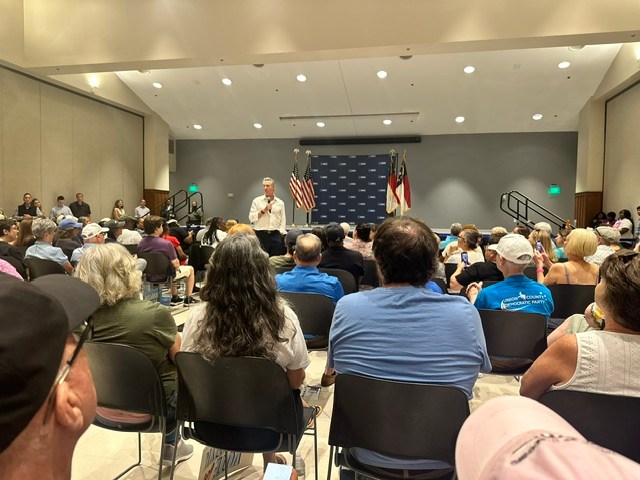
The Democratic governor visited Alabama, rural South Carolina, and labor-heavy North Carolina communities where President Donald Trump won comfortably. He talked to hundreds of voters in triple-digit heat and braved the humidity. Some were deep-blue Democrats, while others were on the fence, curious about the governor, who looked more like a movie star with perfect hair, a white button-down, and a seemingly effortless talent for captivating a room of admirers.
It wasn’t all love, though.
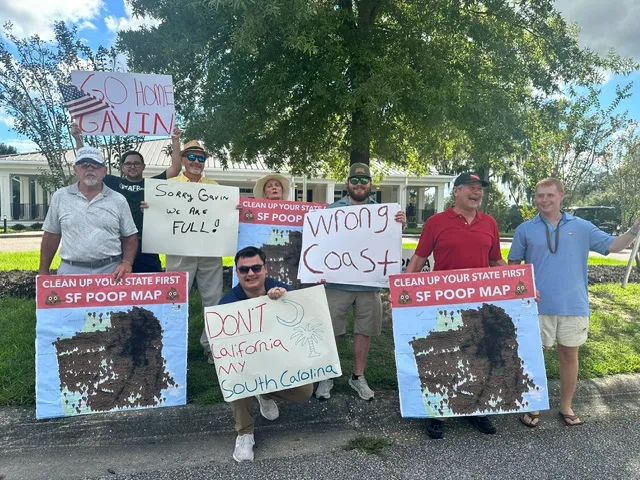
At several stops in the Carolinas, protesters carried signs and yelled at him to go home and clean up his state before coming to theirs. They claimed he was more focused on hair gel than substance, called him a communist and a socialist, and, in Aiken, South Carolina, pulled out the ultimate Southern insult: “Bless your heart, Gavin.”
‘It’s all familiar’
On the surface, Newsom, who traveled with security, a photo crew, and a communications team, seemed to have little in common with the people he was talking to. But the governor, who is widely expected to announce a 2028 presidential run any day now, argues the distance between California and rural America is smaller than it appears.
“It’s all familiar,” Newsom told the Washington Examiner in a wide-ranging, exclusive interview during his swing through the South.
California, he noted, is home to major agricultural, manufacturing, forestry, and hunting industries. Ranchers worry about diesel and fertilizer costs. Farmers confront the consequences of trade and tariff policy.
“The challenges of ignorance, poverty, and disease are incredibly familiar,” he said. “And the recipe and strategies to solve for that are very similar to California and here.”
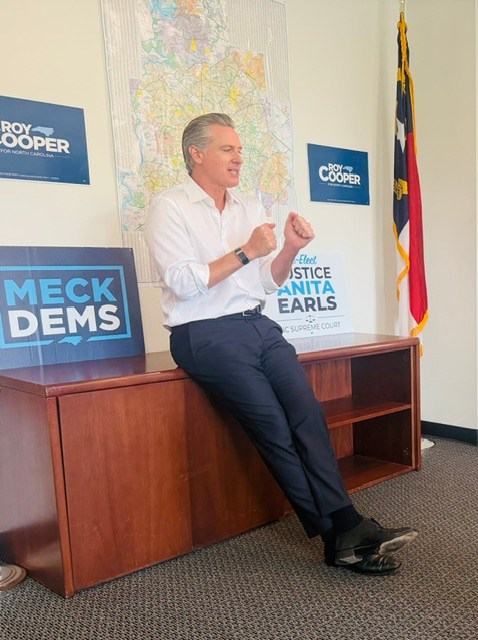
It is an argument that Newsom is increasingly making as he travels outside his home state: California’s governor may be a liberal from the West Coast, but the problems facing voters elsewhere are not foreign to him.
‘We stopped showing up’
The bigger challenge, he suggested, is convincing Democrats that they cannot afford to keep ignoring places like rural South Carolina.
“We stopped showing up,” Newsom said of the Democratic Party’s retreat from Republican-controlled states. “I remember a case where we just saw red, and we said it’s not worth the drive.”
“You are worth the drive,” he added.
Newsom’s trip through South Carolina is part of a broader effort to build Democratic infrastructure in states and communities where the party has struggled for years. He has argued that Democrats became too focused on winning the presidency while Republicans invested in the less glamorous work of building power through state legislatures, congressional districts, and local offices.
‘It’s our performance’
In the interview, however, Newsom went further, offering an unusually blunt assessment of his own party.
Asked about the hardest truth Democrats need to confront, he answered simply: “It’s our performance.”
“We’ve not delivered,” he said.
Newsom said Democrats have lost their identity as a “big tent” party, becoming too judgmental and too willing to impose ideological “purity tests” on their own coalition.
The party, he argued, needs to expand its coalition and “unite around the things that bind us together.”
That requires Democrats to do something else they have increasingly resisted: show up in places where they may not agree with everyone in the room.
Newsom said he believes Democrats like former President Joe Biden, former Vice President Kamala Harris, and former Secretary of State Hillary Clinton made a mistake by becoming too insulated from voters and media outlets outside their ideological comfort zones. He cited his own willingness to sit down with figures ranging from Steve Bannon to the late Charlie Kirk and conservative media personalities.
“Divorce is not an option,” Newsom said. “We’ve got to live together across our differences.”
Long-form interviews and conversations with political opponents can be uncomfortable, he acknowledged, and candidates risk producing a viral “gotcha” clip that follows them for weeks.
But Newsom argued that avoiding those conversations is ultimately more damaging.
“I think it was a mistake not to do more of that,” he said. “And I think it’s now table stakes for candidates.”
The ‘original sin’
The California governor’s willingness to critique Democrats was matched by an equally candid assessment of his own record.
For years, Newsom has defended California against Republican criticism of its high taxes, cost of living, homelessness, and population losses. But asked which criticism of California he believes has the most merit, he did not hesitate.
“Housing,” he said. “It’s the original sin.”
California’s failure to build enough housing over decades, Newsom said, has done “more things in more ways on more days to hurt working families and the middle class.”
“The core of that is housing policy over 50 years in California,” he said, pointing to restrictive zoning and what he described as decades of NIMBYism that created a severe imbalance between supply and demand.
The consequences, Newsom said, extend beyond housing prices and into the state’s homelessness crisis.
The governor defended his own record, arguing that previous administrations had avoided confronting both issues and that he had been willing to sue cities and threaten political consequences to force change.
“I had to sue cities,” Newsom said. “I put 46 others on notice.”
His approach, he said, reflects one of the central lessons he has learned in government: Sometimes compromise preserves a failing status quo.
“You’re sort of doing the compromise,” Newsom said. “And in that was the status quo. You’re playing in the margins. You’re failing more efficiently.”
On housing, he said, he decided to abandon that approach.
“No more accommodation,” Newsom said. “We go.”
That experience has also shaped his broader view of government and its limitations.
Newsom said he does not believe government has “a pill for every problem” and argued that Democrats have sometimes emphasized opportunity without placing enough emphasis on personal responsibility.
He pointed to student loan forgiveness pushed by Biden and Harris as an example, saying he had argued that debt relief should be tied to public service.
“Give us 450 hours, and then we’ll cut $10,000 off that debt,” he said. “Give something back.”
“I think the Democratic Party has been focusing on opportunity,” Newsom added. “It’s focused on community, but not enough on responsibility.”
It is a notable message from a governor who Republicans often present as a symbol of liberal California — and one that Newsom is now taking directly into conservative territory.
That contrast was evident throughout his South Carolina trip.
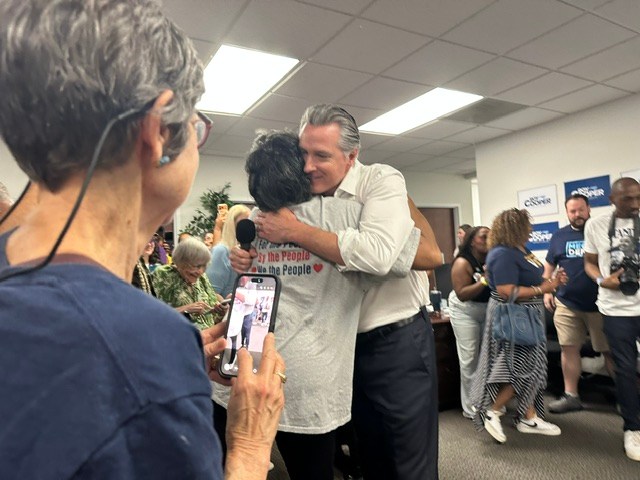
Inside his events, Newsom was greeted by enthusiastic crowds. One man, Peter Nepita, who lived in Germany, watched as Nazis destroyed his country. He became a citizen of the United States two years ago so he could vote. Another man, T. Houston Fitzpatrick III, served as a Baptist deacon with perfect attendance at his Rotary Club. He went from being on food stamps to attending the Masters Tournament for 17 years, and said Newsom resonated with him.
“I look at the person’s mind and their bandwidth and their heart and he’s got it,” he told the Washington Examiner. “You have to have the intelligence and have the compassion.”
Outside one stop in Dorchester County, however, protesters carried signs reading “Wrong Coast,” “Don’t California My South Carolina,” and “Go Home Gavin.”
Newsom acknowledged that skepticism in the interview but insisted his party cannot afford to write off voters or communities simply because they are unlikely to vote Democrat.
He said his message was not that Democrats should expect immediate victories in every Republican state. Success can also mean competing, organizing, and giving voters a reason to believe the party has not abandoned them.
For Newsom, showing up is itself part of the strategy.
“Time — we had time to come down here, at least show up,” he said. “That’s free. Your presence is free.”
The interview also underscored the balancing act Newsom faces as he builds his national political profile: defending California while acknowledging its problems, criticizing his own party while remaining one of its most prominent national figures, and reaching across political lines while remaining one of Trump’s most outspoken critics.
Midterm math
On redistricting, Newsom said he was not assuming Democrats would win all five of the California congressional seats targeted under his signature Proposition 50 but insisted the party needed to “finish the job.”
“I’m confident, but not overconfident, because I’m not naive,” he said. “And the idea was, we obviously want to win all five, but I would say the exact same thing with more confidence that they’re not going to pick up all five in Texas. And I think there’s more evidence to suggest that’s the case.”
Newsom called Trump’s initial push to have Texas redraw its political maps to favor Republicans “a big tactical mistake,” adding that it “emboldened the Democratic Party, not just us in California. It ignited a movement, and people started to stand up.”
Looking toward the midterm elections, he warned Democrats against complacency, citing Republicans’ fundraising advantages and raising concerns about the handling of mail voting.
But the broader message Newsom repeated throughout the interview was directed inward, at his own party.
Democrats, he argued, cannot wait for the perfect presidential candidate to rescue them. They cannot rely on Washington to rebuild their political infrastructure. And they cannot expect to regain voters they have stopped trying to reach.
NEWSOM’S SOUTH CAROLINA TRIP DOUBLES AS TEST OF DEMOCRATS’ REBUILDING STRATEGY
The party has to get back in the car.
And start driving.