
Rep. Young Kim (R-CA), the subject of past financial scrutiny surrounding her disclosure filings and how she characterized her business interests to voters, has not reported any income for her husband since she first ran for Congress despite local records stating that he did earn money through a South Korean nonprofit organization.
The recently discovered discrepancy adds to Kim’s history of disputes involving her finances, including a failed 2018 lawsuit claiming the congresswoman wrongly portrayed herself to be a small business owner on the ballot and an ethics complaint from 2025 alleging she omitted nearly $50,000 in privately funded travel over a two-year period.
Husband’s payments from nonprofit organization unreported
House Ethics Committee rules require that sitting members and congressional candidates report the source of all household income, including a spouse’s earnings, exceeding $1,000.
When she first ran for Congress in 2018 and lost, Kim did not report dual income, nor has she in the eight years since, but financial statements say that her husband, Charles Joo Kim, supposedly earned up to six figures that same reporting year.
Orange County records obtained by the Washington Examiner state that he was earning as much as $100,000 from a South Korean nonprofit organization as its U.S. coordinator in 2017, the first year the three-term congresswoman was required to disclose spousal income.
Charles Kim reported on a personal-finance form receiving between $10,000 and $100,000 in “gross income” from the Dam Jae Friends of Korean War Veterans, a private foundation based in Seoul. Under the section denoting his “business position,” he wrote “coordinator” of U.S. veterans and marked the business activity as ”travel & event coordination.”
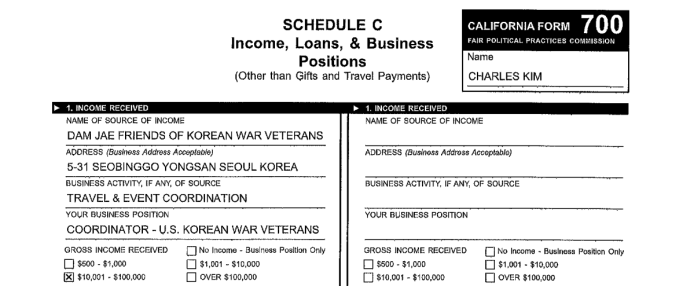
At the time, Charles Kim was a member of the Orange County Waste Management Commission, an advisory body to the county’s board of supervisors, and had to submit an annual statement of economic interests signed under the penalty of perjury. His municipal position only paid a maximum monthly stipend of $300.
However, the payments from Dam Jae appear to have been improperly declared as income.
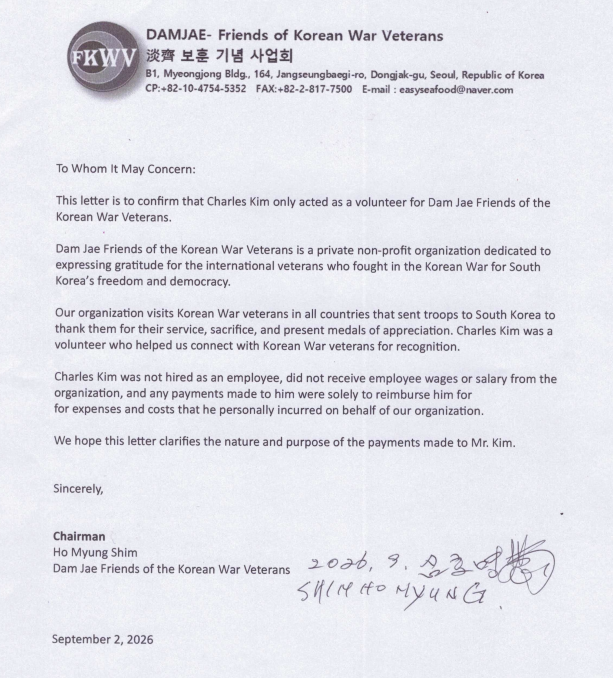
According to Dam Jae, they were reimbursements related to Charles Kim’s volunteer work with the foundation, which travels around the world to thank the troops who were sent to defend South Korea and recognize those servicemembers with medals of appreciation. An Association of the United States Army newsletter from around that time identified Charles Kim as Dam Jae’s “American Liaison.”
A letter written by Ho Myung Shim, the chairman of Dam Jae, and provided to the Washington Examiner in response to an inquiry about the nature of his compensation, said Charles Kim “only acted as a volunteer” who helped the organization connect with Korean War veterans to honor their service.
“Charles Kim was not hired as an employee, did not receive employee wages or salary from the organization, and any payments made to him were solely to reimburse him for expenses and costs that he personally incurred on behalf of our organization,” the chairman wrote.
Kim campaign spokesman Chris Pack said that Charles Kim has been fully retired since 2017 and that his income to date includes Social Security benefits, which House reporting requirements expressly exempt from reportable income.
“There is therefore no missing employment income from Charles that Young needs to go back and add to her disclosures,” Pack told the Washington Examiner.
Charles and Young Kim, both grandparents, have been together for 40 years. Young Kim, 63, would have been in her mid-50s in 2017.
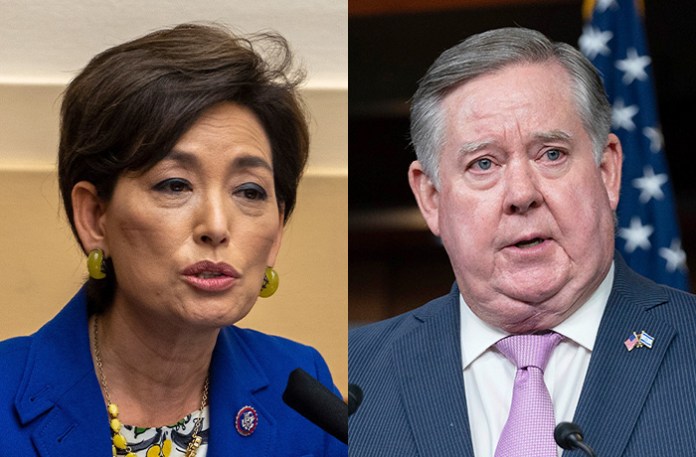
Now a vulnerable House Republican fighting to keep her seat in California’s newly redrawn 40th Congressional District, she is fending off a challenge this election cycle from fellow longtime Rep. Ken Calvert (R-CA), whose neighboring district was diced up by last year’s Democrat-initiated redistricting effort.
Calvert’s old 41st District was radically redrawn to take in liberal areas of Los Angeles County and Orange County, while most of its conservative core was moved into the district over into Kim’s turf. With his competitive home district turning a deeper blue, Calvert decided to run in Kim’s district, which remains safely red and even gained more Republican ground.
Kim and Calvert advanced from the nonpartisan primary as the top two candidates and will face off in the general election. Calvert claimed about 35% of the vote, and Kim garnered around 21%. The collision between the two Republican incumbents in November will result in only one winning reelection, while the other will be forced out of office.
GOP HOUSE INCUMBENTS FIGHT FOR SAME INLAND SOUTHERN CALIFORNIA SEAT
Both their finances are becoming a line of attack in the bitter GOP showdown, as Calvert is carrying some financial-disclosure baggage of his own.
“If amended financial disclosures are going to be part of a story about the race between Young Kim and Ken Calvert,” said Pack, “it would be journalistic malpractice to ignore Calvert’s record in this space.”
Addressing an ethics complaint against Kim in early December that flagged a series of trips missing from her disclosure forms, Pack said, “Young simply acknowledged an oversight and corrected it,” referring to the congresswoman swiftly amending three years of financial filings.
“Calvert, meanwhile,” he continued, “amended six consecutive years of disclosures only after the Los Angeles Times uncovered an undisclosed commercial real estate investment near a project that received a $2 million taxpayer-funded earmark at Calvert’s direction.”
In 2024, the Los Angeles Times reported that Calvert failed to disclose his 2016 purchase of a commercial rental property in Corona. The property, according to the report, is about one mile from a bridge that received $2 million in earmarked funds through Calvert’s office. Following the Times’s article, Calvert amended his disclosure reports, covering 2016 through 2021, to disclose the property.
“Those revelations also prompted an ethics complaint over Calvert’s undisclosed real estate holdings and potential conflicts involving taxpayer-funded earmarks,” Pack told the Washington Examiner. “So, if Calvert wants to scrutinize amended filings, let’s scrutinize them.”
Up to $50,000 in undisclosed travel
Kim was hit late last year with an ethics complaint from End Citizens United, a left-leaning campaign finance reform group, accusing her of violating federal disclosure law by failing to report on her financial forms five privately sponsored trips she took between 2022 and 2024.
Two of them were paid trips abroad, including one to Israel and another to South Korea. Kim’s husband had accompanied her on both overseas trips, which cost a combined $44,000.
Travel itineraries show that during their trip to Israel, paid for by the AIPAC-affiliated American Israel Education Foundation, the Kims stayed at Jerusalem’s leading luxury hotel, a five-star locale. While they were in South Korea, the Korea Society and the U.S. Association of Former Members of Congress jointly footed the bill for the couple’s overnight stays at two other five-star hotels.
“Congresswoman Kim didn’t just slip up once; she blatantly disregarded federal disclosure law five separate times, hiding the source of nearly $50,000 used to fund multiple trips, including business class flights and luxury hotel accommodations,” Tiffany Muller, the president of End Citizens United, said in a press release. “These laws exist to protect the public by exposing conflicts of interest and preventing public officials from letting perks influence their votes.”
Lawmakers may accept paid trips covered by private entities as long as the travel is connected to official congressional business and provided they secure advance authorization from the House Ethics Committee.
THE LIKELY HOUSE GOP CALIFORNIA REDISTRICTING SURVIVORS
Kim indeed sought and received prior permission for each trip, disclosing the trip sponsors each time, but did not name any of them on her financial disclosure reports, due annually, as she was instructed in the letters of approval.
Days after the Dec. 4 complaint’s submission to the Office of Congressional Conduct, demanding an “immediate” investigation, Kim amended her yearly disclosure filings to mention those five trips and acknowledged failing to properly disclose the travel.
“Rep. Kim always acts in accordance with House rules, and as soon as this oversight was identified, she corrected it,” a spokeswoman for Kim told the Orange County Register.
In 2024, End Citizens United also asked the Office of Congressional Ethics to investigate Calvert over his undisclosed real estate holdings and potential conflicts of interest involving the federal funding he reportedly helped direct to projects near the property in which he had financial interests. Calvert’s campaign disputed the allegations.
Small business owner status disputed
In 2018, a lawsuit disputed Kim’s self-description on the ballot as a “small business owner,” claiming that she was misleading voters.
In California, candidates can declare what they do for a living within a three-word limit, and the profession they pick appears beneath their names on the ballot. The paperwork quirk functions as a last-minute pitch at the ballot box that tells voters additional and sometimes surprising biographical information completely different from a candidate’s public image.
Many contenders, even elected officials, ditch their official title and opt for an occupational marker that leaves a final impression that they are an average working-class citizen. For instance, the selected label below California gubernatorial hopeful Xavier Becerra’s name reads “voting rights attorney,” though he is best known as former President Joe Biden’s U.S. secretary of Health and Human Services.
Kim, then a former state legislator who had just served in the California Assembly, chose to identify herself as a “small business owner.”

Two constituents in Kim’s congressional district sued over the descriptor, calling it a mischaracterization. The small business in question was YK Connections, her consulting firm, and the lawsuit alleged that Kim did not disclose income from the company on her 2018 financial disclosure form, which covered all earnings she made the previous year. Thus, it must be “defunct,” they said.
Ultimately, the complainants unsuccessfully challenged Kim’s “small business owner” status, with a California judge finding that two sources of revenue she reported in the 2018 filing were actually clients of YK Connections.
Kim originally reported KBS America, the Korean Broadcasting System’s U.S. subsidiary, paying her $10,800 to host a weekly talk show and making $4,000 from South Baylo University for a commencement speech. She would amend the 2018 report two years later to consolidate that income as $14,800 in general “consulting services” provided by YK Connections. Consistent with federal disclosure guidance, Kim reclassified the specific income sources, which she initially listed out as individual clients, as income from YK Connections, the business through which the income was earned.
“The court is not convinced petitioners have even made a prima facie showing Kim’s ‘small business owner’ ballot designation is either false or misleading,” Superior Court Judge Allen Sumner ruled back in 2018. “Assuming they did, Kim’s declaration sufficiently rebuts any such showing.”
Kim’s campaign suspected the “frivolous” case was brought by her Democratic opponent, Gil Cisneros. “The judge saw right through this false lawsuit and outright rejected this attempt to smear Young Kim’s well-documented history as a local small-business owner,” the Kim campaign said.
CALIFORNIA’S VULNERABLE HOUSE REPUBLICANS SWAP DISTRICTS AND STRATEGIZE AHEAD OF PRIMARY
A spokesman for the Cisneros campaign told the Washington Free Beacon that two small business owners filed the complaint, not Cisneros, but ignored inquiries about whether he helped mount the legal challenge.
“Young reported $0 in income from the business, she did not report having a position with the company, she did not report having a business of any value, and she has not registered to pay business taxes with the city of Fullerton,” the Cisneros spokesman said. “The question is if Young Kim does, in fact, own a small business, then why has she not paid taxes?”
The judge who denied the petition noted in his ruling that YK Connections was structured as a sole proprietorship, meaning she reported profits on her personal income tax returns. Because her company was unincorporated, that also explained why YK Connections did not appear in California’s business registration records.