
President Donald Trump does not believe the Iranian public is currently capable of rising up against their government due to overwhelming violence, but he would not say if he would materially assist dissident groups.
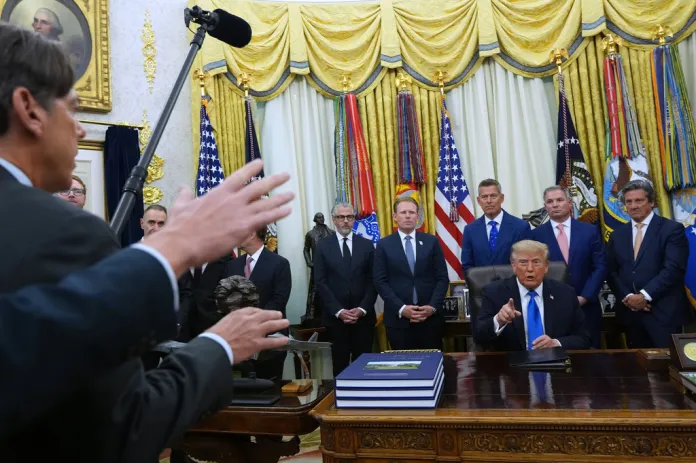
Speaking from the Oval Office on Wednesday, the president told reporters that it “wouldn’t be appropriate to say” whether U.S. intelligence personnel would materially aid Iranian protesters. He expressed empathy for the citizens, saying his Tuesday night Truth Social post questioning “when are the Iranian people going to rise up and fight?” was rhetorical.
“I understand their plight, they’re being shot,” Trump said. “When I ask that question, I ask it sort of knowing the answer. The only answer is that they’re being shot.”
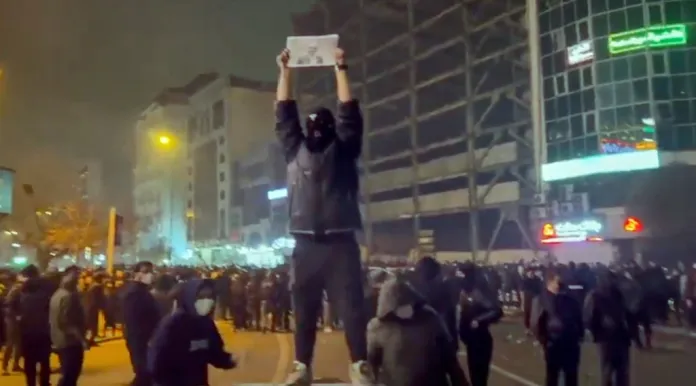
He asserted that close to 65,000 protesters have been killed following the attempted uprising that took place in December 2025 and January, which saw the mass mobilization of citizens into the Iranian streets. It was these protests that inspired Trump to promise Iranians that “help is on the way.” He eventually launched Operation Epic Fury, the large-scale assault on Iranian leadership and military infrastructure, in February.
But a crackdown from the government and military quashed the protests before the United States began its operations. Thousands of demonstrators were gunned down in the streets, and many more have been arrested and executed in the months since.
“That’s why it’s not happening — and who can blame them?” Trump said Wednesday.
On Tuesday night, Trump said via social media that he is “not trying to force Iran to the bargaining table” but is instead simply waiting for the country to implode.
“I couldn’t care less if [Iranian officials] sign a worthless, to them, agreement,” Trump said on Truth Social. “I like our position now much better, with almost total control of the Hormuz Strait, and their economy totally collapsing. They are just playing out the inevitable.”
This posture against any further negotiations was echoed by Secretary of State Marco Rubio in a Wednesday interview on The Brian Kilmeade Show.
Asked about reports that Tehran is open to revisiting the lapsed memorandum of understanding that failed to establish peace in the region earlier this year, Rubio said, “That ship, in many ways, has sailed — no pun intended with regards to the straits.”
Despite the president acknowledging the threat of violence suppressing popular discontent, the White House seems to be banking on hopes that economic despair and political instability will be enough to jolt Iranians back into the streets and topple Tehran.
“The regime is getting weaker and weaker by the day, and at some point, they’re not going to be able to shoot [dissidents] so easily because the people aren’t going to take it,” Trump said Wednesday in the Oval Office.
Ali Safavi, a member of the Foreign Affairs Committee of the National Council of Resistance of Iran, told the Washington Examiner that “the overthrow of the regime is tied to the convergence of two essential factors: a popular uprising and an organized resistance movement.”
“Iranian society is in an explosive state,” Safavi said. “All the underlying causes and conditions that produced the January uprising remain firmly in place and, indeed, have become more acute: economic hardship, inflation, unemployment, corruption, political repression, and, above all, the Iranian people’s profound rejection of the existing political order.”
Alan Eyre, a distinguished diplomatic fellow at the Middle East Institute, told the Washington Examiner that he is not convinced the Iranian public is the powder keg many hope it to be.
“The brutal truth is the U.S. can’t do regime change from outside,” Eyre said. “There are currently many brave people opposing the Iranian regime both inside and outside Iran, but there is no effective Iranian opposition movement. Opposition movements need organization and time.”
Eyre told the Washington Examiner that while there is widespread discontent with the officials in Tehran, there is also massive skepticism toward a U.S.-backed coup that would likely collapse the country.
“One shouldn’t confuse the desire of many if not most Iranians for a more competent and less corrupt regime with a desire to see Iranian society collapse and have Iran become a near-failed state,” Eyre said. “The most likely alternative to the current regime isn’t a caring and competent pro-Western regime, it is chaos, and I don’t know how many Iranians want that.”
Sen. Ted Cruz (R-TX) has urged Trump to furnish weapons for dissident forces in Iran.
US ‘LOOKING INTO’ REPORTS FROM IRANIAN STATE MEDIA THAT US MISSILE HIT WEDDING
“What I’ve been urging is for President Trump … to arm the protesters, the people of Iran,” Cruz said last month during an interview on Meet the Press. “Arm the Kurds and let the protesters remove this regime.”
Cruz said it is “not fair to expect an Iranian protester standing with a rock to face soldiers carrying machine guns.”