
The House Republican campaign arm is pumping millions of dollars into ad reservations for more than 20 competitive races that could decide chamber control, a maneuver that comes in response to the Supreme Court allowing unlimited coordinated spending between political parties and candidates.
The National Republican Congressional Committee has nearly $8.7 million reserved for so-called coordinated ad buys starting this week, roughly two months out from the midterm elections, according to ad-tracking firm AdImpact. In contrast, the group’s Democratic counterpart, the Democratic Congressional Campaign Committee, had not made any coordinated buys for the general election as of Wednesday.
The Supreme Court sided in June with a Republican-led legal challenge that allows political parties to open the spending floodgates and, most importantly for the GOP, help candidates offset individual fundraising deficits with endless advertising coordination with candidates.
But in a setback for Republicans, an appeals court ruled last week that coordinated ad buys between political parties and joint fundraising committees are not entitled to lower candidate TV ad rates. That decision was in response to a Democratic lawsuit and is being appealed to the Supreme Court by Republicans.
The ad reservations, or lack thereof, underscore the diverging spending strategies ahead of the midterm elections and Republicans’ eagerness to take advantage of the Supreme Court ruling. In an off-year election cycle in which the GOP majorities face headways at the ballot box, Republicans are getting their messages out on the airwaves early and spreading the wealth across districts in 17 states.
For example, two of the ads are for toss-up races with Reps. Rob Bresnahan (R-PA) and David Valadao (R-CA). The spot for Bresnahan paints Democratic challenger Paige Cognetti as a newcomer to the district who’s “too radical,” and one for Valadao features Spanish-speaking constituents and labels Democratic rival Randy Villegas a “socialist professor.”
Other districts include offensive targets such as Rep. Marcy Kaptur (D-OH) and Rep. Henry Cuellar (D-TX), whose race is considered one of the committee’s top priorities.
Meanwhile, Democrats have so far only spent on coordinated ad buys with their candidates in primaries, in which three of the committee’s preferred candidates lost.
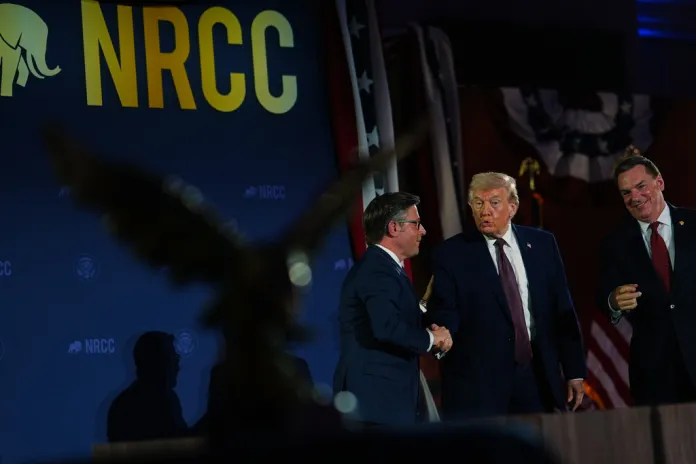
“While the DCCC lit millions of dollars on fire trying and failing to save their handpicked candidates from socialist primary challengers, the NRCC built a war chest and is already putting it to work where it matters,” NRCC spokesman Mike Marinella said in a statement. “We’re on offense with 20 coordinated ads up already, helping our candidates get on air early, and entering the final stretch with the resources and firepower to expand our House majority while the DCCC is still sitting on the sidelines.”
The DCCC did not respond to a request for comment.
GOP APPEALS CAMPAIGN FINANCE SETBACK TO SUPREME COURT
It is possible that Democrats are waiting until the lowest ad rates for candidates under federal law become available 60 days before an election, which is Friday.
Either way, both parties sit on massive war chests. The NRCC had more than $92 million in cash on hand at the end of July, while the DCCC had just over $80 million. The $12 million gap is the NRCC’s largest fundraising lead at this point in the election cycle in the last 14 years.