
President Donald Trump reposted a claim Monday that there have been no documented cases of an unvaccinated Amish child being diagnosed with autism, adding to skepticism about public health officials’ claims regarding the measles outbreak in Pennsylvania.
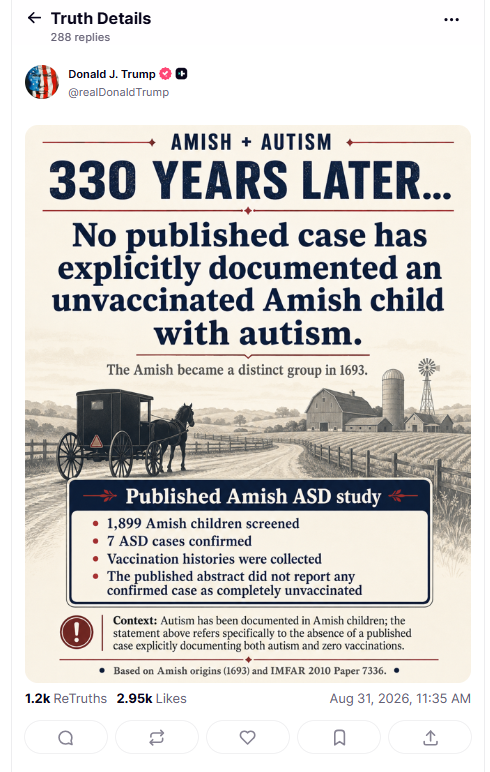
The president’s post on Truth Social consists of a graphic that contends there is not an “explicitly documented” case of an unvaccinated Amish child with autism, citing a 2010 study.
Traditional Amish communities have been subject to intense scrutiny because vaccination rates, particularly for the measles, mumps, and rubella or MMR vaccine, remain low in Amish communities and some Mennonite groups.
Trump’s post cites that, across the entire 330-year history of distinct Amish communities in the United States, there has never been a recorded case of an unvaccinated child being diagnosed with autism.
But the claim is highly misleading and unsupported by the evidence cited.
The narrow claim: No documented cases
The text of the graphic reads, “Amish + Autism 330 years later … No published case has explicitly documented an unvaccinated Amish child with autism.”
A disclaimer at the bottom of the graphic acknowledges that cases of autism have been documented in Amish children, but clarifies the claim as referring “to the absence of a published case of both autism and zero vaccinations.”
The graphic cites a 2010 study, published by the International Society for Autism Research, that screened 1,899 Amish children for autism and confirmed 7 cases. The study’s findings indicate that, at the time, approximately 1 in 271 Amish children fit the 2010 definition of having autism, compared to roughly 1 in 91 in the general population at the time.
The graphic also says the researchers collected vaccination histories for the children, and the published abstract for the paper “did not report any confirmed case as completely vaccinated.”
The reality: A misleading statistic and skewed evidence
The study does not directly support the graphic’s claim that there is no recorded case of “an unvaccinated Amish child with autism.”
Researchers collected the vaccine histories of the children involved in the study, but the version of the research paper referenced in the graphic does not link the Autism Spectrum Disorder screening results to each child’s vaccination status.
In other words, the study does not say whether the children diagnosed with autism were vaccinated or unvaccinated.
Further, the study does not support the claim that there has never been a confirmed case of an unvaccinated Amish child with autism because the study examines only a segment of time.
Researchers surveyed Amish children screened in Ohio and Indiana in 2008 and 2009 and did not examine the entirety of Amish history. The data in the study are also not representative of the 16 years after its publication in 2010.
The White House did not respond to the Washington Examiner’s request for additional studies to support the claim of the social media post.
How diagnoses play a role in autism numbers
Adam Omary, psychologist and biostatistician for the libertarian Cato Institute, told the Washington Examiner the most likely reason for a difference in autism diagnoses among the Amish compared to the general population is due to genetic differences within the Amish community, rather than an environmental exposure.
“There is no reliable evidence of any environmental exposures—vaccines or otherwise—causing autism,” Omary said. “The single biggest risk factor is family history.”
Omary has focused his research on how the expansion of diagnostic criteria in the 2014 DSM-5, the official mental health diagnostic manual, has led to milder forms of autism receiving a formal diagnosis of ASD than in the past.
The study cited by Trump, published before the new definition of ASD from the DSM-5, used the older and more conservative diagnostic criteria. Omary says this switch in diagnostic criteria contributes to what appears to be rising autism rates over time.
“Even if the underlying psychology or symptomology of a population is unchanged, more conservative screening will produce lower prevalence estimates and more expansive screening will produce higher estimates,” Omary said.
Trump’s past comments about autism and the Amish
Trump’s Truth Social post is not the first time that the president has made a connection between low vaccination rates and low autism rates among traditional Amish communities.
During a press conference in September 2025 on the risk of causing autism by taking Tylenol while pregnant, Trump made multiple comments that multi-virus vaccines can cause autism and that unvaccinated Amish children do not have autism.
“I think I can say that there are certain groups of people that don’t take vaccines and don’t take any pills that have no autism — that have no autism. Does that tell you something?” Trump said last year.
Trump during the event went on to say, “The Amish, as an example, they have essentially no autism.”
Trump has also been a vocal critic of the MMR vaccine, calling it “lethal” during an Oval Office event in August announcing a reduction in the number of recommended childhood vaccines. He has also called on pharmaceutical companies to “break up the shot,” creating three separate vaccines for measles, mumps, and rubella.
Measles outbreak among the Amish in Pennsylvania
Trump’s post comes amid a sweeping measles outbreak across Lancaster County, Pennsylvania, home to the largest Amish community settlement in the U.S.
The outbreak has drawn national attention following a dispute over vaccine misinformation between Gov. Josh Shapiro (D-PA) and Health and Human Services Secretary Robert F. Kennedy Jr., who in the past has supported the debunked claim that vaccines cause autism.
Shapiro and the Pennsylvania Department of Health last week announced two measles-associated deaths in Lancaster County, sparking an intense dispute over whether the cause of death for the two reported individuals was indeed measles.
The Lancaster County Coroner reported last week one of the deaths was of a newborn infant, whose immediate cause of death was a lacerated spleen that the coroner concluded was not caused by a measles infection.
The infant’s mother, an unvaccinated Amish woman, had a severe case of measles during the last weeks of her pregnancy and had a difficult home birth as a result. The cause of death for the infant is being debated among physicians online.
According to the nonprofit Association of Immunization Managers, the MMR vaccination rate in Lancaster County is roughly 87%. Only an estimated 25% of the Amish settlement in the county is vaccinated against measles.