
Israel’s most consequential battles are not only taking place in diplomatic chambers, newsrooms, or political debates. They are also unfolding in cultural spaces where millions of people form opinions without ever meeting an Israeli or setting foot in the country.
That is why Danielle Yablonka’s decision to use the Miss Israel crown as a platform for advocacy matters.
Yablonka, an American-raised Israeli who made aliyah and now lives in Israel, was crowned Miss Israel 2026 and is expected to represent the country at Miss Universe. Her goal is not simply to wear a sash or compete for another crown. She wants to reach audiences that traditional political advocacy rarely touches.
“For years, I have believed that advocacy begins with a simple choice: to show up,” Yablonka told me. “Show up in the room. Show up in the conversation. Show up in the places where people are forming opinions about you, your community, and your country.”
When people are absent, the conversation does not stop. It simply continues without them.
That principle has guided Yablonka through years of advocacy, public speaking, digital content creation, and conversations about Israel and Jewish identity. Now, she is bringing the same mission into a world that many people misunderstand.
The average person may associate pageantry primarily with evening gowns, appearances, and crowns. Yablonka argues that the reality is much closer to “Miss Congeniality” than outsiders might imagine. Behind the presentation is a platform for storytelling, representation, and advocacy.
Pageantry and political advocacy may appear to belong to entirely different worlds. Yet both are connected by the same fundamental question: Who gets to tell your story?
For Israel, that question matters more than ever.
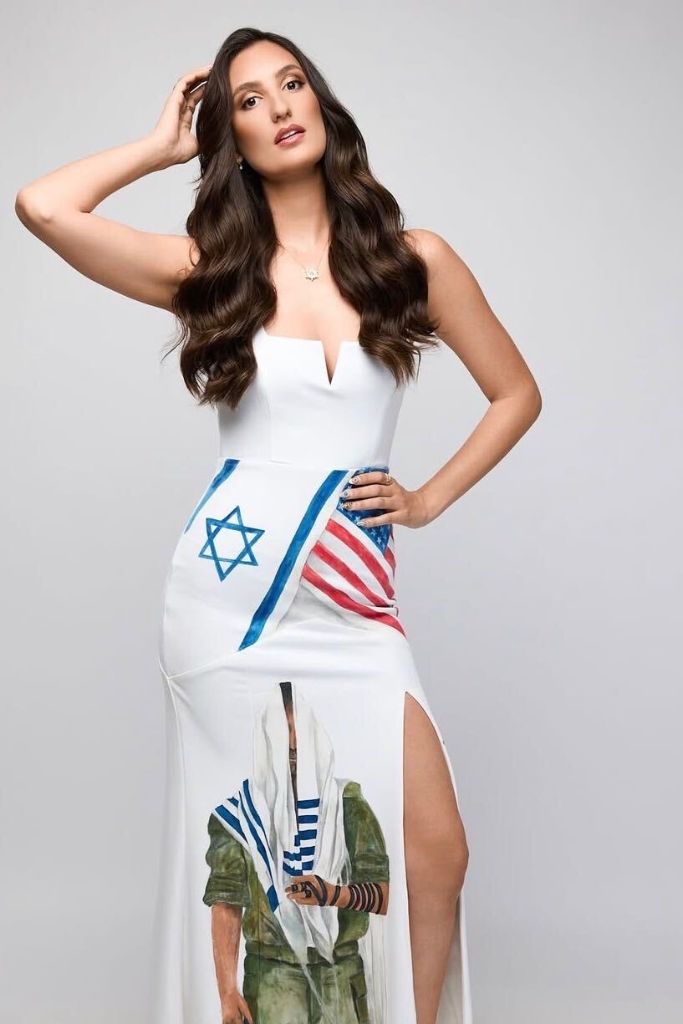
Most people around the world will never walk through the streets of Tel Aviv, sit around an Israeli dinner table, celebrate a holiday with an Israeli family, or experience the diversity of Israeli society for themselves. Their understanding of the country is shaped by headlines, social media posts, political debates, and the loudest voices online.
When Israelis are not present in global cultural spaces, other people fill in the blanks for them.
Yablonka has learned throughout her advocacy that facts matter, but presence and perception matter too. People often connect with other people before they connect with arguments. Sometimes changing a perception does not begin with a debate, a lecture, or a list of historical facts. It begins with meeting someone who challenges what you thought you knew.
That is why representation in a competition such as Miss Universe matters.
In much of Latin America and Asia, international pageantry occupies a place in popular culture that can be difficult for many Americans or Europeans to understand. Yablonka compares it to Eurovision or even the Olympics: a combination of entertainment, national pride, fashion, personality, culture, and identity presented on an international stage.
Millions of people follow contestants not merely as models but as representatives of their countries. For Israel, that stage is therefore much larger than a pageant. It offers the country an opportunity to be seen through a person rather than solely through a conflict.
When an Israeli woman walks onto an international stage, viewers may encounter a side of Israel they have never seen. They may see ambition, humor, warmth, creativity, strength, femininity, and complexity.
None of that erases political disagreements or requires anyone to believe that Israel is perfect. Showing up does not mean demanding universal agreement. It means refusing to disappear and allowing people the opportunity to encounter an Israeli before someone else defines Israelis for them.
That is cultural diplomacy, and Israel needs more of it.
Countries around the world have long understood the ability of music, fashion, sports, film, art, and popular culture to connect with people who may never watch a political speech or attend an educational seminar. Israel should not dismiss those platforms as frivolous while others understand precisely how influential they can be.
If the world is going to understand Israelis, Israelis must be present where the world is watching.
Yablonka is particularly well-positioned to occupy that space because her life has always existed between two worlds. She grew up in the United States and later made aliyah, the Hebrew term for immigrating to Israel, where she chose to build her life.
She understands how Israel is perceived from abroad because she grew up outside of it. She also understands the daily reality of living in the country because Israel is now her home.
“I know what it means to explain Israel to someone who knows almost nothing about it,” she said. “I know which assumptions exist outside the country, how easily Israelis and non-Israelis can speak past one another, and how powerful it can be when someone becomes a bridge between those worlds.”
Since the Miss Israel Organization returned in 2024, the women who carried the title internationally before Yablonka were based in the United States. Their participation helped return Israel to the international pageant stage.
Yablonka wants to take that return one step further. As someone who lives in Israel, her goal for 2027 is to help bring the heart of the Miss Israel competition closer to Israel itself.
She has worked as an activist, speaker, content creator, artist, and fashion model. She understands both communication and presentation. More importantly, she understands that representing a country begins with knowing who you are.
Pageantry is not replacing her advocacy. It is allowing that advocacy to enter a different space and reach a potentially much larger audience.
“I am not entering this world because I suddenly discovered advocacy through pageantry,” Yablonka said. “I am bringing years of advocacy into pageantry.”
That distinction matters. A crown cannot resolve a geopolitical conflict or reverse worldwide hostility toward Israel. But cultural representation can create an opening that politics often closes.
Yablonka wants someone watching in Mexico, Brazil, Colombia, the Philippines, Thailand, South Africa, or anywhere else in the world to see her and think: “I have never met an Israeli before. Maybe I understand them a little differently now.”
That small shift matters.
Every relationship and every change in perception begins when people encounter one another. At a moment when Israelis are frequently caricatured, excluded, or spoken about rather than spoken with, allowing audiences to encounter an Israeli as a complete human being is itself meaningful.
Israel cannot control every opinion expressed about it. It cannot correct every misleading post or answer every accusation. But it can ensure that Israelis are present before others define them.
Too often, advocacy focuses only on responding after a falsehood has spread or a damaging narrative has taken hold. Cultural diplomacy offers something different: the opportunity to build familiarity before the next controversy begins.
‘I WOULD GET FIRED’: THE ADMISSION EXPOSING MAMDANI’S ANTISEMITISM OFFICE AS A MUZZLE, NOT A SHIELD
The Miss Universe stage may not look like a conventional arena for advocacy. That is precisely why it can be so effective. It reaches people beyond political audiences who have already chosen a side.
From advocacy to the crown, the mission has not fundamentally changed: Tell your story, represent where you come from, build bridges wherever possible, and never leave your place on the world stage empty.
Ariella Noveck is a journalist specializing in antisemitism and Middle East affairs, with extensive experience covering Jewish communities worldwide.