
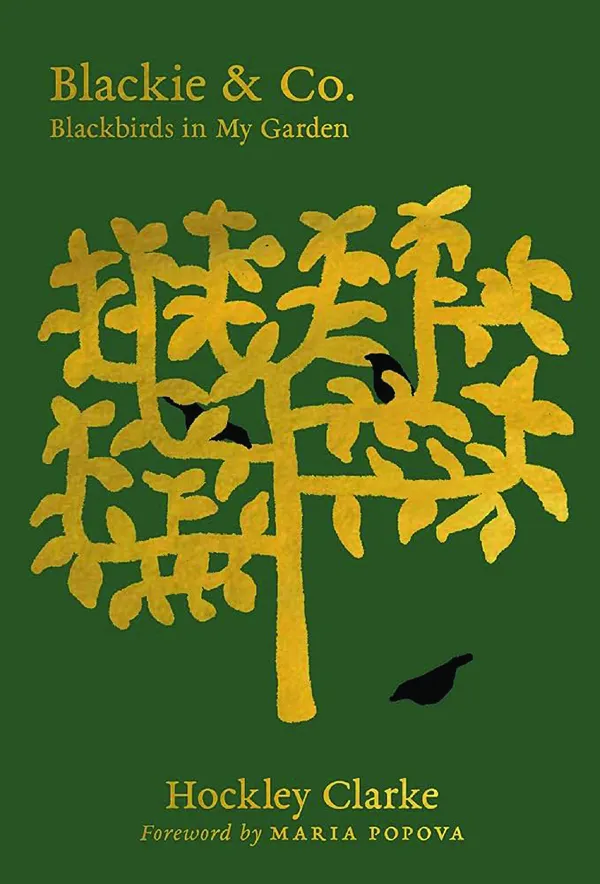
At first glance, Blackie & Co.: Blackbirds in My Garden, by the English writer Hockley Clarke, is quite unsurprisingly a nice little book about blackbirds. Namely, two birds, father and son, whose relationship with Clarke began one bitter night in 1962. It was Europe’s coldest winter in 80 years, and, to give the bird a better chance of seeing it through, Clarke and his dutiful wife fed the bird some sultanas and cheese, and arranged the tree he had nested in to provide him a bit more cover. Water immediately froze, so the bird was thirsty. To overcome this, Clarke filled a flowerpot with nightlights and rested the vessel of water on top, keeping it from icing over. Thus began Blackie’s decadelong residency in Clarke’s garden. This 1978 book has just been reissued by Marginalian Editions.
But alongside the main protagonists, including Blackie II — who came along soon after his father’s untimely death by car, upon hearing of a vacancy — there is, quite hilariously, almost as much mention of the dastardly neighborhood cats. Clarke detests them. He makes that extremely clear. As early as the second chapter, he writes of his solace when he saw his neighbor’s cat, who, being a cat, was causing Blackie I some trouble, “at the side of the road, dead, having been run over by a car. It lay there, its head crushed, in a pool of blood. I was sorry for it, of course, but my sorrow was tempered by a feeling of relief that a burden had been lifted.” In fairness to Clarke, he was spending an inordinate amount of time shooing it away — a task so crucial to the social harmony of the garden that it was undertaken in shifts by Clarke and his wife. “Now my wife and I seldom went out together, feeling that one or the other had to remain at home to keep watch,” he writes. Blackie would notify the pair when he needed help by clacking at the window.
It would be easy to discount Clarke as a grumpy old man, one more concerned with his own lawn and his birds than his neighborly duty not to delight in the gruesome hit-and-run of a cat who lives some 20 yards away from him. To say nothing of his neighborly duty not to alert his neighbors every time their cat did something that he determined was a nuisance. Then again, as well as hating the neighborhood cats, he also hated the neighbors, and their houses, and their cars, and the increase in planes he could hear from London Heathrow Airport. “Soon after World War II, things began to happen,” he writes. “New houses were built while the larger, Victorian three-storey ones with a basement were pulled down or converted into flats, their spacious gardens destroyed to make way for garages and parking places.”
Clarke, then, is a good, old-fashioned NIMBY, a man I would’ve detested in my teenage years for being an inflexible, crotchety old sod, the type who campaigns against building a supermarket 10 miles from his house on the chance that it might cheapen the area or somehow disturb his view. But, as I get older and live in my own slice of heaven in the countryside, the grumpy old man mindset is far more comprehensible, and, at times, one I adopt myself. Something starts to happen soon after you move into a home. One day, you’re young and cool and shifting 100 miles a minute, and then, just like that, you wake up and start to notice the world around you, the flowers blooming, the birds singing, the groundhog digging holes in the yard, and the bastard neighbor who, in some way or another, is disturbing your peace. What’s worse than becoming one with nature is that you start to hate city folk. You start calling them city folk, even.
‘TREASURED ISLAND’ IS A DEFINITIVE LOOK AT THE ELITE ISLAND OF ST. BARTH
“’What’s a walk in the country if you do not know some of the birds, flowers, and trees which you see,’ someone said to me the other day,” Clarke writes. “What, indeed, and yet many fond of walking let the years pass without knowing much about the countryside except that it is pleasant to get into it and enjoy the scenery. They miss so much!” The country hardens you, but it also softens you. You are your own protector, gardener, handyman, trash pick-up service, and delivery driver. You also realize, for perhaps the first time, that there are things worth protecting and worth conserving. Take my husband, for example, who is grouchy in his own way but is also softening the longer we live in the countryside. For years, he has been talking a big game about killing deer. He’s bought guns and has spent countless hours strategizing about exactly how to do it and what he’d make with the meat. A few weeks ago, he heard a commotion near our pool, rushed over, and found a fawn flouncing around, trying to keep afloat, with his mother dutifully close and visibly panicked. He saved the fawn, who clumsily ran off in the direction of his mother, and announced that he simply couldn’t stomach the idea of ever killing one again.
“Although I am not a religious man in the strictest sense of the meaning,” Clarke writes, “I have always regarded birds and all wildlife as the manifestations of God.” This may have something to do with Clarke’s first introduction to them, in France, when he served in the infantry in World War I, and “look[ed] for birds when out of the trenches for a few days’ rest, and saw and heard new species, sometimes with the guns and machine guns blazing a mile or two away.” For Clarke, birds were evidence that whenever horror feels all-encompassing, there is always beauty alongside it — proof that whatever else is going on, life always finds a way to sing.
Kara Kennedy is a contributing writer at the Free Press and writes for the Daily Telegraph.