
Dolly Parton was not, as I always think of her, an Aquarius. She was technically a Capricorn, as befits her indefatigable work ethic and prodigious output. She was born in the Great Smoky Mountains, into the utterly vanished world that predated universal electrification, on Jan. 19, 1946, one day before Aquarius season officially begins. Whenever I am tempted to doubt the subtle science of planetary influences, bequeathed to us by Albumasar and practiced by his unlicensed successors in hair salons across this great nation, I remember that Parton was born on the Capricorn-Aquarius cusp. She died on Aug. 25 at age 80.
I always think of her, wrongly, as an Aquarius, because Aquarius is the water-bearer, the chosen symbol of enlightened utopias, the sign of all things airy and aloof, fluid and free. It is a sign for changelings, and people who believe they go through life escorted by angel protectors. You get a sense of this when you look at pictures of Parton before the final stretch of old age, and a cheerfully baroque attitude to cosmetic interventions masked the natural structure of her face: those fantastically fine, elfin bones, those wide or narrowed eyes whose natural resting point seemed to be something far in the distance that only she could see. Her voice was Aquarian too, in that it was filled with water: pure and clear, bubbling with life from a Tennessee mountain spring, enclosed in glass, and ringing with the unearthly trueness of the verillon — rippling and trilling, breaking on a joke like a river rock, refracting light.
If there is something uncouth in discussing Parton, national treasure, through the lens of hair salon-style astrology, I believe she would understand. She was an appreciator of feminine trivia, of hair salons themselves and all their associations, and a great reconciler of opposites and uniter of discordant registers. She was a woman, after all, whose love of plastic surgery seemed genuinely — and uniquely, despite various protestations and publicist talking points contending otherwise — borne of a sportive affection for the face and body the Almighty bestowed on her. She was a woman whose big-haired, white buckskin-fringed, rhinestone-covered tackiness achieved the final frontier of elegance: commanding poise and total ease in her own skin. And she was a woman who loved a joke, especially if it was just a little at her own expense.
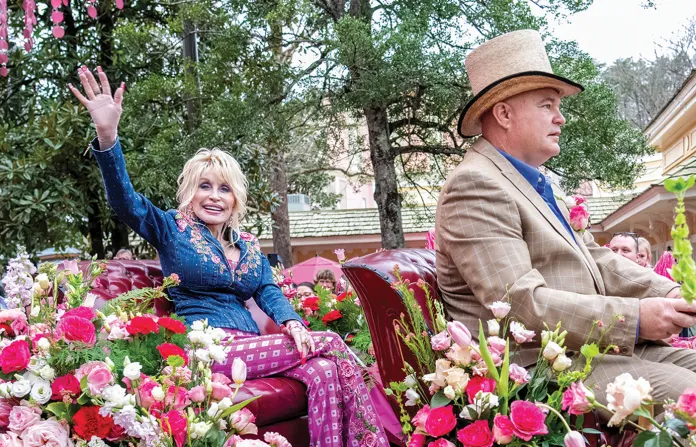
There is something real, something essential to Parton’s magnetism, I think, that I am struggling to capture with my Aquarian misidentifications. For all her warmth, all her quick, responsive liveliness, there was a place deep in Parton’s core that remained detached, that remained inaccessible and wholly her own. Her greatest hits bear this sense of detachment like a watermark. It is what makes them haunting.
The narrator of the classic song “Jolene,” despite her raw vulnerability, is clear-eyed to the point of ruthlessness. She lays out, point by point, the dimensions of her rival’s beauty. She can quite appreciate where Jolene is coming from. She does not dispute Jolene’s superior position of advantage, and she is indifferent to any question of her partner’s agency or responsibilities. She knows exactly where she stands and wants one thing only. She zeroes in on it like a laser. She wants, despite all this, to keep her man.
When Beyonce rewrote the song for her album Cowboy Carter, she took a different tack. There is no more merciless accounting, no more unconcerned abjection. It is the righteous warning of a woman who knows her rights and knows her worth and is prepared to insist on both. The result is a fine song in the tradition of “Fist City” and “You Ain’t Woman Enough to Take My Man.” But it is no longer haunting. It is no longer Jolene.
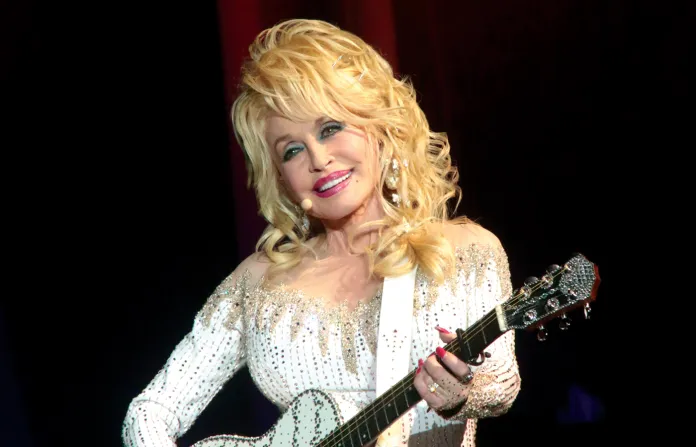
In Parton’s version of “I Will Always Love You,” as opposed to Whitney Houston’s inspired reinterpretation, the song’s grand, affectionate magnanimity is inseparable from its lack of anguish. There are no tortured doubts here, no sense of loss, no irresolvable dilemmas. The singer will always love the man she is leaving precisely because no part of herself will be left behind with him. There is not a chance in hell you could make her stay. She is already warbling away, untroubled as a songbird.
When I watch videos of her hamming it up, with great delight in the process and to the great delight of the viewer, at the Grand Ole Opry or on The Porter Wagoner Show, she seems to have this same unfettered songbird quality. She would be equally at home, you feel, if one day she shook off the sequins, as lightly as drops of rain, and disappeared into the Smoky Mountains, to haunt the woods and secret places unseen with a voice like springtime.
Parton was an American icon because she had this essential quality of freedom, a quality wholly internal and independent of circumstances. Wherever she was, that was where she wanted to be most. Whatever she did, that was what she wanted to do. However she lived, it was because she thought it best. Parton was free. She was free in a way we now associate with the vanished mountain men. It was how she could be what she was: a one-man woman with a body for sin; a connoisseur of dirty jokes who would not swear or take the Lord’s name in vain on television; an octogenarian in hot pants whose feelings, you felt, it would be impossible to hurt.
DOLLY PARTON DIES AT AGE 80 AFTER ‘BRIEF BATTLE WITH CANCER’
Improbable as it would seem absent the evidence, this core of self-possessed freedom did not translate to a restless, high-flying, celebrity rootlessness. She was not the kind of person for whom home is merely whichever real estate portfolio asset — the Malibu mansion, the Montana ski chalet, the New York brownstone — you momentarily inhabit. Parton’s home was Tennessee. She introduced its traditions to the world. She elegized its past and lyricized its beauties. She spent her life and, most importantly, kept her money there, in both business ventures and a string of philanthropic schemes too long to enumerate.
This, and not merely her once-in-a-century talent, is what has made her so big, so grand, so out of scale to reality. It is why she is the object of an impersonal reverence — impersonal, because it is truly universal. It is why she has become an unfurled flag, beyond critique, beyond any response more equivocal than love. She was as rich as all Americans hope to be, and she was as free as all Americans think themselves. And what she chose, in total allegiance, in ceaseless hustle, in generosity and joy, was the rocky land that gave her life.
Clare Coffey is a writer from Pennsylvania.