
Before launching Operation Epic Fury against Iran on Feb. 28, one of President Donald Trump’s favorite refrains was that he “ended” eight wars during his first year-plus back in office.
On closer examination, the reality is more complicated. Half of the conflicts mentioned saw a quick return to fighting, or Trump had claimed credit for halting fighting in conflicts where no hot war was taking place. The other three saw peace remain elusive, paused only as delays to larger wars.
But Trump does have diplomatic bragging rights in one case: the conflict between Armenia and Azerbaijan, which erupted shortly after the late 1991 fall of the Soviet Union, which both had been part of until independence just before that one-time global superpower collapsed. It’s a war Trump appears to have both stopped and transformed into a lasting peace. His administration did so by locking two of the world’s most bitter rivals into a framework favoring cooperation.
It’s a significant diplomatic achievement because the South Caucasus countries are located in delicate geopolitical territory. Both border Iran on the northwest side of the Islamic Republic of 93 million. Armenia, with about 3.1 million people, and Iran share a 27-mile border, which is a key trade route through Iran to the Gulf States and Asia further beyond.
The Azerbaijan-Iran border is about 428 miles long, separated into two parts by Armenia. With a population just over 10 million, Azerbaijan has, at times, seen cargo traffic across the border interrupted amid regional tensions.
Put another way, the South Caucasus is a neighborhood near Iran where American and Iranian interests directly collide. American policymakers want to reduce not only Iranian influence there, but also that of Russia and China. So, peace between Armenia and its larger neighbor, Azerbaijan, is part of the diplomatic equation as the Trump administration seeks to get out of the Iran war, which, in addition to national security threats, has spiked U.S. gas prices.
Long-running conflict
The Armenia-Azerbaijan conflict primarily centered on the disputed region of Nagorno-Karabakh. The wars played out in fits and starts over decades. But since 2023, diplomatic efforts have progressed toward a formal border demarcation and a comprehensive peace agreement.
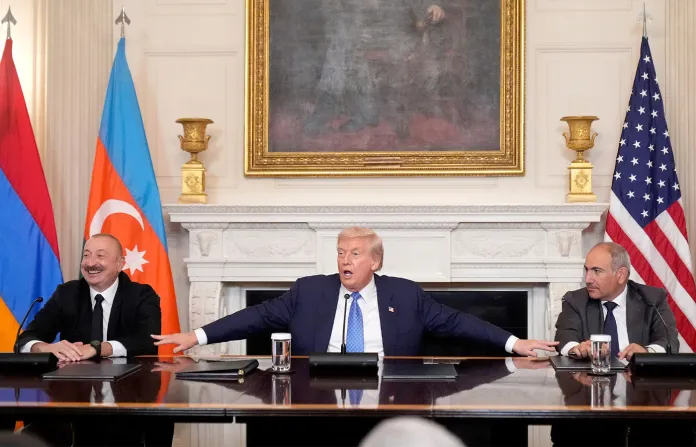
Which is where Trump comes in. On Aug. 8, 2025, he hosted a White House summit at which Armenian Prime Minister Nikol Pashinyan and Azerbaijani President Ilham Aliyev initialed a joint peace framework and declaration to permanently end their decadeslong conflict.
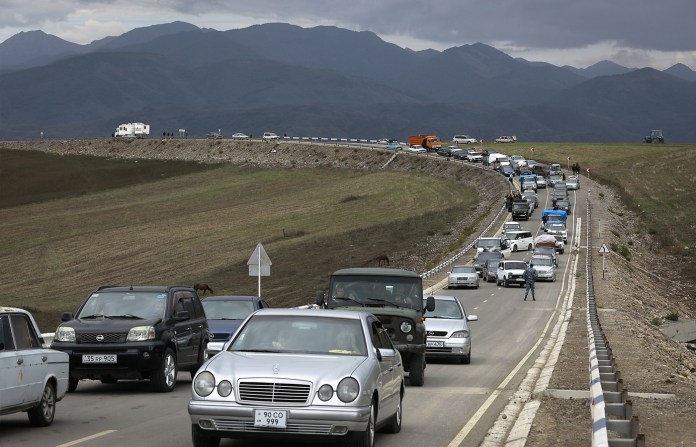
The peace has now held for more than a year. For the first time since the twilight years of the Soviet Union, the guns have fallen into a sustained, complete silence across the Armenia-Azerbaijan border.
“For more than two years, there have been no casualties along the border. There are no shootings, there are no killings, etc.,” Armenian Ambassador to the United States Narek Mkrtchyan told the Washington Examiner in an interview.
“For the first time, after three decades, we have two years with no casualties,” he said. “This is a real peace.”
Mkrtchyan and Azerbaijani Ambassador to the U.S. Khazar Ibrahim both gave Trump full credit for bringing about the peace agreement. The pair argued, separately, that his unique touch was required to push it through.
“The overarching thing was actually the personality of President Trump himself, because he put himself on top of these issues, and I think without him, it wouldn’t have happened last year,” Ibrahim told the Washington Examiner in an interview.
The personal nature of the violence and hatred between Armenians and Azerbaijanis has passed under the radar in the West due to the remote location of the Caucasus and the previous understanding that the region was firmly within Russia’s sphere of influence. Despite this lack of attention, the bitter rivalry ranks among the bloodiest ethnic conflicts of the late 20th and early 21st centuries. Before the wars following the Oct. 7, 2023, Hamas attacks on Israel, the death toll from the Armenian-Azerbaijani conflict was much higher than all rounds of fighting between the Israelis and Palestinians combined. South Caucasus fighting involved the deaths of anywhere from 60,000 to 100,000 people from 1905 to 2023.
The main focus of the feud has been around the region of Nagorno-Karabakh, an area of deep cultural, historical, and religious significance for both. The much smaller Armenia pulled off an upset victory in the First Nagorno-Karabakh War from 1988 to 1994, followed by a decisive Azerbaijani victory three decades later, which led to the flight of the enclave’s entire Armenian population.
Though Nagorno-Karabakh was put fully under Azerbaijani control in September 2023, tensions didn’t dissipate. The biggest issue was Azerbaijan’s separation from its Nakhchivan exclave, which was cut off by Armenian territory. Western powers openly floated the idea of Azerbaijan invading Armenia outright, with then-Secretary of State Antony Blinken telling Congress as much in late 2023.
Diplomatic efforts to end the Armenia-Azerbaijan conflict are as old as the conflict itself — Russia, France, and the U.S. mediated talks for decades without success.
Ibrahim argued that the previous peace efforts failed because they were dominated by domestic political concerns, leading to unrealistic demands and debates over semantics. Trump’s effort, in contrast, focused on “real things which can bring real peace on the ground.”
“It was about connectivity,” Ibrahim said. “It was about economic relations. It was about development. It was about investment. It was about regional affairs. That makes it different.”
What a long, strange TRIPP it’s been
The centerpiece of the peace initiative was a U.S.-developed land corridor connecting Azerbaijan with Nakhchivan, overseen by Armenia. In Trumpian fashion, though, upon the suggestion of the Armenians, it was officially called the Trump Route for International Peace and Prosperity.
The TRIPP is technically separate from the peace agreement itself and is a bilateral deal between the U.S. and Armenia. According to the plan, U.S. companies would develop rail, oil, gas, and fiber-optic lines along the 27-mile-long corridor. The U.S. will hold a 74% stake in the project, with the Armenian government holding the rest. The route will be officially under Armenian control.
The project kills several birds with one stone — the U.S. is given a material interest in the South Caucasus, Azerbaijan is connected to Nakhchivan while respecting Armenian sovereignty, Armenia improves its connectivity to the outside world, and their final territorial gripe is solved.
Given a solution that satisfies the governments of Armenia and Azerbaijan, and a blossoming relationship with the world’s premier superpower to boot, the two age-old enemies have now embarked on an effort to make their peace permanent. Reciprocal visits from civil society groups, experts, officials, and athletes have begun and gained steam.
Ibrahim noted a recent occurrence that would’ve been unthinkable even as recently as just over a year ago. The 2026 U17 World Wrestling Championships, hosted by Azerbaijan in Baku, its capital and largest city, showed the ice was melting.
“A huge Armenian delegation came, and I think it was the first time the Armenian anthem was heard in Baku, and there were no hard feelings,” he said, adding that it was reciprocated in Armenia.
“Even if you look at social media and some other places, I see a huge decrease in terms of animosity between Azerbaijani and Armenian societies,” Ibrahim said.
Mkrtchyan touted the progress the civil society and official visits have brought about, though he said they would need more to continue on the path to peace.
“The pain is still fresh,” he said. “We need more people-to-people contact. We need more success stories and stories that would bring confidence to people to think that not only certain leaders of the government are committed to peace, but also people.”
Despite these leaps in progress, there remain more than a few issues that defy an easy solution. The Azerbaijani delegation still hasn’t actually signed the Washington agreement of last year, as one of its key stipulations was the removal of language laying claim to Nagorno-Karabakh in Armenia’s constitution. The only way to go about this change is a difficult parliamentary process that requires a supermajority, which Pashinyan doesn’t have.
The language in the constitution, Mkrtchyan argued, reflected attitudes of centuries past, “like, let’s say, post-Soviet Union expectations. Now we live in a new reality, and we have to adapt.”
With or without a constitutional change, both ambassadors remained optimistic about a sustainable peace, even if an official agreement wasn’t signed. Ibrahim reasoned that a peace without a document was far preferable to a document without peace, as has been seen in numerous recent conflicts across the globe.
Mkrtchyan held that peace was a “process,” rather than just a single document.
Unresolved issues
Aside from the issue of the peace treaty itself, lingering anger over their fraught history isn’t likely to disappear anytime soon. An entire generation grew up in Armenia and Azerbaijan viewing each other as their ultimate enemy. Each government has accused the other of ethnic cleansing and the murder of civilians, and the last war, just six years ago, left thousands of fathers and sons dead. Armenia and Azerbaijan also have remaining immediate problems, including vandalism of cultural sites in Nagorno-Karabakh, the continued presence of mines in the region, and the imprisonment and trial of several Armenian Nagorno-Karabakh leaders in Baku on terrorism charges.
Ibrahim explained that the two governments have dealt with these barriers by pursuing a Fabian strategy — avoiding battle with the most contentious issues while focusing on their mutual interests.
“They have issues in their mind, we have issues in our mind, but when you concentrate on issues that you can solve, when you concentrate on issues which create a positive agenda, that’s what helps,” he said.
“I know it from my own experience: Sometimes the issues parties have in their mind — they’re not real issues,” Ibrahim added. “They dissipate, they disappear when the environment changes.”
In each separate interview, Ibrahim and Mkrtchyan both independently pointed to post-World War II Europe as the prime model for how fanatical enemies can be turned into friends. They hope that the TRIPP and other burgeoning projects sprouting from the U.S.’s new engagement will recreate the success of the European Union.
‘THAT’S THE JETSONS THAT’S COMING TO LIFE’: TRUMP OFFICIALS TOUT MULTIFRONT DRONE INITIATIVE
While much of the newfound peace can be credited to Trump’s unique approach, there were other influential factors outside his control, too. The biggest was just how defeated Armenia was in 2020 — nearly all its heavy equipment was destroyed or abandoned in Nagorno-Karabakh after the ceasefire, leaving it largely defenseless against Baku.
Nevertheless, Trump’s Armenia-Azerbaijan peace deal has stood for over a year. It’s just the kind of rapprochement among former enemies that Trump has proclaimed himself Nobel Peace Prize-worthy, with visions of accepting the prize in Norway a recurring theme in his second, nonconsecutive term. The continued peace in a region sitting on the border of Eastern Europe and Western Asia could secure him as a winner of peace in the hearts of the South Caucasus, even if not in Oslo.
Brady Knox (@Brady_k6) is a foreign affairs reporter for the Washington Examiner.