
Santa Fe Public Schools has changed its gender transition policy to require parental involvement in a Gender Support Plan. It is a move advocates for parental rights are calling a step in the right direction, but the school could still lose federal funding due to active transgender policies.
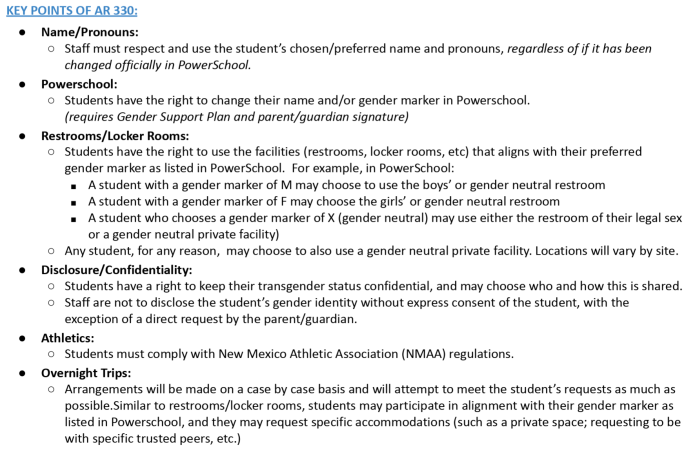
The change, adopted Aug. 20, requires a parent or guardian to participate and sign off when a child goes on a Gender Support Plan, meaning a student can use the bathroom of their gender identity, and requires faculty and other students to use their preferred pronouns and name. Before the student would chose whether or not the school let parents know their child began transitioning at school.
However, the revised process does not require SFPS to notify other parents when their child must share a private facility, such as restrooms or locker rooms, with a student based on gender identity rather than the student’s biological sex.
That distinction is at the center of a complaint filed with the U.S. Department of Education’s Office for Civil Rights by Liberty Counsel on behalf of New Mexico parents.
Mat Staver, founder and chairman of Liberty Counsel, said the new requirement represents progress but it still needs to do more to protect students.
“It certainly is a good step in the right direction because now you have at least parental notification and consent and involvement,” Staver told the Washington Examiner. “Santa Fe Public Schools risks losing its federal funding, and also risks litigation from the Department of Justice with regards to its Title IX discrimination.”
The policy change comes following Santa Fe mother Kristy Borrero Ojinaga publicly challenging the district over what happened to her then six-year-old daughter.
Ojinaga said her daughter came home from first grade visibly upset and eventually told her a boy in her class was following her into the girls’ bathroom and engaging in other inappropriate behavior in class.
“He plays with his privates in class,” Ojinaga said, recounting what her daughter told her. “He’s told my friends and I that he has crushes on us and wants to kiss them.”
When Ojinaga went to the school, she said administrators told her the boy had a gender support plan. Ojinaga questioned why she was not told a boy would be allowed in her daughter’s restroom and whether the boy’s behavior – touching himself in public and trying to kiss the girls – should be considered appropriate.
Ojinaga told the Washington Examiner, a district wellness coordinator responded “the behavior is very typical and normal for this age.”
“She told me that he could be a lesbian at six years old,” Ojinaga exclaimed. “I mean, we’re talking about a six-year-old little boy!”
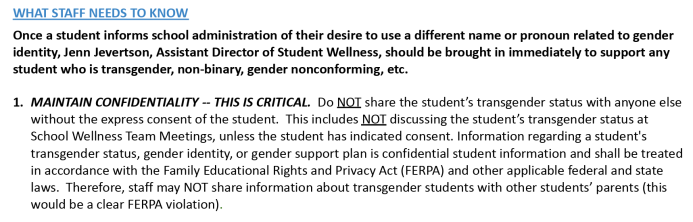
The Gender Support Plan explicitly tells teachers to “maintain confidentiality” and cites the Family Educational Rights and Privacy Act, or FERPA, as the reason they could not disclose the information to other parents.
“They totally violated my parental rights by just doing that to her, putting her in that position,” Ojinaga said. “They did not give me, as my daughter’s parent, the same opportunity to put any type of boundaries around her, remove her from a situation that I felt was not safe for her. At six years old she was not old enough to consent to being in there with him, she was not old enough to put boundaries around herself.”
Staver argues FERPA will not stand up as a reason for keeping other parents in the dark.
“I don’t think they can hide behind that law,” Starver said. “Exposing himself to the girls, making sexually explicit comments to the girls, anyone in their right mind would say, ‘that has to stop, and that kind of sexual harassment needs to be reported.’ That’s not something protected by some federal privacy law.”
The federal complaint filed by Liberty Counsel alleges Santa Fe’s policies violate Title IX by permitting biological males to access female intimate facilities and by failing to protect female students.
“[School Counselor] also dismissed [child] psychological, mental, and emotional distress caused by the Classmate’s hyper-sexualized conduct,” the complaint states. “Claiming it was [child] not the Classmate, who needed counseling so she could be more understanding and accepting of so-called “transgender” students.”
Liberty Counsel filed the complaint in March after the district declined to make the changes requested in an earlier demand letter sent in January.
Now, the new gender-support requirement could be an early indication that the pressure is having an effect.
The Department of Education’s Office for Civil Rights is responsible for investigating complaints alleging violations of Title IX. If OCR investigates and finds a violation, it can seek a voluntary resolution with the school district. If the district refuses to come into compliance, OCR can initiate proceedings to suspend or terminate federal financial assistance or refer the matter to the Department of Justice.
“By not protecting these girls and allowing boys, as in this particular case, to come into the girls’ restroom, touch himself, and then make sexually provocative statements like he is attracted to them in the girls’ restroom, it makes the girls feel uncomfortable,” Staver said. “It makes them unsafe. The school needs to do its job and follow the law.”
NEW MEXICO PARENTS, IT’S TIME TO START ASKING QUESTIONS
The Department of Education has already demonstrated it is willing to use federal funding as leverage in Title IX disputes. In 2025, the department placed five Northern Virginia school districts on high-risk status and reimbursement status after finding Title IX violations related to transgender policies.
Staver says the Santa Fe complaint remains pending.