
I have never been especially drawn to landmarks. Battlefield plaques, preserved taverns, roadside markers — I understand the appeal, and I have stopped for a few. But they have always seemed less like history than tombstones: fragments of a past life that meant far more to those who erected them than to those who pause to read them decades later.
What an idiot I was.
Brady J. Crytzer’s The National Road: George Washington and America’s First Highway West forced me to see our nation’s landmarks differently. More than once, I found myself stopping mid-chapter to look up a river crossing, a cast-iron bridge, or an old stretch of road that still traces the spine of the early republic. The National Road was America’s first federally funded highway, authorized by Congress in 1806 and begun at Cumberland, Maryland, in 1811. It eventually pushed west through the Appalachians and across much of what was then the American frontier.
Crytzer brings the National Road to life. You see surveyors pushing through forests, workers laying stone, travelers in stagecoaches heading west with everything they own. The book makes a simple case, and it makes it well: The republic needed this road — and more importantly, the idea that led to the road’s creation — if it was going to hold together. “It was the first example of interstate cooperation, the first interstate highway, the first project to unite the East and West,” Crytzer writes. “It was the original connection between the continent’s most vital watersheds.”
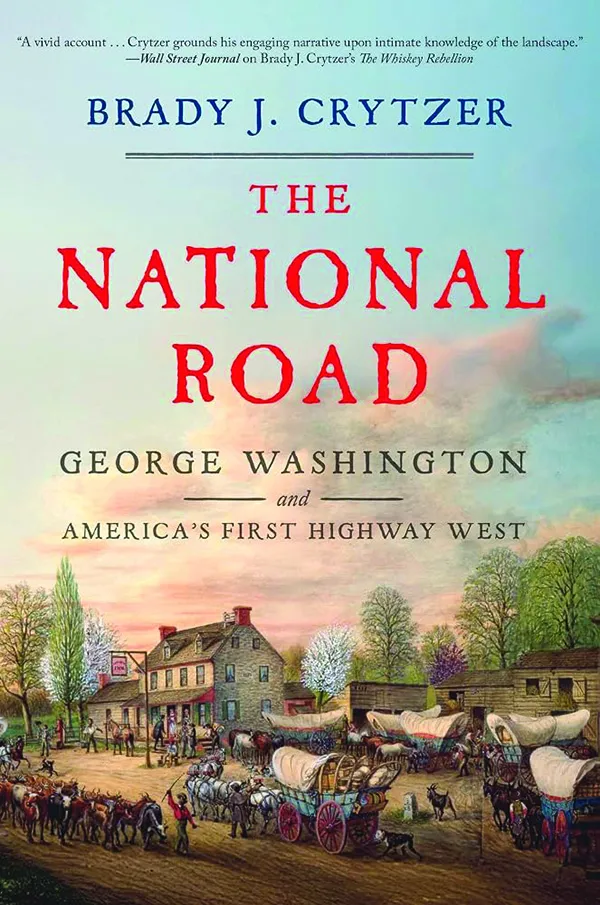
For George Washington, it was a lifelong passion he hoped to leave to the nation he founded. But he would never see the National Road itself. Washington died in 1799. The road was the posthumous realization of a vision he had carried for much of his adult life.
Crytzer reintroduces Washington to us in a very fresh way. We know Washington: the general, the president, the father of his country. Crytzer gives us a rare glimpse of Washington the surveyor, the young man who walked the frontier, measured land, and saw with unusual clarity how the continent’s vast geography, and the conquest of its space, would shape the fate of the new United States.
The idea of linking the Potomac River to the Ohio River was not new for President Washington. The notion had been formed decades earlier, when Washington was a young man surveying the territory and building the road for Braddock’s disastrous campaign during the French and Indian War. As Crytzer writes:
“Whether he marched as an agent of Virginia, of the British Empire, or of a sovereign United States, he always reached the same conclusion: The future was in the west, and the Ohio River was critical to controlling the North American continent. He saw it as a major in the Virginia militia, and then again as a colonel; in both instances he marked it as the most strategic military target in the west. He later returned as a speculator, an entrepreneur operating in the name of profit, not empire.”
And, of course, he remembered his observations when he became president. A national road, in Washington’s mind, was not about convenience and only partly for commerce. It was about cohesion in a new nation that had very little of it, particularly in the East and West, following the aftermath of the Whiskey Rebellion. Crytzer shows how Washington’s aim for the National Road was carried forward by two of the early republic’s most consequential figures; Albert Gallatin, the Swiss-born treasury secretary who served under Presidents Thomas Jefferson and James Madison; and Henry Clay, the Kentucky statesman who won the House speakership in 1811 and spent the next four decades as one of the nation’s foremost champions of federally supported roads and canals.
Gallatin is not remembered by the general public as he should be. In Crytzer’s account, he emerges as the figure who carried Washington’s vision forward. The immigrant from Geneva understood the problem clearly: Settlement without connection leads to isolation, and isolation to grievance. If the West could not move goods east, it would look elsewhere. Binding it to the union required more than rhetoric. It required roads, trade, and the steady movement of people and goods. That meant funding, and Crytzer shows how Gallatin used the Treasury to keep the project moving when it might otherwise have stalled.

While Gallatin translated Washington’s idea into fiscal reality, Clay extended it into a coherent national program. As speaker of the House for much of the period between 1811 and 1825, Clay occupied one of the most powerful positions in the federal government, and he used it to champion what became known as the American System. Like the first president, Clay understood that roads and canals were never just economic tools — they were political glue. By physically linking distant Americans, the National Road would tighten the bonds of the union itself. Roads had equally important indirect effects on institution-building. Supply routes became mail routes, and mail routes became the early republic’s communications network, the nervous system that helped knit a shared culture even as the nation began to break over the issue of slavery.
GEORGE WASHINGTON REMAINS AMERICA’S INDISPENSABLE MAN
The real hero of the story is not Washington, Gallatin, or Clay, but the Army Corps of Engineers. They were hardly romantic about the purpose of the National Road. Where the statesmen saw destiny, they saw grades and drainage. They worked with transits and compasses, survey chains and expense ledgers, and understood what it took to put a road on the ground. In a young republic that often could not agree on much, the corps quietly pushed road-building into new territory. Crytzer argues they were among the most innovative road- and bridge-builders since the Romans. When the politicians moved on to the next debate, the corps was still in the mud, still arguing about which way to construct the road around a bend.
What strikes you, finishing the book, is how conventional the road must have seemed to the people who traveled it. It was just a road. Muddy in spring, rutted and bumpy by summer, impassable in bad winters. They couldn’t see what it was doing: binding markets, pulling settlements into the orbit of the republic, ensuring the West remained American rather than transforming into something else entirely. That’s often how it works with the things that hold us together. You only see them clearly once someone makes you look. Next time you’re driving on U.S. Route 40, particularly east of Ohio, be sure to stop to read the plaques.
Carl Paulus is a political historian from Michigan who formerly worked on Capitol Hill.