
The Trump Justice Department’s position in a legal fight over Biden-era “ghost gun” regulations is the latest instance of the Trump administration breaking with gun rights groups on Second Amendment issues.
The administration is evaluating whether to appeal two recent Texas decisions favoring gun-rights groups: one striking down a Biden-era “ghost gun” regulation, and another blocking federal registration and approval requirements for some suppressors and other weapons.
On most Second Amendment issues, the Trump administration has hewed closely to the positions of gun rights groups. But on a handful of niche issues dating back to the first Trump presidency, the administration has taken public stances or held private discussions that have placed it opposite groups such as the National Rifle Association.
What the Trump administration will do next in response to the pair of Texas decisions has some gun rights advocates on edge.
Aidan Johnston, Gun Owners of America’s director of federal affairs, worries resistant bureaucrats could squander a rare opportunity while gun rights advocates have momentum by backing an appeal of a ruling that activists are otherwise celebrating.
“I think this is the debate going on in the administration right now,” Johnston said of discussions over ATF policy and whether the Trump administration will appeal the suppressor ruling. Some officials “would have you believe it’s all in good faith, but there’s certainly an element of bureaucrats backing an appeal that wants us to lose.”
John Commerford, executive director of the NRA’s Institute for Legislative Action, says he trusts senior political officials to make the right decision.
The disagreement is not over Trump’s broader record. Advocates consider him among the most pro-Second Amendment presidents of the modern era. His administration has sued Virginia over its semiautomatic weapons ban, challenged California’s Glock restrictions, and begun unwinding dozens of Biden-era firearm regulations.
But the relationship has not gotten off without a hitch.
Past breaks on gun policy complicate Trump’s trust meter
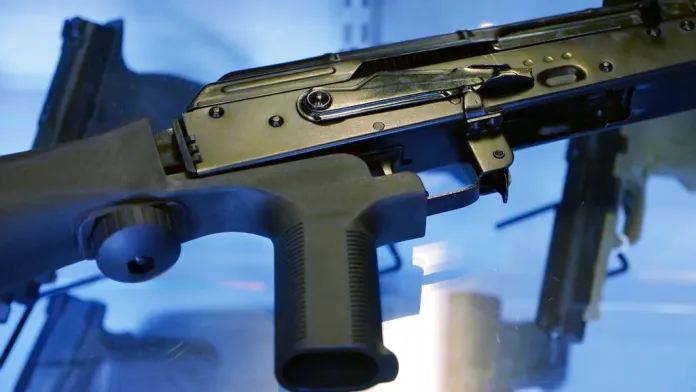
In one of his more controversial first-term decisions, Trump banned bump stocks after the devices were used in the 2017 Las Vegas mass shooting. Bump stocks are gun attachments meant to help semiautomatic rifles fire more rapidly. Gun-rights groups warned at the time that the policy was an overcorrection, arguing the administration improperly rewrote federal law through regulation.
The Supreme Court ultimately vindicated those concerns in 2024 after finding that the Bureau of Alcohol, Tobacco, Firearms and Explosives exceeded its statutory authority.
A more recent rift emerged in September 2025 when DOJ officials reportedly considered whether transgender people could be barred from possessing guns under a federal law governing certain people with serious mental conditions.
The possibility prompted immediate opposition from the NRA and other gun-rights groups, which warned against disarming an entire category of people without individualized findings of dangerousness. The DOJ said no specific proposal had been advanced.
The Trump administration also maintained the Biden DOJ’s position in United States v. Hemani, urging the justices to uphold the prosecution of a Texas man who possessed a firearm while admitting to law enforcement to using marijuana “about every other day.”
The Supreme Court sided with Hemani in June, holding that the government had violated the Second Amendment through its prosecution of a regular marijuana user. The ruling did not weigh in on the legality of barring addicts or intoxicated drug users from possessing firearms. Gun Owners of America and other Second Amendment organizations had backed Hemani, placing them opposite the Trump administration once again.
Those episodes are fueling suspicion as the administration decides what to do in two new cases gun-rights advocates have won so far.
Ghost-gun victory presents the latest mystery
U.S. District Judge Reed O’Connor ruled Monday that a 2022 ATF regulation governing partially completed firearm frames, receivers, and weapons-parts kits violated the Second and Fifth amendments.
The Biden administration initially adopted the rule in the second year of his presidency in an effort to crack down on so-called “buy-build-shoot” kits that had begun to proliferate across the country. The goal was to require commercially sold kits capable of being assembled into functioning firearms to be treated like other guns. Covered products must carry serial numbers, while licensed dealers must conduct background checks and retain transaction records in order to sell them.
The Trump administration continued defending the rule after taking office, placing it in conflict with Second Amendment organizations that argued the measure interfered with the nation’s historical tradition of personal gunsmithing.
“The Court cannot conclude that the Final Rule’s imposition of ambiguous and far-reaching regulations, which would restrict access to component parts thereby inhibiting home gunsmithing, comports with the Second Amendment,” O’Connor wrote.
He also found the rule unconstitutionally vague.
The Supreme Court upheld the regulation in a 7-2 decision in March 2025, but that case addressed only whether ATF had statutory authority to regulate at least some kits and unfinished frames. O’Connor resolved the remaining constitutional questions in favor of the Second Amendment Foundation and other plaintiffs.
The DOJ said it is evaluating the ruling’s impact but has not disclosed whether it will appeal.
Oct. 5 deadline looms in suppressor case
The administration faces a more immediate decision in the consolidated Silencer Shop Foundation v. ATF and Jensen v. ATF litigation, which may become the clearest clue about the direction of the DOJ’s litigation strategy.
U.S. District Judge James Wesley Hendrix ruled Aug. 5 that the government could not enforce challenged National Firearms Act registration and approval requirements against the plaintiffs and certain covered members and customers. The DOJ declined to seek an emergency stay before Hendrix’s order took effect Aug. 13, and the government has until Oct. 5 to file a conventional appeal.
Additionally, two cases are still ongoing, challenging the NFA in Missouri and Kentucky.
The legal dispute initially arose after Congress, via the One Big Beautiful Bill Act, reduced the law’s making and transfer tax from $200 to zero while leaving its paperwork requirements intact. The maneuver immediately prompted gun rights groups to sue.
Hendrix found the challenged requirements could no longer be justified under Congress’s taxing power when there was no tax to collect.
The order is limited and does not eliminate the NFA gun attachment registration nationwide. Its practical effect depends on whether distributors are members of the NRA or GOA, as well as several notable state law prohibitions in at least nine states. Ordinary background-check requirements also remain in place.
Commerford credited the victory to the NRA’s work with Trump and congressional Republicans.
“This case is possible because of our work in the Big, Beautiful Bill zeroing out the tax,” Commerford said.
“Congress’s intent was zeroing out the tax,” he said. “So if you’re not enforcing the tax, how can you enforce the paperwork requirements?”
Johnston, meanwhile, was more willing to point his finger at DOJ officials such as the Civil Division’s leader Brett Schumate, whom The Federalist reported earlier this month was interested in continuing to appeal the matter.
“I think that there is still internal struggle with Brett Schumate the head of Civil Division who apparently wants to appeal the case,” he said.
There are additional signs that the pressure effort could be working as well. In a statement to NPR earlier this week, the ATF said it is still “processing forms and will continue to process forms consistent with applicable law, regulations, and agency policy.”