
You start by arguing against “market fundamentalism,” “neoliberalism,” and “extreme libertarianism,” and you end by arguing against economics. Vice President JD Vance is the latest postliberal to embrace what is now, for all intents and purposes, an anti-growth position.
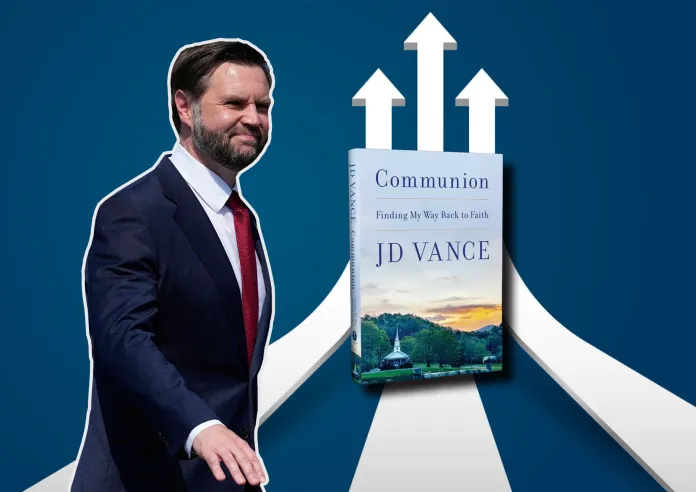
In his latest book, Communion, Vance inveighs against those perennial straw men, the GDP-obsessed economists. We keep hearing about these mysterious figures, cold-hearted calculators who believe that GDP is the only measure that counts. Oddly, despite having spent my life around free-marketeers and despite now running the world’s oldest classical liberal think tank, I have yet to meet one.
Vance, though, is evidently convinced that people who “struggle to put a value on anything that can’t be specifically measured” not only exist, but run America. The country is governed, he tells us, “by numbers on a spreadsheet and the people who built those spreadsheets.”
He goes on to write, with the air of a man imparting an original insight, that looking after your children is more fulfilling than adding to GDP. Whom does he imagine disagrees? Economists, practitioners of what Vance, unconsciously quoting a pro-slavery tract, calls “the dismal science,” will point out that higher living standards — higher GDP, if you insist — frees up a lot of time to play with your kids, because you no longer need to work six days a week just to feed them. But no economist, indeed no sentient adult, has ever argued that you get more pleasure from a large bank balance than from reading a bedtime story.
We are used to hearing degrowth rhetoric from the extreme Left. To hear it from a leading figure in the main right-wing party — Vance is said to have locked down big donors and the Republican National Committee in advance of the next presidential election — is extraordinary.
Large chunks of what are still sometimes called the Right have adopted radical socialism: National Conservatives, “Groypers,” integralists, and a mass of the MAGA rank-and-file. While much of the democratic world has seen a political realignment, in which culture displaces economics as the chief division, this development makes the United States an outlier.
Latin America, for example, has seen a string of Trump-like election victories. Chile, Bolivia, Peru, and Colombia have all recently elected rightist candidates who won mainly on the issues of crime, immigration, and security. Unlike the NatCon Right, though, these candidates were not especially interested in economics and were quite happy to let free-marketeers run the key departments, provided they delivered growth.
In the U.S., by contrast, the NatCons define themselves primarily, not against the Left, but against the traditional Right. “Today we declare independence from neoconservatism, from neoliberalism, from libertarianism, from what they call ‘classical liberalism,’” was how the organizer of the inaugural National Conservatism Conference, Yoram Hazony, introduced the movement in 2019.
This attitude matters because it makes it impossible to reconstruct the alliance that led to Ronald Reagan’s presidency and its benign transformation of American life. In her wonderful new book, Fusionism, Stephanie Slade of Reason magazine argues that that combination ensured both liberty and virtue. She rejects the NatCon claim that the libertarian wing of the alliance is uninterested in “the common good.” Like Vance, Slade is a Catholic. Unlike him, she does not presume that Catholics must follow a particular set of economic policies. She believes that Reaganism is more than compatible with what Pope John XXIII called the “one basic principle,” namely that “the individual is prior to society and society must be ordered to the good of the individual”.
Genuine conservatives understand that virtue flourishes in the absence of coercion, that a small state means a more conscientious citizenry, that families and churches are better at almost everything they do than governments are. In NatCon fancy, by contrast, libertarians are numerous, powerful, and pitiless. They favor some kind of wretched anomie, in which no one looks out for anyone else. I suppose it is possible that such people exist. I can only say that I have no more met one of them than I have met one of those imaginary economists who care only about GDP.
I suspect that Vance’s real game is to depreciate the whole concept of economic growth because several of the policies he favors, notably on trade, will reduce it. If free trade is the last idea that unites every economist, then, for Vance, the entire profession must be flawed. Or as the vice president puts it in his book, “Maybe economics is just fake.”
Maybe it is. Maybe gravity is just fake. There is a way to test the theory, and I have a nasty suspicion that, if he gets the chance, Vance will do precisely that.