
The first time Marie-Joseph Paul Yves Roch Gilbert du Motier, Marquis de La Fayette, arrived in the United States in 1777, the defining characteristic of both the French nobleman and the new nation for which he’d come to fight was their paucity of years, the one but a babe and the other barely more than a youth. When he returned for the last time, in 1824-25, just before its 50th birthday, America had matured into a sturdy, even rude adolescence and stood on the precipice of what would prove to be a boisterous and vigorous adulthood. But plain Gilbert du Motier, as he now was, had become an old man.
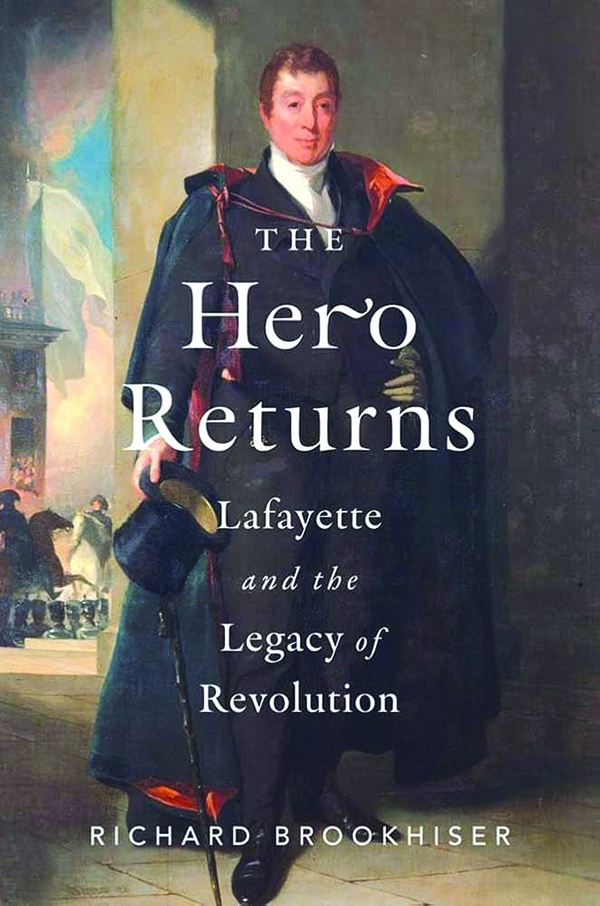
Coming back all those years later, he and the country he’d helped birth hoped to prove to themselves and each other that the toil and sacrifice, the blood and tears shed, had been worth it and had not been in vain. As historian and National Review senior editor Richard Brookhiser explains in The Hero Returns: Lafayette and the Legacy of Revolution, his finely sketched, pleasingly lapidary, and economical study of Lafayette’s triumphant return to America, in this homecoming, host and visitor alike would be honored by his presence.
President James Monroe’s invitation to Lafayette, extended on behalf of Congress, to venture across the Atlantic, arrived at a propitious moment. The erstwhile aristocrat’s political fortunes were at a low ebb. The revolutionary spirit was in retreat across the continent. The forces of reaction, particularly in the form of the hated Holy Alliance, ascendant. The French government, led by the restored Louis XVIII, had finally succeeded in driving Lafayette, one of France’s leading liberal political figures and a long-standing thorn in the crown’s side, from the Chamber of Deputies. Lafayette dabbled in various conspiracies and plots to keep the revolutionary fire burning. They came to nothing. “A fellow deputy called him ‘a monument wandering around in search of its pedestal,’” Brookhiser notes. There were “pedestals aplenty” waiting in America. So, in July of 1824, two months shy of his 67th birthday, he embarked for the shores upon which he had first set foot as a 19-year-old.
Lafayette’s yearlong tour, during which he visited all 24 states now in the Union, including the near-dozen that had been added since the war, had a “double purpose,” Brookhiser tells us: Americans could show their hero what, with his assistance, they’d become, while Lafayette would use the occasion “to praise them before the world.” By turning back to the past, “he wanted to inspire a freedom-loving future, in America and abroad.”
Lafayette was accompanied by a small entourage that included his son, Georges Washington Lafayette, and his secretary, Auguste Levasseur, who produced a two-volume account of the voyage that made him something like a proto-Tocqueville. They began their peregrinations in Staten Island, where they landed in August. They relocated to New York City, then traversed New England. They went back and forth, visiting states multiple times. Among his pilgrimage sites were Newburgh, West Point, Lexington, and Concord.
The marquis was, of course, his own site of pilgrimage. “If one wanted to see and celebrate the Revolution as a living event, now was the last opportunity,” Brookhiser writes — or nearly the last. Hence, people flocked in droves wherever he went and whatever time of day it was. He was feted with balls and banquets, parades and processions, and speeches and soliloquies from Independence Hall to the backwoods of Indiana, according to what the local populace could manage. From the Northeast, he and his companions headed southward, crossing New Jersey, Pennsylvania, Delaware, Maryland, and Virginia. Naturally, he called at Mount Vernon to pay his respects to the man who had in so many ways taken the place of the father he’d never known. Then, for the first time, he saw new states such as Illinois and Mississippi, Missouri and Ohio. Nor was Maine forgotten (though it had to wait until near the end of his American sojourn). His travels ran the gamut, from America’s largest cities — New York, Boston, Philadelphia, New Orleans, and Charleston — to villages and hamlets barely deserving the name. It was in this period that Lafayette’s own name started being used to grace such villages and hamlets.
Brookhiser relates many amusing stories and anecdotes about the trip. A few things stand out. One is just what a massive social occasion Lafayette’s coming was, wherever he went. Members of the fairer sex bedecked themselves in their best finery. Young ladies blushed at his gaze. Another is how Lafayette, soldier and aristocrat, still knew his duty. Even if his group arrived at 2 in the morning, he would be awake to greet the welcoming party and acknowledge his reception. Like Joe DiMaggio, Lafayette gave his best each time out because somewhere in the stands was a kid who might be seeing him for the first, and possibly last, time.
Lafayette met with mighty and mechanic alike. He was not afraid to be seen publicly embracing black men, such as James Armistead Lafayette, a slave who had worked as a spy for Lafayette during the war and took his name when granted his freedom, or Pompey, who had been Lafayette’s first servant upon his arrival in 1777. Lafayette did keep his share of august company. He met every living president and several future ones: John Adams, Thomas Jefferson, James Madison, James Monroe, John Quincy Adams, Andrew Jackson, and William Henry Harrison.
Lafayette encountered all sorts on his tour, including Simon Bolivar’s nephew and surrogate son, Fernando Bolivar, near Philadelphia, where he was a student, and Joseph Bonaparte, former king of Spain, now a gentleman farmer in New Jersey. Later in his life, Walt Whitman recollected how, as a 6-year-old, Lafayette had picked him up and kissed his cheek during one of the New York excursions.
At every stop, Lafayette was inundated with “torrents of admiration.” He coped with the adulation by deploying what Brookhiser labels “the turn,” a rhetorical maneuver in which he deprecated his own efforts and emphasized the contributions of others and the nation itself. If I played any part, he seemed to say, it was only because of everything everyone else did to make it possible. Lafayette may have helped to make the Revolution, but even more had the Revolution helped to make him.
Much of Lafayette’s journey was undertaken by steamboat, and he was able to save considerable time on his return east by taking advantage of the Erie Canal, which was on the verge of completion. Yet he still couldn’t avoid bad roads and horseback travel. Nor were steamboats entirely reliable. Lafayette’s retinue lost their possessions when one sank. Brookhiser doesn’t belabor the point, but we can see in the various modes of conveyance Lafayette used how much the country had changed.
Looking back on his trip two centuries later, one must marvel at Lafayette’s endurance, stamina, and dedication. Such a journey would be arduous even today. In the early 19th century, it took real dedication — the kind of dedication, indeed devotion, Lafayette still felt for his adoptive homeland. And which, over the course of 14 months, his adoptive homeland made clear it still felt for its favorite French son.
Varad Mehta is a writer and historian. He lives in the Philadelphia area. Find him on X @varadmehta.