
To call Spider-Man: Brand New Day a movie is to do a disservice to all other examples of filmed entertainment that bear the name. As traditionally understood, a movie purports to tell a story to an audience whose ideal state is one of relative ignorance. Preconceptions, assumptions, and advance knowledge in the viewing public are regarded as impediments to the capacity of the tale to surprise, startle, or transport.
The writer-director Peter Bogdanovich (The Last Picture Show) used to tell me to assume the reader knows nothing, and although he was referring to writing, his exhortation applies to moviemaking, too. Whatever else can be said of the recent film version of The Odyssey, no one can claim that Christopher Nolan assumed that the viewer was overly familiar with Homer. For better or for worse (in his case, for worse), Nolan took it for granted that his audience was a blank slate. Even sequels and prequels — say, those in the Star Wars canon — ideally aspire to a degree of self-sufficiency in which the audience can discern the story and, properly bewitched, can proceed to seek out the other movies. You can see the second Indiana Jones movie first and not feel like an idiot.
Alas, this compact between viewer and moviemaker is discarded in most contemporary comic book movies. I am hardly the first critic to observe that the big-screen adaptations of the DC and Marvel Comics canon demand constant consumption and unflagging attention from the viewer: missing but one entrant in a given series is a sin worse than falling asleep in French class. In French class, at least, the student will presumably still be able to say “Bonjour” and “Merci beaucoup,” if not carry on a conversation, but if someone watches, say, Avengers: Infinity War (2018) without seeing whatever preceded it, well, good luck.
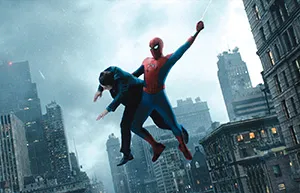
No, I am not the first critic to say this, but, having just endured Brand New Day, I am among the latest. This movie so decisively requires audience acquaintanceship with the other Spider-Man movies starring Tom Holland — 2017’s Spider-Man: Homecoming, 2019’s Spider-Man: Far From Home, and 2021’s Spider-Man: No Way Home — that I contend it is something other than a normal movie. It is an assembly of scenes that do not exist to further a discrete narrative but to amplify, reference, or complicate the movies that came before. Since I have not faithfully followed any screen versions of Spider-Man since Tobey Maguire was still in his 30s, I am not the ideal viewer for the Holland franchise, or even one contemplated by the studio.
Yet perhaps my estrangement from the Spider-Man film series gives me a certain valuable perspective on the whole enterprise. To start with, Tom Holland makes for a very weak sort of superhero. As Peter Parker, Holland alternates between states of loneliness and lovesickness, which, after all, are not such different conditions. As near as I can tell, the actor’s limited range is attributed to a kind of amnesic event in the last Holland-starring Spider-Man movie that induced mass forgetfulness of Peter/Spider-Man’s existence, including in Peter’s girlfriend, MJ (Zendaya).
Peter’s plight might have acquired a certain stoic dignity were his alter ego a truly impressive superhero, but I’m afraid I fail to see the appeal of Spider-Man: he has neither the transcendent, Christ-like grace of Superman nor the anguished personal agenda of Batman, and his defining characteristics — namely, the ability to will webbing from his wrists and to swing wildly from said webbing — are profoundly repetitive. Furthermore, Spider-Man’s chief means of identifying criminal activity, at least in this movie, seems to be to monitor the police radio and to place phone calls, seemingly every five minutes, to a detective (Liza Colon-Zayas), whose tolerance for Spider-Man’s extrajudicial methods is truly remarkable.
I will concede that the filmmakers seem to imply other reserves of superhuman strength in Spider-Man, given his ability to withstand repeated nosedives from skyscrapers, but since other, non-superhero characters are put in similarly perilous situations and emerge unharmed, including MJ, this seems less a quality assigned solely to Spider-Man and more a matter of Hollywood physics. Undoubtedly, many, many millions of fans will think my assessment of Spider-Man wrongheaded.
I do feel on solid ground in objecting to the movie’s distorted moral universe. Even if they offer nothing else, most comic book movies are unafraid to draw clear moral distinctions: Superman is good, and Lex Luthor is evil. Brand New Day offers something else altogether: for most of the movie, an unnamed character marshals some sort of telepathic power to invade the psyches (and control the words and actions) of other characters, leading to such obviously bad things as jailbreaks and general urban chaos. In time, it is revealed that one Jean Grey — my comic book-savvy brother informs me she is a character from the X-Men universe — is behind all this psychic mayhem and that, in fact, she is somewhat justified in her mayhem since the government, represented by the Department of Damage Control, kidnapped her sister, the equally telepathically inclined Sara. Sadie Sink plays Jean Grey as a Gen Zer malcontent who wears a hoodie and whose affect suggests a steady diet of Sylvia Plath. That we are meant to sympathize with this angst-ridden character, despite her antisocial tendencies, is a little disturbing.
REVIEW: NOLAN’S ‘THE ODYSSEY’ IS CLUMSY, ANACHRONISTIC, AND BADLY ACTED
Many other things were lost on me in the movie, such as the fact that the characters played by Jon Bernthal (Punisher) and Florence Pugh (Black Widow, who, for reasons unclear to me, operates out of a spa) each have their own extensive comic book histories. I concede this is my limitation. But it was not lost on me that Marisa Tomei, as Peter’s dear departed Aunt May, is made to sound like a fool in flashback scenes in which she tells her half-arachnid nephew pearls of wisdom such as: “This whole thing can get really scary.” There were scenes involving red-outfitted ninjas, too. (I did recognize that a professor identified as “Banner” was really the Hulk.)
I also have no idea what the title means, although, if you choose to see Brand New Day fairly late in the evening, as I did, by the time it is over — it runs well over two hours, not including trailers and a weird filmed greeting by Holland — it may well be a brand new day by the time it is, blessedly, over.
Peter Tonguette is the Life & Arts editor of the Washington Examiner magazine.