
Sen. Jon Ossoff (D-GA) does not look or present like the same person he was five years ago.
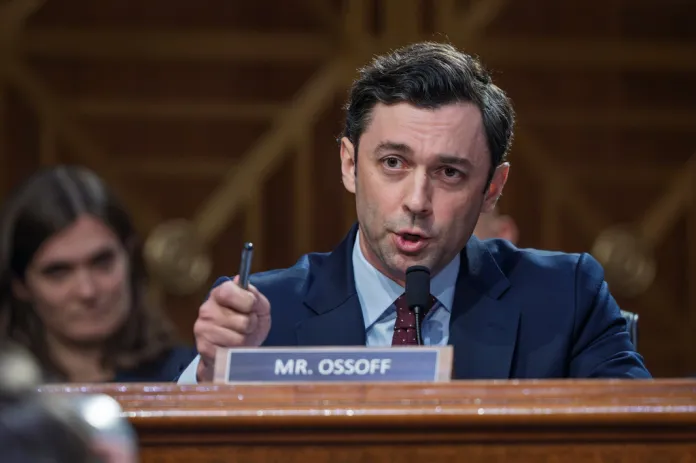
The boyish face that made him a cable news fixture during the 2017 Georgia special election, the one that Republicans in the 6th Congressional District hung in mailers next to the word “outsider,” has been replaced by something harder and more deliberate. He will often be seen on the campaign trail with rolled-up sleeves, sporting a more chiseled frame. His jaw carries more weight. When he goes after a Trump administration Cabinet member in committee, which he does with increasing regularity and to viral effect, the affect is not eager. It is controlled. The Obama cadence is visible in how he builds to a finish, the measured wind-up, and the precise landing.
Whether this is the natural maturation of a man moving through his 30s or a calculated repackaging ahead of what everyone in Washington can plainly see building toward is, in the Ossoff story, essentially the same question. The answer is probably both, which is what makes him interesting.
His political biography has the structure of a story Democrats badly need right now. In April 2017, at 29 years old, with no elective experience and a resume built on documentary filmmaking and a congressional staff job, he ran in a special election for Georgia’s 6th District. The seat had belonged to Republicans since Newt Gingrich won it in 1978. Tom Price had just vacated it to become Trump’s Secretary of Health and Human Services. Democrats, smelling blood in the Atlanta suburbs, poured money in. Ossoff raised $8.3 million before the first vote was cast. He finished first in a crowded field with 48.1% of the vote, nearly 30 points ahead of Republican Karen Handel, but fell just short of the 50% threshold Georgia requires to avoid a runoff. Two months later, Handel beat him, 51.8% to 48.2%.
It was, at the time, treated as a referendum Democrats lost. The most expensive House race in American history at the time, and they had nothing to show for it.
Three years later, Ossoff was back, this time challenging incumbent Republican Sen. David Perdue for a Senate seat. In November 2020, Perdue finished ahead of him with 49.7% of the vote to Ossoff’s 47.9%, again just shy of the majority Georgia law requires. Again, a runoff.
What happened between November 2020 and Jan. 5, 2021, is a matter of public record that the Ossoff campaign did not manufacture, but benefited from completely.
President Donald Trump spent the two months between the general election and the Georgia runoffs insisting the presidential election had been stolen from him. Perdue, to maintain good standing with Trump, had to buy into the narrative, and it cost him. It drove down Republican turnout in a state where the party’s voters were being told simultaneously that their votes would not count, but at the same time, the runoff election was the last line of defense. No one in Trump’s orbit could prove the fraud he hollered about. Georgia’s Republican secretary of state certified the results and said there was no evidence of fraud. None of it moved Trump. By the time Jan. 6 arrived and the Capitol was breached, Georgia had already voted. Ossoff beat Perdue by nearly 45,000 votes. The Senate split 50-50, and Vice President Kamala Harris would hold the tiebreaker in just two more weeks.
The loss of GOP Senate control set up the scenario for Joe Biden and the Democratic Party to pass the $2 trillion American Rescue Plan, which helped contribute to the inflationary spiral that lasted into late 2022.
Ossoff is now 37, in his first Senate term, and running for reelection in a Georgia that Republicans are convinced they can still win. He is also, whether he will say so or not, a figure Democrats are projecting something much larger onto. On Polymarket, the prediction market that has become a go-to gauge for pundits and the press, Ossoff sits at 14%, second only to Gov. Gavin Newsom (D-CA) at 19% in the 2028 Democratic presidential field, and ahead of Harris, Rep. Alexandria Ocasio-Cortez (D-NY), and every other name in the party.
For a first-term senator who has not won a general election since January 2021, it is a remarkable position to occupy. When asked directly, he gives the standard answer. He told CNN recently he has “no interest in running for president in 2028.” A senator genuinely uninterested in a presidential run does not publicly brand Trump’s advisers “the Mar-a-Lago mafia” or grill Secretary of War Pete Hegseth on the cost of the Iran war in exchanges clearly engineered for circulation. The “Epstein class” line. The “world’s most famous sore loser” characterization ahead of Trump’s primetime election-fraud address. Denying any interest in running for president before winning his Senate race is standard pablum, and certainly not his actual intentions.
What the clips and focused media attention do reveal is how carefully Ossoff has staked out the progressive positions along with the performance, while walking a tightrope that has become difficult for Democrats to walk in the current political environment. He does not use the language of the Bernie Sanders and AOC wing of the party. He does not call for Medicare for All or abolishing ICE. But he has pushed aggressively for Medicaid expansion, Affordable Care Act tax credit extensions, and a public option (which is essentially Medicare for All without the title). On immigration, he has run a formal Senate investigation into alleged reports of abuse in ICE detention facilities, called agents “roving gangs of masked men,” and fought the Trump administration’s plan to convert a Georgia warehouse into a detention center holding up to 10,000 immigrants. He’s ditched the slogans while still anchoring himself to those positions, but doing so in a way that he could still win Georgia in November.
What makes Ossoff’s positioning unusual, and what separates him structurally from other Democrats the base has chewed through in recent years, is that he is not paying the normal price (yet) for being what he is. His profile on immigration is enforcement paired with legal protections, a lane that requires him to hold two things at once without lurching toward either extreme. In any other Democratic cycle, the balancing act alone would be enough to draw fire. Whether that is the desire for Democrats to take control of Congress or a strategic lane remains to be seen.
The one place where Ossoff broke from the party’s mainstream, on some Israel military funding votes, buys him credibility that other Democrats casting the same votes would not enjoy. He is Jewish, and the votes carry a weight that a non-Jewish senator casting the same ballots would not enjoy. A statement his office released last July captures the balance he is trying to hold. He voted to block a sale of rifles to Israel, citing “the extreme mass deprivation of civilians in Gaza, including the intolerable starvation of children” under Prime Minister Benjamin Netanyahu’s government, and noted the weapons would likely have gone to police forces controlled by Minister Itamar Ben-Gvir. On the same night, he voted against blocking a separate sale of air-to-ground munitions, writing that Israel’s capacity to defend itself against rocket and missile attack depends on its air force. Hamas, he wrote, “a despicable terrorist organization, started this horrific round of conflict with the brutal massacre of October 7th, 2023.”
Whether that is a sincere expression of a position shaped by faith and identity or a calculated insurance policy against the attack line that comes from the Democratic Party’s progressive wing, including the Democratic Socialists of America faction that is openly hostile to Israel and gaining traction within the party, is the kind of question the Ossoff story refuses to answer cleanly, but it gives him some cover in the short term.
Compare him to Gov. Josh Shapiro (D-PA), another Jewish Democrat with national ambitions. Shapiro’s job approval sits near 60%. His crossover appeal with Republicans and independents is genuine and documented. Meanwhile, the far-left has spent two years calling him “Genocide Josh” for positions on Israel that are not all that materially different from Ossoff’s. The difference is not policy. Ossoff gives the base the performance they are looking for. He makes the fight visible. Shapiro, in an executive role, has to govern. The base does not want governance right now. It wants someone who will “fight,” and Ossoff is staking out that ground.
The DSA types who will come after him in a primary are a real problem, just not necessarily the most immediate one. His more pressing task is winning reelection in a state that his party has carried twice in four years, both times narrowly and under circumstances that may not recur. If he loses Georgia in November, the 2028 speculation collapses with it. There is no presidential primary lane for a one-term senator who lost his reelection bid. The entire architecture of the next chapter of his political life rests on holding a seat in a state Trump won, but by a little more than two points.
OSSOFF’S CAMPAIGN DOMINANCE PAYS OFF AS RACE SHIFTS HIS WAY
Rahm Emanuel, who has recently and accurately diagnosed the Democratic base’s hostility to its own winning Democrats with characteristic precision, is not particularly popular with the activist wing that has warmed to Ossoff. Emanuel argues the base rejects winning Democrats who don’t perform the fight. Ossoff is the counterargument, at least for now. The base will accept someone who performs the fight and hits the right symbolic notes, which means the disagreement was never really about ideology but rather about the kind of performative politics that has become part of the mainstream in today’s culture.
Whether Ossoff can hold that position, win Georgia, and keep the 2028 door open while the base’s patience for anything short of the full progressive program continues to thin is the question his career is currently structured around and remains to be seen. The predictive markets, the viral clips, and the new look and demeanor are winning people over for the moment.
Jay Caruso (@JayCaruso) is a writer living in Florida.