
ERIE, Pennsylvania — Long before the furthest left corner of the Commonwealth began welcoming millions of sunbathers, Presque Isle State Park served as a critical shield for a young nation.
During the War of 1812, the peninsula’s natural, 5.8-square-mile harbor provided the perfect sanctuary. Master mariner Daniel Dobbins recognized that a shallow sandbar across the bay’s entrance would protect American shipbuilders from deep-draft British warships.
Under the cover of Presque Isle’s dense forests, Commander Oliver Hazard Perry constructed a formidable naval squadron. In September 1813, Perry sailed this fleet out of the bay to win the pivotal Battle of Lake Erie, securing the Northwest Territory for the United States.
Perry himself did not coin the phrase “Don’t give up the ship,” as popular legend has it. In fact, they were uttered three months earlier by his close friend, Captain James Lawrence, who was mortally wounded. And his dying command to his crew actually was, “Don’t give up the ship! Fight her till she sinks!”
SALENA ZITO: HOW PITTSBURGH BECAME THE EARLY ALARM BELL FOR THE DSA’S RISE
Perry had women in Erie stitch the phrase in white bold letters across a large blue battle flag, then hoisted the banner aboard his flagship, using it as a visual battle cry to inspire his fleet to a historic American victory.
That battle cry is immortalized everywhere here. On the sides of buildings, beer bottles, school slogans, and festivals. There is even a flagship district, making it the defining cultural and commercial brand of the entire region.
Decades after its military service concluded, the peninsula transformed into a vital ecological escape hatch for the region’s industrial backbone. Indeed, it was the commonwealth’s only access to the Great Lakes. From the 1840s through the 1950s, it was an industrial powerhouse until changes in trade led to a decline in both manufacturing and its prominence as a commercial shipping port.
But in the mid-20th century, Presque Isle became the premier “ocean-like” vacation spot for blue-collar families originating from the steel, coal, and manufacturing hubs of Western Pennsylvania, Eastern Ohio, and West Virginia.
The park’s endless horizon and seven miles of sandy coastlines provided an affordable alternative to costly Atlantic coast travel for landlocked Appalachian communities.
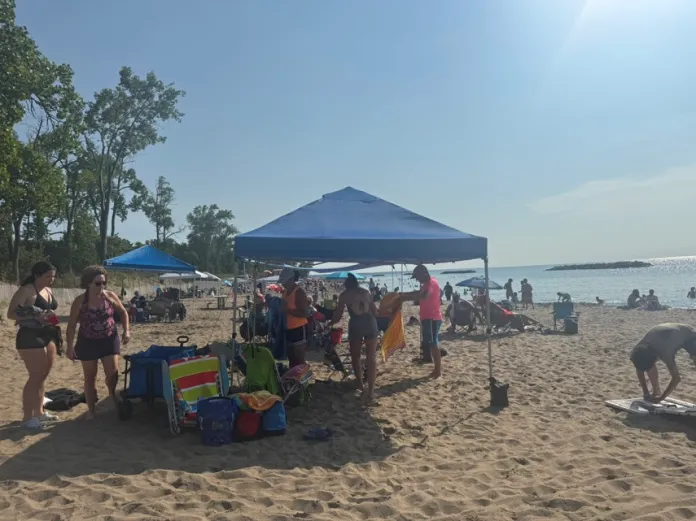
Entire generations of working-class families established traditions here, loading up station wagons for a taste of fresh, sweetwater surf without ever leaving the region.
This deeply rooted cultural draw eventually solidified into a massive economic engine for Northwest Pennsylvania. Today, the park acts as the financial heartbeat of Erie County tourism.
SALENA ZITO: META PARTNERS WITH TRADE CENTERS TO BUILD AI DATA CENTERS
Last Sunday, I made a trip to Presque Isle, something that I have been doing with my family since the 1960s. Back then, it was with all of us stuffed into a family station wagon stocked with four kids, two parents, a grandmother, and a large pot of homemade sauce, and another to boil water for the pasta to cook on the grills located in the picnic areas near the beach.
I don’t think that there has been a year since 1960 that I have not made the two-hour drive with some combination of my family in tow. Mostly, it has been the same experience. We pick a beach (there are 11) and make sure it has restrooms and changing areas, a park, and drag everything to the beach. Usually, we picked numbers 8 through 10, which are normally much less crowded than the 1-7.
I started at 11, and to my utter shock, it was packed. I’ve never experienced a packed Erie beach, at least not to this level. It was the same at 10, then 9, in fact, the closer I drove toward beach 1, the more crowded it was. People were parked on the grass, in areas that have hundreds of sandy parking spaces.
And families of all shapes, ages, and sizes were everywhere. The city of Erie has one of the largest refugee communities in the state, and hundreds of families — many of them women from their large Bhutanese population dressed in modest colorful wraps — were schlepping children, coolers, chairs, blankets, and a ton of anticipation for a day at the beach.
So what is going on? Pre-pandemic, Presque Isle was doing well, but had flatlined under 4 million visitors per year. Notably, visitors include not just the beach but also the 17-mile bike and walking trail along the back side of the beaches, as well as boating, ski-dos, world-class angling, and, in the winter, ice fishing and snowshoeing.
Outdoor recreational travel surged drastically, driven in part by indoor closures in 2020. Annual visitation jumped to 5 million visits, then stabilized in 2024. But usage started surging again last year, nearing the 5 million mark.
Americans have found that they enjoy vacationing in their own backyard, with the average visitor traveling for the day or the week, driving anywhere from 25 to 120 miles. All to enjoy the sandy beaches, the massive waves, and oftentimes to connect to a place that was so important to their parents and grandparents that they want their children and grandchildren to have the same experiences.
It’s a place for both the not-so-famous and the famous to enjoy. Pennsylvania Gov. Josh Shapiro, along with both of the state’s U.S. senators, David McCormick and John Fetterman, are big fans, both personally and professionally. They’ve campaigned heavily here, and spent the day at the beach or walking the trails. Fetterman recently announced $1.5 million in federal funding for the Presque Isle through his personal effort with Assistant Secretary of the Army-Civil Works Adam Telle to identify available funds for the park’s shore protection.
SALENA ZITO: GLENN YOUNGKIN MAKES THE CASE FOR NEW FEDERAL EDUCATION TAX CREDITS IN PENNSYLVANIA
Fetterman, ever gracious, said he was grateful that Telle took his call to get the funding secured and thanked McCormick, local Rep. Mike Kelly, and the local and state legislators for their advocacy for the project.
“Presque Isle is an iconic Pennsylvania destination that my family and I have the pleasure of visiting often. It’s one of our favorite spots and everyone should be able to enjoy it. We should be doing everything we can to ensure places like Presque Isle continue to thrive environmentally and economically,” he said.