
Latin America’s great contribution to literature is magical realism, the style Gabriel Garcia Marquez made famous: Impossible events unfold in an ordinary world, and everyone accepts them as natural. Ghosts have breakfast with the living, time folds back on itself, and the extraordinary becomes routine. Spend enough time following Venezuelan politics, and you start seeing it everywhere.
This past week in Caracas offered another chapter. An American congressman celebrated Venezuelan democracy. Washington’s most influential Republican lobbying firm opened an office before the country has held a free national election. More than $13 billion in Venezuelan oil revenues accumulated with little public accounting. Negotiations over Venezuela’s democratic future began without the Nobel Peace Prize winner who made them possible.
Individually, each seems almost plausible. Together, they read like magical realism.
The administration deserves credit for outcomes critics called impossible. Six months after U.S. forces captured dictator Nicolas Maduro, Venezuela hasn’t descended into another Iraq or Libya. Oil production has climbed from roughly 800,000 barrels a day in January to 1.1 million by June. Hundreds of political prisoners are free, opposition parties operate openly, and after June’s earthquakes, Washington responded fast, with humanitarian aid and military assets for disaster relief. An estimated $37 billion reconstruction bill remains unanswered, but the immediate response was real.
Yet two realities can exist at once.
Find the Venezuelan whose grocery bill reflects it. Annual inflation exceeded 70% in the first quarter. Even after April’s wage increase, the minimum salary falls well short of the canasta básica a family needs. Nearly 8 in 10 Venezuelans live in poverty. Hospitals and schools are broken. Electricity and water remain unreliable. Personal security still shapes everyday life. Oil production is rising. Living standards are not.
As Ronal Rodriguez of the Spectator put it, “Everything has changed, and nothing has changed.” The faces in power have changed. Access to oil wealth has changed. The underlying structure has not. The administration itself describes its strategy as stabilization, then economic recovery, then democratic transition. Democracy exists. It simply waits patiently at the end of the line.
The contradiction sharpens once you look at who Washington protects.
This month, the Justice Department argued that Delcy Rodriguez is immune from a $314 million judgment over the torture of three Americans, because Washington recognizes her as head of state. Her interim mandate expired last month. In most democracies, that would end a presidency. In Caracas, they continue governing, as though calendars were merely advisory.
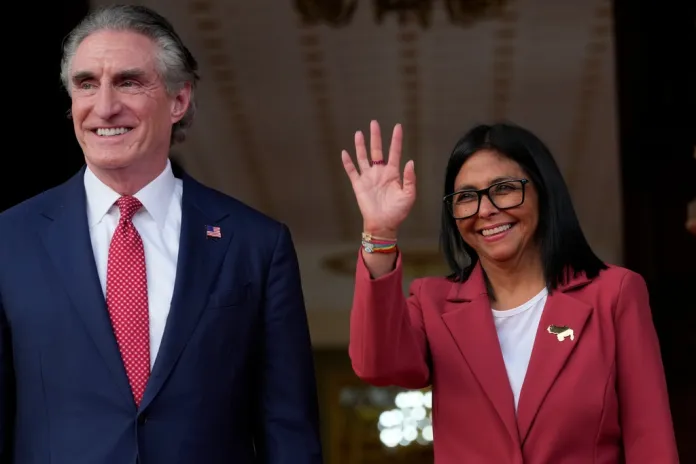
Benjamin Gedan, a former National Security Council director for South America, put it bluntly: While Secretary of State Marco Rubio tries to broker talks with the opposition, President Donald Trump is simultaneously providing “legal and public relations services for Delcy.”
Ballard Partners opening a Caracas office before a single free election reflects where influential actors see the opportunity. Partner Scott Wagner called Venezuela “the threshold of one of the most significant economic openings in the hemisphere in a generation.” Lobbyists rarely arrive before democracy. They almost always arrive before contracts.
The same pattern extends into Venezuela’s oil industry.
Alejandro Betancourt Lopez, one of the Chavez-era bolichicos, is reportedly back running major operations in Zulia despite active money-laundering investigations in Switzerland and legal proceedings elsewhere. None of it is proven, and Betancourt disputes it. Even so, the pattern is hard to ignore: Old-guard figures keep finding their way back into the country’s most valuable industry, while Washington protects the government overseeing the transition.
Then there is the person missing from the room.
Maria Corina Machado, the Nobel laureate who commands roughly 80% public trust, more than 16 times Rodriguez’s own, vanishes from the room every time negotiations begin, and no one ever explains the trick.
House Foreign Affairs Committee Chairman Brian Mast (R-FL), who led a congressional delegation to meet both Rodriguez siblings in Caracas in July, has separately told the Council on Foreign Relations, “You actually have democracy flourishing there.”
An optimistic read for a country where the person most responsible for reopening democratic politics was absent from the negotiations deciding what comes next. Gedan puts it plainly: The administration is “boxing out the leader of the opposition, reluctant to rock the boat.” If magical realism has a political equivalent, it’s a democracy whose most trusted leader disappears whenever the future is negotiated.
Then there is the number that still refuses to explain itself.
The Financial Times and others estimate the U.S. has collected more than $13 billion from Venezuelan oil since January. Venezuela’s own transparency portal accounts for only a fraction of it, while official explanations have shifted from roughly $3 billion to more than $6 billion in authorized disbursements. KPMG was hired for quarterly audits. Two reports are overdue.
None of this proves wrongdoing — oil moving through sanctions licenses, escrow accounts, and debt settlements is genuinely hard to trace. But complexity argues for more transparency, not for leaving billions unexplained while millions of Venezuelans can’t afford the canasta básica.
Viewed separately, these developments appear unrelated. Viewed together, they describe a transition organized around commercial opportunity and political stability rather than democratic legitimacy.
Ending Maduro’s rule was a genuine achievement, and the recovery is real. But recovery and democratization aren’t the same accomplishment. Washington’s own sequencing — stabilization, economic recovery, then democratic transition — concedes the distinction. The question is whether that third stage ever arrives.
AMERICA KEEPS WINNING BATTLES WHILE LEAVING REGIMES STANDING
The genius of magical realism was never making the impossible believable — it was making the impossible feel ordinary. Venezuela deserves better than a government that runs on those rules. If Washington wants a democratic transition to be more than rhetoric, it should publish the overdue audits, stop treating temporary arrangements as permanent institutions, and give Venezuela’s democratic opposition the seat it has earned.
Otherwise, magical realism stops being a literary tradition and becomes the most accurate description of how Venezuela is governed.