
A report that the Justice Department has convened a rare special grand jury in Washington has raised questions about how the little-used investigative tool works and what, if anything, U.S. Attorney Jeanine Pirro plans to use the rare investigative move to advance.
Special grand juries can investigate alleged federal crimes, much like ordinary grand juries, but they carry a significant additional power. In limited circumstances, they can issue a public report about details from an investigation that are normally kept hidden from public view when prosecutors do not bring criminal charges.
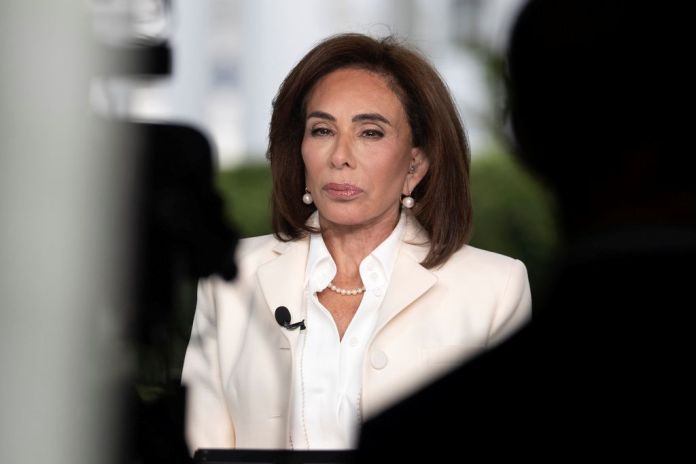
On Wednesday morning, the Washington Post cited three anonymous government officials who said that Pirro’s office assembled a special grand jury and that special counsel Steven Vandervelden would oversee it. Asked about the report, a spokesman for Pirro did not deny that a special grand jury exists in a statement to the Washington Examiner but said, “We don’t confirm or deny the existence of investigations.”
The reported panel’s mission is unknown, though Pirro has relied on Vandervelden to investigate some of her most high-profile cases, including an investigation into then-Federal Reserve Chairman Jerome Powell and an inquiry into allegations that the Washington, D.C., police force purposely skewed its crime statistics, which resulted in 13 officers getting placed on leave earlier this year.
Other cases Vandervelden has reportedly played a role in have faced larger setbacks, including the failure to secure indictments against six Democratic lawmakers over a video advising military and intelligence personnel to reject unlawful orders.
Still, the special grand jury’s reported formation comes as President Donald Trump has publicly pressed the Justice Department to pursue perceived political adversaries and as Pirro faces her own scrutiny from the president over a recent decision to drop a case against former Olympian David Hearn.
Pirro’s office last week moved to dismiss charges against Hearn, whom prosecutors accused of vandalizing the Lincoln Memorial Reflecting Pool. The government said it determined the purported damage resulted from a faulty installation, not vandalism. Trump publicly criticized the decision, saying Pirro “choked” by moving to dismiss the charges, and called for the case to be revived.
The officials cited by the Washington Post said paperwork to establish the special grand jury was submitted before Pirro’s office sought dismissal of the Hearn case. The timing has added to questions about the purpose of the reported panel, although no evidence has emerged linking it to the Hearn matter.
A special grand jury differs from the ordinary grand juries prosecutors regularly use to seek indictments. It can investigate alleged violations of federal criminal law in the district, its proceedings generally remain secret, and prosecutors must establish probable cause to obtain an indictment.
The key difference is the potential for a report. Under the United States Code, a special grand jury may submit a report about noncriminal misconduct by an appointed public officer or employee when it involves organized criminal activity. The report may recommend removal or discipline even if no one is charged.
It cannot be a free-standing political review. Any report must arise from an authorized criminal investigation, be supported by a preponderance of the evidence, and receive court approval before release. A person named in one must have an opportunity to testify and present defense witnesses.
Former federal prosecutor Neama Rahmani said a public report can sometimes provide a mechanism to explain why evidence did not support charges in a politically unpopular case. He said that prosecutors’ decision to dismiss the Hearn case without prejudice, for example, means prosecutors could pursue the case again and that a special grand jury report could, in theory, lay out why a prosecution was not warranted.
“It’s the only time a prosecutor wants to ‘lose’ before the grand jury,” Rahmani said, offering a possible rationale for the special grand jury’s formation.
Hans von Spakovsky, a senior legal fellow at former Vice President Mike Pence’s think tank Advancing American Freedom, said the scope of reporting authority is what most distinguishes a special grand jury from a conventional one.
“That means that this special grand jury could go after employees in the federal government who engaged in misconduct during the Biden administration and are still employed there,” Spakovsky said.
While not aware of the specific intent behind the special grand jury, he added that a potential inquiry could, in theory, examine alleged suppression of “the Biden family corruption,” among other possible misconduct.
For a historical comparison, Spakovsky pointed to the public report issued after a federal grand jury investigated fraud in Chicago’s 1982 Illinois election. In a paper he authored back when he was at the Heritage Foundation, he stated the report was released in 1984 after an investigation that resulted in 65 federal election crime indictments.
The mechanism is unusual in the District of Columbia, in part because Washington falls below the population threshold requiring a special grand jury. Because of this, the chief judge would receive written certification from the attorney general, another senior DOJ official, or a designated assistant attorney general that one is necessary because of criminal activity in the district.
DOJ WON’T RULE OUT NEW CHARGES FOR REFLECTING POOL VANDALS AS TRUMP CALLS TO REVISIT DROPPED CASES
The filing would go to Chief Judge James Boasberg, though Rahmani said a judge is not required to sign off on the special grand jury’s formation. It is unclear whether Attorney General Todd Blanche, another listed official, or a properly designated assistant attorney general authorized any certification.
Once impaneled, a special grand jury normally serves 18 months, though a court can extend it in six-month increments, generally up to 36 months.