
Open any newspaper and the word “genocide” is everywhere, attached to a conflict now in its third year of international litigation, endlessly debated by legal scholars, contested by governments, and argued over in United Nations chambers and on cable news alike. Reasonable people disagree about it, and that disagreement drives coverage.
Then there is Sudan. In January 2025, the United States government designated the Rapid Support Forces’ campaign in Darfur a genocide. No serious government contests the finding. And for three years, the International Criminal Court, the institution supposedly built for exactly this purpose, has not sought a single new arrest warrant over it.
America named the crime. The court shelved the warrant. A Gulf ally helped fund the perpetrators. That gap is not two separate failures. It is one failure with a single cause: an institution too weak to act alone and too exposed to great-power relationships to act when it matters.
The shelved warrant
Middle East Eye reported this month that the Office of the Prosecutor had an arrest warrant application ready to file against a commander of Sudan’s Rapid Support Forces. The application concerned crimes against humanity and war crimes in West Darfur dating to the war’s outbreak in April 2023. The office shelved it.
This is not a story about an overwhelmed institution struggling under an impossible caseload. It is a story about a specific promise the prosecutor’s office made and then abandoned when they thought no one would notice.
The promise
In January 2025, then-Chief Prosecutor Karim Khan told the U.N. Security Council that his office was “taking the necessary steps to put forward applications for warrants of arrest” over Darfur. He described widespread sexual violence, destroyed communities, and mounting evidence gathered by investigators. Eighteen months later, no warrant has been filed.
Washington sanctioned RSF commander Mohamed Hamdan Dagalo, known as Hemedti, the same month Khan made his promise. The fall of El Fasher to RSF forces in October 2025 drove tens of thousands of refugees into Chad. None of it produced a warrant.
Days after the Middle East Eye story broke, Deputy Prosecutor Nazhat Khan told the BBC during a visit to refugee camps in Chad that her office had achieved a “breakthrough.” The timing is not subtle. A breakthrough announced immediately after an embarrassing leak is public relations, not accountability.
Asked about the shelved application, the Office of the Prosecutor declined to explain itself, citing a “duty of confidentiality.” In this context, the phrase functions as a shield.
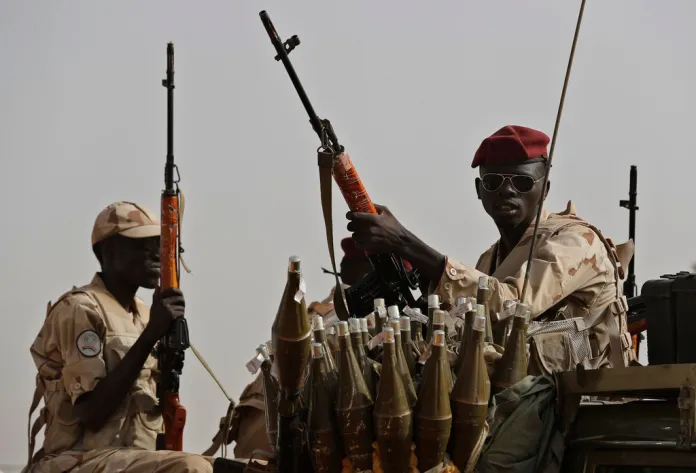
The Gulf ally the warrant would have implicated
The shelving makes more sense once you follow the money. The RSF does not arm and sustain itself in isolation. In January 2025, the Treasury Department sanctioned seven UAE-based companies, under the same executive order used against Hemedti, for financing the RSF. A U.N. Panel of Experts and a U.N. Fact-Finding Mission have documented weapons and cargo flights moving from the United Arab Emirates toward RSF-held territory since 2023. Le Monde reported in March 2026 on a covert air corridor running through the Central African Republic and Chad to disguise the origin of the shipments. Sudan’s government has accused the UAE of complicity in genocide, and on July 15, 2026, its deputy U.N. representative asked the ICC to expand its investigation to include Emirati actors by name.
The UAE denies the allegations and points to an earlier U.N. panel report that reached no findings against it, along with the International Court of Justice’s dismissal of a related case brought by Sudan. What remains undisputed is that any serious investigation beyond militia commanders quickly approaches a wealthy Gulf state that buys billions of dollars in American weapons, hosts a growing U.S. security partnership, and has pledged large humanitarian assistance to the same crisis.
A court that has never successfully prosecuted a sitting head of state, let alone a well-connected Gulf patron several steps removed from the killing, was never built to survive that kind of case. Shelving the warrant was the path of least resistance. It reflects the court’s central weakness: an institution with no enforcement power of its own ultimately bends to states with greater leverage.
What accountability actually looks like in this docket
The court is not entirely empty-handed on Sudan. That only makes the pattern clearer. Ali Muhammad Ali Abd-Al-Rahman, a mid-level Janjaweed commander, was convicted for crimes committed in 2003 and 2004 after voluntarily surrendering in 2020. It remains the court’s lone successful Darfur prosecution.
The men who directed Sudan’s Darfur policy are a different story. Omar al Bashir has had a warrant outstanding since 2007. Ahmad Harun and Abdel Raheem Muhammad Hussein have had warrants outstanding since 2007 and 2012. All three remain free.
The scale problem underneath it
This is not unique to Sudan. As of November 2025, the ICC has issued roughly 65 arrest warrants across its 24-year history. Only 21 have been implemented by 2025, while more than 40 suspects remain at large. The court’s 2026 budget approaches 197 million euros. Sudan alone accounts for three outstanding warrants, plus a fourth application that never reached a judge.
Even the body theoretically responsible for backing the court’s warrants remains divided. When the institution meant to enforce the warrants cannot agree that they are worth enforcing, the warrants become theoretical.
What this actually shows
Sudan is the plainest test case the ICC has been handed in years: a genocide the U.S. government has already named, a responsible commander already sanctioned, three years of investigation, and a specific promise to the Security Council. The result is a shelved application, a defensive “breakthrough” announcement timed to a leak, and three command-level warrants that have gone unenforced for nearly two decades.
RUBIO IS RIGHT: THE ICC SHOULD BE DISMANTLED – BRICK BY BRICK
An institution that cannot close this case is not failing on the margins. It is failing at the center of its founding purpose. It thrives on political theater and selective outrage while proving incapable of delivering accountability when the facts are clearest, and the politics are hardest.
Marco Rubio’s promise to dismantle the ICC “brick by brick” has drawn predictable outrage from the court’s defenders. Darfur is the brick they should be forced to explain first. If the court cannot act on an uncontested genocide while a U.S. Gulf ally is credibly linked to financing the perpetrators, the institution has forfeited the benefit of the doubt.