
On a Thursday afternoon, as Jews across the world sat on low stools and read the Book of Lamentations to mark Tisha B’Av — the fast day that mourns the destruction of the First and Second Temples and the long catalog of catastrophes that have befallen the Jewish people ever since — a man stabbed two people in the Upper West Side of Manhattan while shouting “Allahu Akbar.”
The first victim, a 57-year-old man, was attacked near West 84th Street and Central Park West. The second, a 50-year-old man wearing a kippah, was stabbed in the chest near 86th Street and Amsterdam Avenue, half a block from The Jewish Center, a modern Orthodox synagogue where he had just finished praying the Mincha service on the saddest day of the Jewish calendar.
New York Police Department Commissioner Jessica Tisch identified the suspect as a 51-year-old male. Both men survived. By that Friday, prosecutors had charged the attacker with hate crimes. Comptroller Mark Levine identified the victims as Chok Sung and Moshe Yezhak Grunhaus.
Tisch was careful to note that detectives were still working to determine motive, and that mental illness may have been a factor. Well, yes, I don’t think anyone who commits a crime like this is exactly mentally stable — though, of course, he should still be held responsible for his actions like anyone else. Yes, nobody yet knows with certainty what was in the attacker’s head when he lunged at a stranger leaving a synagogue on the holiest day of Jewish mourning. What we do know is the atmosphere into which that attack landed — and that atmosphere did not appear from nowhere.
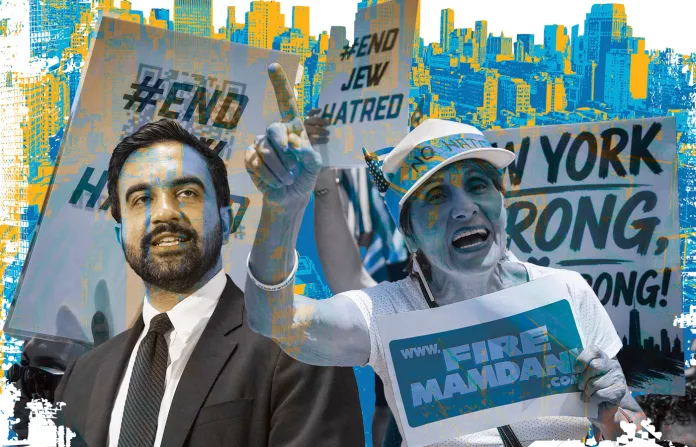
Two days earlier, on July 21, Mayor Zohran Mamdani released a two-minute video to his millions of social media followers. He opened by calling Israeli Prime Minister Benjamin Netanyahu “a war criminal, the architect of a horrific genocide against the Palestinian people.” He announced that his administration had examined every legal avenue and concluded that New York City could not execute the International Criminal Court’s arrest warrant against Netanyahu, so he called on the federal government to do it instead. And he declared, in case anyone had missed the point: “Benjamin Netanyahu is not welcome in New York City, nor is any other war criminal at large.” The video, by the account of one outlet that covered it, had been viewed more than 80 million times within a day.
I do not think it is a coincidence, or at least not merely one, that a Jewish man was stabbed outside a synagogue on Tisha B’Av 48 hours after the mayor of New York City used the word “genocide” to describe the leader of the Jewish state, and did so in a video that made no mention whatsoever of the Hamas-led massacre of Oct. 7, 2023, that started the war he was describing. I made this argument about Mamdani before he was ever elected, and I made it again after he took office. I wish, more than anything, that I had been wrong.
Readers of this magazine may recall that I wrote about Mamdani before now: Once while he was still a candidate, warning that beneath the inclusive imagery of his campaign lay a genuine unease among Jewish New Yorkers, and again shortly after his inauguration, when his very first acts in office included rescinding his predecessor’s executive orders combating antisemitism — the order barring city agencies from boycotting or sanctioning Israel, and the order adopting the International Holocaust Remembrance Alliance’s working definition of antisemitism. A coalition of major Jewish organizations — the UJA-Federation of New York, the Jewish Community Relations Council, the Anti-Defamation League, Agudath Israel of America, the New York Board of Rabbis, and the Orthodox Union — has put out a joint statement calling the move a reversal of “significant protections against antisemitism.” The Israeli foreign ministry, in a striking phrase, accused him of pouring “antisemitic gasoline on an open fire.”
I did not write those pieces because I relished the prospect of being proven right. I wrote them because the pattern was already visible: A mayor who had spent his campaign refusing to unambiguously condemn the phrase “globalize the intifada,” who had pledged to have Netanyahu arrested if he set foot in New York, and who treated Israel not as a foreign policy question on which reasonable people disagree but as a singular moral emergency deserving of uniquely inflammatory language, was going to keep speaking and governing that way once he held the reins of the largest police force and the largest Jewish community outside Israel itself. He has. And we are now starting to see the results.
Words, and what they do
Rabbi Dr. Josh Joseph, the executive vice president and chief operating officer of the Orthodox Union, told Fox News Digital after Mamdani’s Netanyahu video that the mayor “needed to remember that his words matter” and warned that he was “willing to risk inciting further violence based on misinformation.” That was Wednesday. By Thursday afternoon, a man was screaming “Allahu Akbar” as he stabbed a Jewish New Yorker outside his synagogue.
I put the question of what this moment means to Pamela S. Nadell, a professor of history at American University and the author of the recent award-winning book Antisemitism, an American Tradition. She replied to me in the following way: “Hateful rhetoric fans flames that can ignite violence. At a time when Jewish New Yorkers face rising threats and antisemitism, I join the many New Yorkers urging their mayor to turn away from his anger toward Israel and devote himself fully to the job he was elected to do: protecting every resident of the city he serves.”
That is not, it should be said, a claim that Mamdani caused a stabbing. Nadell is a careful historian, and she would be the first to say that no single video creates a violent man out of nothing. But her point is a subtler and, I think, a more important one: that words from people who hold power do not float freely above the societies in which they are spoken. They settle into the air people breathe. They tell the aggrieved and the unstable and the merely impressionable what and whom it is permissible to hate, and how loudly. A mayor is not a podcaster shouting into the void. He commands the NYPD, sets the civic tone for 8.5 million residents, and speaks with an authority that trickles down into every precinct, every subway car, and every mind already primed toward violence for reasons that have nothing to do with him. When that authority is used, again and again, to brand the world’s only Jewish state and its leader with the most inflammatory word in the modern moral lexicon, genocide, while offering no acknowledgment of the massacre that began the war, it does not merely describe a foreign conflict. It teaches New Yorkers, including the unwell and the unmoored, that Jews and the things Jews hold sacred are fair targets for the deepest possible contempt. As David Wolpe, rabbi emeritus of Sinai Temple in Los Angeles, told me: “When a public figure witnesses rising hatred against any group, then chooses language that can reasonably be expected to inflame that hatred, whatever his stated intentions, his words both stoke division and can become a catalyst for violence.”
To his credit, Mamdani did not stay silent after the stabbing. He called the attack “horrific” and said on X that he was “thankful” hate crime charges had been filed, adding: “This kind of despicable violence is not who we are as a city.” I take him at his word that he means this. But sincerity after the fact does not erase the responsibility to consider, beforehand, what a video watched 80 million times might do to a city already on edge. A mayor who wants to be taken seriously as a guardian of every New Yorker’s safety cannot also be the city’s most prominent amplifier of the claim that the only Jewish state, and by extension the overwhelming majority of Jews who feel some connection to it, are the perpetrators of the worst crime human beings can commit against one another.
A connection older than the mayor’s office
It is worth pausing to consider why “genocide” and “war criminal” land so differently on Jewish ears than they might on others’. For the overwhelming majority of American Jews — not merely the Orthodox, not merely the political Right — a connection to the land of Israel is not an optional policy preference to be adopted or discarded like a position on zoning reform. It is woven into Jewish liturgy, into the prayers we recite three times a day, into the fast days like the one interrupted by Thursday’s stabbing, and into our historical memory that runs through pogroms, expulsions, and the Holocaust into the founding of a state whose very existence was, for many of us, the difference between survival and annihilation. To tell a Jewish New Yorker that the leader of that state is committing genocide is not, for most of them, a narrow critique of a prime minister’s policies. It reads as an accusation leveled at something close to the core of Jewish identity itself. A mayor is entitled to his views on the war in Gaza, as fierce and as critical as he likes. He is not entitled to be surprised when rhetoric pitched at that register, deployed with that repetition, and stripped of any accounting for Oct. 7, makes an already anxious community feel that City Hall sees them as suspects rather than as constituents.
That, more than any single video or any single act of violence, is the greater danger Mamdani is courting. New York City has spent more than two centuries building something close to unprecedented in human history: a metropolis in which Jews, Muslims, Christians, Hindus, Sikhs, and every other faith and ethnicity on Earth largely coexist, compete, and even flourish alongside one another without descending into the kind of communal warfare that has defined so many other multiethnic, multireligious societies. That achievement is fragile. It has never been guaranteed by law or geography — it has been sustained by civic norms, by the shared understanding that no religious or ethnic group is to be collectively blamed for the actions of a foreign government or a terrorist organization, and by leaders willing to enforce that norm rather than erode it. Importing the zero-sum, blood-soaked politics of the Middle East into the heart of American civic life — treating a New York mayoralty as a platform for adjudicating who among 8.5 million New Yorkers belongs to the side of the righteous and who belongs to the side of the guilty — is not a continuation of that American tradition. It is a break from it.
THE MAMDANI LEFT ISN’T GOVERNING — IT’S CLOUT CHASING
Nobody can say with certainty whether last month’s attacker had ever watched Mamdani’s video or cared what the mayor of New York thinks about Netanyahu. But certainty about a single man’s motive was never the point. The point is the climate a city’s chief elected official helps to create, message by message, and what that climate permits people already inclined toward violence to imagine is acceptable. New York’s Jewish community does not need its mayor to agree with every Israeli policy. It needs him to stop speaking about the Jewish state and its leadership in terms so absolute, so detached from context, and so frequently repeated that they function less as foreign policy commentary and more as a standing invitation to see Jews as a people apart — a people whose grief, even on their saddest day of the year, can be interrupted without much civic reckoning.
New York built something extraordinary over the past 250 years: a model for the world that has shown people how we can coexist, and even occasionally love one another, not in spite of our differences but because of them. That inheritance is worth defending, loudly and without equivocation, by New Yorkers of every background — and especially by the man who leads them.
Daniel Ross Goodman (@DanRossGoodman) is a Washington Examiner contributing writer and teaches theology and religious studies at St. John’s University. His next book, Dante’s Guide to Life: How The Divine Comedy Can Change Our Fortunes, Our World, and Ourselves, will be published this fall by Angelico Press.