
What if, in celebration of America’s 250th birthday, we eschewed UFC fights on the White House lawn and Grand Prix races around the streets of Washington, D.C., and instead buried our heads in an eclectic and engaging volume of short takes on all manner of quintessentially American phenomena?
Happily, this idea, inspired and inspirational, is no longer aspirational. 250 Great American Things comes from County Highway, the offbeat outlet that boasts of publishing “America’s Only Newspaper,” a broadsheet “produced by actual human beings” covering “political and spiritual crises” as well as everything from agriculture to living off the grid.
Quietly, County Highway — and its book-publishing arms, Hard Cider Press and Panamerica — has become a main artery for an impressive array of contributing writers from disciplines beyond journalism: the odd biologist, rancher, herbalist, filmmaker, infantryman, or economist. The roster has also included revered novelists Thomas McGuane and Richard Russo; Brat Pack survivor Tama Janowitz; the late Martin Mull; Amanda Fortini, late of the New Yorker and Paris Review; Krist Novoselić, formerly Nirvana’s bassist; and David Samuels, the veteran journalist who cofounded and edits County Highway.
250 Great American Things is organized alphabetically — starting with A River Runs Through It, Abbie Hoffman, abolitionism, Acme Corporation, Afros, and so on — and thus randomly. This makes the volume untenable as a narrative but irresistible as a reading experience: one of those books you can savor in short bursts, put down and return to at intervals of varying length, and resume at any page, with no diminution in enjoyability. For some, this may make the present volume “Not a Proper Book,” but County Highway encourages irreverence in the conveyance of substantive ideas.
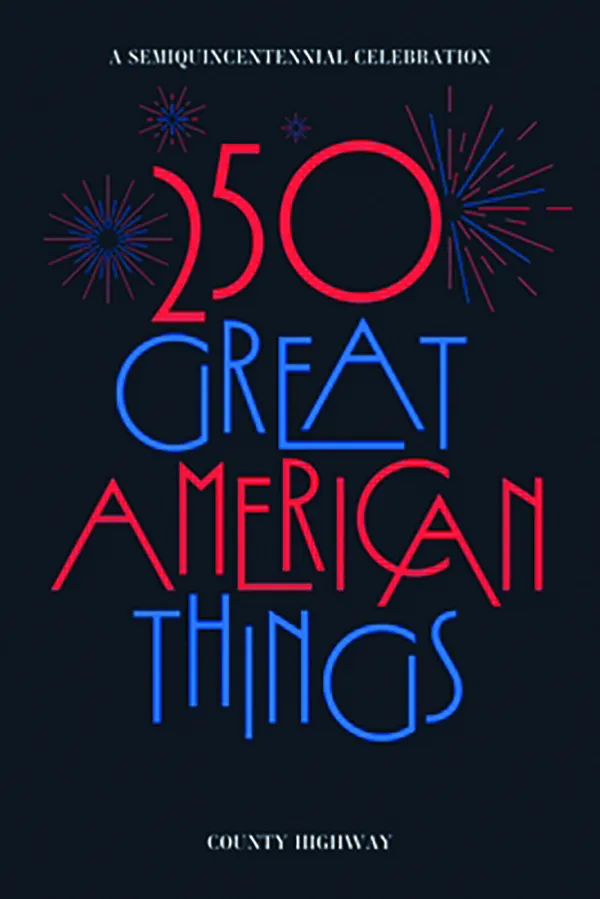
Edited by County Highway; Hard Cider Press; 409 pp.; $25.00
Near the outset, the editors establish their knack for felicitous pairings of subject and author. Written by Ian Frazier, the humorist and author of such renowned collections as Dating Your Mom (1986), the entry on the Acme Corporation revisits a hilarious story Frazier published many years ago in the New Yorker entitled “Coyote v. Acme.” It was rendered in the style of a civil suit filed by the Looney Tunes character Wile E. Coyote against the manufacturer of the Rocket Sled, the Self-Guided Aerial Bomb, and dozens of other defective contraptions the doomed mammal employed, in vain, to entrap his bird of prey, Road Runner, often causing the plaintiff catastrophic personal injury.
“Coyote v. Acme” was so funny that, in that pre-internet era, I actually made photocopies and sent it to friends. Here we learn the grim personal events that planted the seed for the story in Frazier’s mind, as well as the fact that a film based on it, optioned for Hollywood nearly a decade ago and shelved after being filmed, is slated, finally, to see theatrical release later this year. “I’m glad,” Frazier writes, “that sometimes writing humor can take that kind of lucky bounce.” However, this entry, rare in its autobiographical content, also exposed a fact-checking failure: Frazier mistakenly dates his own essay to 1992; in fact, it was published in 1990.
Twenty-five letters and 389 pages later, 84-year-old Jonah Raskin — the ex-radical who enjoyed adjacency to the Weather Underground and helped his former Yippie compatriot, Abbie Hoffman, when he went underground — presents a short history of the zipper, invented by Chicago-born engineer Whitcomb L. Judson (1843-1909). The sketch ends with George Burns’s immortal take on mortality: “First you forget names, then you forget faces. Next you forget to pull your zipper up, and finally you forget to pull it down.”
Raskin’s earlier entry, on his old friend and biographical subject in For the Hell of It: The Life and Times of Abbie Hoffman (1996), reveals the intermittent dubiety of the editorial decision-making behind 250 Great American Things. Of course, not every great American thing, person, or phenomenon could or should be covered. But did we need 1,775 words — second only to the entry on the Frontier, which received 1,838 words — on the colorful but historically irrelevant Chicago Seven prankster and nothing at all on Muhammad Ali, whose multifaceted genius and influence, down even to his tragic demise and Olympian rebirth in Atlanta, were unique and globally felt? Nor is there a word for Howard Cosell, another American original heard ’round the world; nor for Roone Arledge, the ABC executive who beamed Ali-Cosell, and many other sports and news innovations, to the masses.
Likewise, there is an entry on The Honeymooners, by National Book Award finalist Jim Shepard, extolling the seminal 1950s sitcom, but nothing on The Dick Van Dyke Show, The Price is Right (or any game shows), or The Family Guy (not to mention personal favorites The Odd Couple, Mad Men, or Police Squad). Chuck Berry, Elvis Presley, and Sun Records receive entries, but Robert Johnson, Philip Glass, and Motown do not. Yes to entries for Tupac, Lou Reed, Scooby Doo, Brad Pitt (separate from A River Runs Through It), the Unabomber, and Jerry Wexler; not a word for Alex Haley, Neal Adams, Salk and Sabin, or Steven Spielberg. We get Teddy Roosevelt but not Franklin, “the Kennedys” but not Nixon — a County Highway sign that they forgot FDR and RN each ran on the national ticket five times.
Again, anyone compiling lists, rankings, and the like will invariably draw criticism for omitting the worthy, but some of the choices seem arbitrary at best. Why the First and Second Amendments but not the Tenth, which specified that all powers not explicitly assigned to the federal government belonged to the states and the citizenry, or the Fourteenth, which guaranteed “equal protection of the laws” to all people? Indeed, why not devote those two slots to the Constitution — the greatest of American things — and the Bill of Rights?
Still, 250 Great American Things offers something fun and informative on every page and succeeds in reminding readers — never more urgently needed — of so many of the breakthroughs and triumphs that converged to make ours the richest, strongest, most powerful and migrated-to nation on Earth.
Novoselić’s account of joining the Grange in 2004 — “it changed my life” — is both personal and historical. “One hundred years ago, one in three Americans were members of a fraternal group,” he observes. “Since the cultural shift of the 1960s, membership in these groups has dwindled.” I had never heard of the group but learned here that it was founded in 1867 — official name: National Grange of the Order of Patrons of Husbandry — making it the oldest agricultural advocacy group in America, with women admitted as equal members all along.
DAVID MCCOLLOUGH’S AMERICA IS OUR AMERICA TOO
With his entry on another largely forgotten group in American life, Samuels traffics in the “solemn introspection” the promotional copy for the book promised to forswear, presenting twin visions of the United States as it exists in conception and reality:
“If we were righteous, instead of insolent, striving, and greedy; if we agreed to live peacefully together in accordance with God’s Word; if we honored our parents and ancestors and the land from which we draw sustenance; if we walked humbly upon the earth; if we read our Bibles seriously and obeyed the commandments; if we were industrious rather than slothful; if we refused to fight bloody wars against other nations in which thousands and sometimes millions of innocent people die, regardless of the rightness or wrongness of any particular cause, we would not be Americans — not by a long shot. Instead, we would be Amish, or something very like the Amish.”
Surveying the subjects on display in 250 Great American Things — dive bars, Dr. J, Dr. Seuss, drag racing, drive-in movie theaters, drive-thru wedding chapels, duct tape … the Grateful Dead, The Great Gatsby, the Great Plains, grilled cheese … Pet Sounds, peyote, Pez, pie, plastics, Post-It notes, the Postal Service, Prince, pro wrestling — feels like touring an old-time state fair, another great American thing remembered in these pages, where the profound and profane, nestled cheek by jowl, offer a feast, wild and overwhelming, for the eyes and soul.
James Rosen is chief Washington correspondent at Newsmax and the author, most recently, of Scalia: Supreme Court Years, 1986-2001.