
A surprising number of Americans already know who freshman Rep. Brandon Gill (R-TX) is, even if they couldn’t tell you what district he represents.
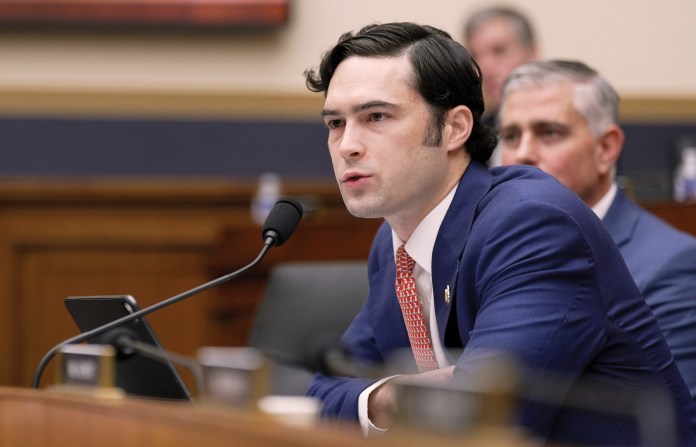
They’ve watched the Texas Republican ask a longtime abortion advocate during a House hearing to name her “favorite method of abortion,” a question so unexpected that it ricocheted across social media, cable television, and the front pages of conservative news sites. They’ve seen him press a witness defending expanded food stamp benefits over whether taxpayers should really be buying Coca-Cola for SNAP recipients. They’ve watched him spar with Gov. J.B. Pritzker (D-IL) over immigration policy, challenge NPR executives over taxpayer funding, and methodically dismantle liberal witnesses without ever raising his voice. Even Americans who have never voluntarily watched a congressional hearing have probably encountered one of Gill’s exchanges as a two-minute clip on X, YouTube, Instagram, or Fox News.
That is unusual for any member of Congress. It is almost unheard of for someone who has occupied his office for only a matter of months.
Washington is filled with lawmakers who desperately want to go viral, whose attempts come off cringe-inducing. Committee hearings have become littered with speeches masquerading as questions, members talking over witnesses, shouting at one another, or performing for the cameras in hopes that 30 indignant seconds will become the next social media sensation. Most of those attempts fail because viewers instinctively recognize theater when they see it. Gill’s exchanges feel different. They are almost unnervingly polite. He asks straightforward questions, waits patiently for answers, and somehow leaves seasoned activists, academics, and Democratic witnesses saying things they plainly wish they hadn’t.
That difference, it turns out, is neither accidental nor instinctive. It is the product of years spent thinking about persuasion long before he ever imagined running for Congress.

When I sat down with Gill in his Washington, D.C., office, I expected to hear him talk about media strategy, algorithms, or perhaps the importance of short-form video. Instead, he started talking about Socrates.
“I try to be civil and polite with witnesses,” he told me. “A lot of people want to yell at a witness. Maybe that’s cathartic. Maybe it feels good. But it’s oftentimes not very effective.”
He laughed before explaining that if his goal were merely to score points against liberals, Congress would be an awfully inefficient place to do it.
“If I wanted to yell at liberals,” he said, “I could sit behind my desk and make a video yelling at liberals.”
A congressional hearing, in his mind, serves an entirely different purpose.
“The whole West’s intellectual edifice is based on the Socratic method,” he continued. “It’s based on asking probing questions and coming to truth by asking probing and enlightening questions. A committee hearing is the perfect place to do that.”
That one sentence explains almost every viral moment Gill has had since arriving in Washington. Take the abortion hearing that made him a household name in conservative circles. The exchange wasn’t built around a rehearsed one-liner — it was built around a simple premise. If someone has dedicated decades of her professional life to defending abortion rights, shouldn’t she be willing to describe, plainly and without euphemism, the procedure she is defending?
“If you’re going to dedicate your life to defending this,” Gill recalled thinking, “tell me your favorite method.”
The question wasn’t designed simply to shock. It forced the witness to abandon abstractions and confront the concrete reality of what she was advocating. When she refused to answer, that refusal proved more revealing than any prepared statement could have.
Listening to Gill describe the exchange, it became obvious that he doesn’t think of hearings the way most members of Congress do. Many lawmakers view their five minutes as an opportunity to deliver a speech that happens to include a witness. Gill treats the witness as the point of the exercise. The hearing is valuable precisely because the person sitting across from him is under oath, the cameras are rolling, and millions of Americans can watch ideas tested in real time.
That approach didn’t materialize out of nowhere.
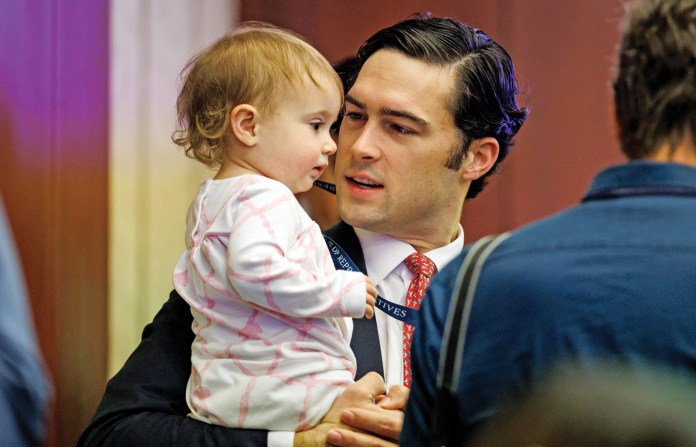
Ask Gill where he learned to communicate, and he doesn’t begin with Congress. He begins with a cattle ranch in West Texas.
Long before he became a congressman, or even a political activist, he spent countless hours driving tractors and working cattle while Rush Limbaugh‘s voice poured through the speakers.
“Our TV was always on Fox News,” he told me. “I’d spend hours listening to Rush while working.”
For Republicans of the 32-year-old Gill’s generation, Rush Limbaugh wasn’t simply a radio host. He was an education.
An entire generation of conservatives learned not merely what they believed, but how to argue for those beliefs by listening to Limbaugh explain current events for three hours every afternoon. Long before podcasts became fashionable and YouTube personalities emerged as political influencers, Rush was teaching millions of listeners how to construct an argument, anticipate objections, dismantle conventional wisdom, and, perhaps most importantly, refuse to apologize for holding conservative views.
David Limbaugh, Rush’s younger brother, sees Gill as part of that generation.
“Despite his schtick,” he told the Washington Examiner, “Rush was a genuinely humble man who would doubtlessly be surprised by the profound influence he had on generations of young listeners, many of whom would grow up to become conservative media figures and public officials, including rising star Rep. Brandon Gill. Since his death, countless people have told me that Rush introduced them to conservative principles, the glory of America, and the sunny optimism that defined him. In so many cases, he radically transformed their thinking and outlook — for the better. Through his talent and passion, Rush shared with millions the values our dad instilled in us at the dinner table. These ‘Rush babies’ are making positive contributions across society, and I couldn’t be more gratified or proud to see it.”
Gill is unmistakably one of those Rush babies.
But if Limbaugh gave him his philosophical foundation, another figure taught him the mechanics of persuasion.
Because before Brandon Gill was Congressman Gill, he was Brandon Gill of the DC Enquirer, a conservative media entrepreneur who spent years thinking not simply about politics, but about how politics is communicated. And before he married Danielle D’Souza, he found himself seated across from an unusually accomplished political mentor at the family dinner table.
The Texas Tribune recently noted that Gill credits his father-in-law, filmmaker and author Dinesh D’Souza, with teaching him to be more precise in discussing politics and encouraging him to “push the bounds of discussion.” Gill told me much the same thing.
“I learned a ton from him,” he said simply. “Dinesh is sort of a political mentor of mine.”
The influence becomes obvious the longer you talk with him. Gill doesn’t answer questions with talking points so much as with first principles. Ask about congressional hearings, and he talks about Socrates. Ask about political communication, and he quotes Winston Churchill.
One of the most revealing moments in our conversation came when Gill began describing William Manchester’s biography of Churchill. He recalled Manchester’s observation that Churchill believed a speaker had to viscerally believe every word he was saying before stepping behind a podium.
“People can tell,” Gill said. “They know if you’re not sincere.”
That may be the single biggest difference between Gill and many of the politicians who spend their days chasing viral moments. He doesn’t talk about virality at all. He talks about persuasion. He doesn’t think members of Congress should memorize talking points. In fact, he believes that’s one of the great mistakes Republicans continue to make.
“If you’re going to go on Fox,” he told me, “have something unique to say — not the same thing every other congressman is saying.”
The advice sounds simple enough. But in an era when political communications has become increasingly centralized, scripted, and consultant-driven, it is almost radical.
And it helps explain why Gill’s clips don’t feel like they were designed by consultants. They feel like they were designed by someone who spent years studying how ideas persuade people.
Gill’s approach to committee hearings reflects that same philosophy. While many lawmakers treat hearings as opportunities to deliver speeches or grandstand, he treats them almost as intellectual exercises, studying successful questioners the way a trial lawyer studies cross-examinations.
When I asked whether there were members he consciously tried to emulate, he immediately brought up one hearing that has already entered congressional folklore: Rep. Elise Stefanik’s (R-NY) questioning of the presidents of Harvard, the Massachusetts Institute of Technology, and the University of Pennsylvania following the Oct. 7, 2023, Hamas attacks on Israel.
“I’ve probably watched that hearing a dozen times,” Gill told me. “What I’m looking for is, what is the basic logic that she progresses through? What’s the point she’s trying to make, and how does she build toward it? Usually it comes down to one really simple question.”
It is an answer that reveals something unusual about Gill. He doesn’t study performances; he studies structure. He isn’t trying to copy Stefanik’s cadence or mimic Rep. Jim Jordan’s (R-OH) intensity. He’s dissecting the architecture of persuasion itself.
Jordan, Gill told me, is another member whose hearings he never misses. “Every time Jim Jordan goes into a committee hearing, I stop what I’m doing and watch. He’s so effective.”
But Gill is quick to point out that effectiveness doesn’t require imitation. Every member has a different personality, and the best questioning grows from authenticity rather than theater. That observation helps explain why his own exchanges rarely feel forced. The viral moments are almost a byproduct of asking straightforward questions that expose contradictions witnesses would rather leave unexplored.
Stefanik sees that same quality. “Brandon Gill is proving to be an exceptional congressional questioner and his star will continue to rise in years to come,” she told the Washington Examiner. “[I’m] excited for his very bright future.”
Spend enough time talking with Gill and another pattern emerges: He almost never begins with policy, he begins with first principles.
Ask him about abortion, and he doesn’t launch into polling or election strategy; he asks what abortion actually is. Ask him about immigration, and he begins with the purpose of immigration itself: whether America’s immigration system exists to benefit the world or to benefit Americans. Ask him about the future of the conservative movement, and he doesn’t begin with personalities or factions; he begins with Ronald Reagan.
Gill’s vision of post-Trump conservatism is strikingly less revolutionary than many of his critics imagine. He describes Reagan’s famous “three-legged stool” — economic conservatives, social conservatives, and foreign policy hawks — not as an artifact of the 1980s, but as a model for the future. The task facing Republicans, he argues, is not to abandon one wing of the movement in favor of another but to build a coalition broad enough to hold them together while adapting to new realities.
“I think we’re at a similar point now,” he told me. “You’ve got different strains of the conservative movement that sometimes feel like they’re starting to disperse. We’ve got the opportunity to help craft a vision that recoheres those different strains.”
That answer may come as a surprise. Much of the media coverage surrounding younger Republicans assumes they are consumed by internecine battles or jockeying for influence in a post-Trump world. Gill spoke instead about synthesis.
His answer also helps explain why he spends so much time communicating.
Earlier this year, in its profile of Gill, the Texas Tribune profile acknowledged his remarkable success in generating attention but questioned whether he had accomplished much legislatively, suggesting that headlines had outpaced substantive achievements.
Measured by the traditional metrics of Congress — bills introduced, amendments adopted, legislation signed into law — that criticism is understandable. Freshman members rarely wield much institutional power, and Gill is no exception.
But that critique rests on an older understanding of political influence, one that increasingly seems out of step with modern American politics.
For decades, Republicans often treated communication as secondary to governing. Policy came first; persuasion followed. Rush Limbaugh inverted that assumption. He never chaired a committee, never sponsored legislation, never cast a vote on the House floor, yet few individuals did more to reshape conservative politics over the last half-century. He understood that before legislation changes a country, people have to change their minds.
President Donald Trump demonstrated much the same lesson from a different direction. Long before he controlled the Republican Party, he changed the vocabulary through which Republicans talked about immigration, trade, China, and the political establishment. The legislative victories came later. The persuasion came first.
Gill belongs to the first generation of Republican officeholders formed entirely within that environment. He did not learn politics and then discover media. He learned persuasion before he ever held office. That distinction may ultimately prove more significant than any single bill he introduces during his freshman term.
A friend and frequent guest host for Limbaugh and one of the most popular nationally syndicated radio hosts in the country, Erick Erickson, recognized Limbaugh’s influence on Gill immediately.
“Rush Limbaugh’s message was always about the opportunity and optimism of America,” Erickson told the Washington Examiner. “It’s why, when you hear Brandon Gill speak, you hear someone whose criticisms are premised on those things undermining America. He doesn’t want to fundamentally change what works. That was the genius of Rush — he understood what makes the nation great and how to relay that understanding to people of all ages.”
That optimism can be easy to miss amid Gill’s often combative exchanges with liberal witnesses. His clips are shared because they are confrontational. But confrontation is not really the point. His hearings reveal a young congressman who believes ideas matter, words matter, and persuasion matters — that changing the way Americans think about an issue is itself a political accomplishment.
That belief also marks a departure from an earlier generation of Republicans. For years, many conservatives seemed almost apologetic about their own convictions, reluctant to challenge the premises embedded in hostile questions or media narratives. Trump changed that by demonstrating that accusations of racism, sexism, or xenophobia no longer could dictate the terms of debate. Gill, who came of age listening to Rush Limbaugh and entered politics after Trump had already remade the Republican Party, never seems to have inherited that older instinct for defensiveness.
He doesn’t apologize before making an argument. He simply makes it.
Whether that style ultimately translates into a long congressional career remains impossible to know. Washington has seen plenty of young political stars whose early promise never matured into lasting influence. At 32, Gill is only beginning what could be decades in public life.
HOUSE FREEDOM CAUCUS FACES UNCERTAIN FUTURE AS FIREBRAND MEMBERS HEAD FOR THE EXITS
But it is already apparent that he represents something different from many of the Republicans who came before him. He belongs to the first generation of conservative officeholders who were not merely consumers of conservative media but products of it. Limbaugh taught them how to frame an argument. Dinesh D’Souza taught them how to sharpen one. Trump showed them that politics is downstream from communication. Gill has synthesized those lessons into a style that feels uniquely suited to the modern era.
That is why his committee hearings so often escape the confines of Capitol Hill. Gill may be sitting in a hearing room questioning a witness under the lights, but he isn’t really speaking to the handful of members seated around him. Like Rush before him, he understands that the real audience is somewhere else entirely: the millions of Americans scrolling past another congressional clip, deciding in a matter of seconds whether anyone in Washington is still capable of changing their mind.
Bethany Mandel (@bethanyshondark) is a homeschooling mother of six and co-host of The Mom Wars podcast.