
The Trump administration scored a legal victory on Tuesday after a federal appeals court threw out a judge’s ruling that blocked Postal Service changes that were feared to slow down mail-in voting in the final stretch of the 2020 election.
The U.S. Court of Appeals for the District of Columbia Circuit ruled that the states challenging the changes went to the wrong court. Rather than seek emergency relief from a federal district judge, the court said, they first had to take their complaint to the Postal Regulatory Commission — even if that route could have taken too long to provide a remedy before Election Day.
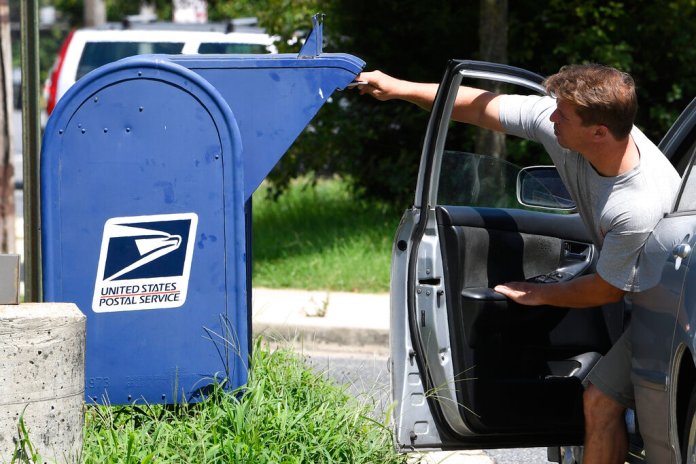
This 15-page ruling marks a win over a dispute dating back to the first Trump administration, as it fought hard six years ago to press the broader argument that election-related Postal Service decisions should not be subject to last-minute intervention by federal judges. However, Tuesday’s decision is largely a procedural victory.
The three-judge panel, composed of Chief Judge Sri Srinivasan and Judges Robert Wilkins and Neomi Rao, did not decide whether the 2020 changes were lawful or whether they risked delaying ballots. It held only that the district court lacked jurisdiction to decide the issue.
The case stems from the summer of 2020, when the Postal Service reduced high-speed mail sorting machines and employee overtime, eliminated late or extra delivery trips, and changed some carrier delivery procedures. States and cities, including New York, New Jersey, Hawaii, New York City, and San Francisco, warned that the changes, made amid a pandemic-driven surge in voting by mail, could interfere with their ability to run the election and voters’ ability to cast ballots by mail.
U.S. District Judge Emmet Sullivan, an appointee of former President Bill Clinton, issued an injunction in September 2020, weeks before the presidential election, and later permanently barred the Postal Service from ending late or extra trips without first obtaining an advisory opinion from the Postal Regulatory Commission.
Writing for a unanimous panel, Rao, a Trump appointee, said Congress created a specialized process for that kind of Postal Service challenge. Parties must first file a complaint with the commission, then seek review in the D.C. Circuit if they lose.
The states argued that process was inadequate because the commission could take up to 90 days to act — an especially consequential delay with an election only weeks away. The appeals court was unmoved.
“We decline to adopt a general ‘irreparable harm’ exception” that would allow parties to bypass the process Congress set out, Rao wrote.
Abhishek Kambli, a partner at Holtzman Vogel and a former Justice Department attorney and prosecutor, said the decision shows how challenges to Trump administration policies can initially win fast relief in district court, only to be overturned when an appeals court finds Congress required the case to begin in a specialized forum.
“What we see with litigants against the Trump administration policies is that they rush into district court (often in a Temporary Restraining Order posture) when the district court was never the right forum for the case,” Kambli wrote in a thread on X.
JUDGE BLOCKS TRUMP’S USPS MAIL-IN BALLOT CHANGES
The decision lands as mail voting is again becoming a major point of political conflict heading into the midterm elections. Democrats and voting rights groups have argued that reliable election mail is essential for voters who cannot easily vote in person, while Republicans, including President Donald Trump, have called for tighter controls on mail ballots and voter roll procedures to strengthen election security.
Still, Tuesday’s ruling does not directly settle current legal fights over the Trump administration’s proposed Postal Service rule governing mail-in and absentee ballots. Earlier this month, Sullivan also blocked that proposal, which would require states to provide voter roll information to the Postal Service or risk having ballots withheld from delivery.