
The recently concluded Supreme Court term was a blockbuster and, on balance, a victory for conservatives. While the Trump administration lost its birthright citizenship case, the Right scored victories on transgender athletes, gun rights, and campaign finance. Yet a pair of cases illustrates the massive power of the contemporary court, and calls into question its competency to wield such authority, especially in a republic where the people are supposed to rule.
In Trump v. Slaughter, the court ruled that the president has the power to remove a Federal Trade Commission commissioner. In Trump v. Cook, the court limited the power of the president to remove a member of the Federal Reserve. If that seems like a tension, several justices pointed it out in dissents, and only two justices — Chief Justice John Roberts and Justice Brett Kavanaugh — ruled with the majority in both cases. Roberts, writing for the majority both times, tried to reconcile these seemingly contradictory positions but ultimately demonstrated the reality that his court is fundamentally unbound, free to act as an unelected policymaker.
Trump v. Slaughter was a sweeping ruling. The court held that the president could fire a commissioner of the FTC, who was protected under the authorizing statute. In doing so, it overturned not only Humphrey’s Executor (1935), the original case that limited him, but also revised in substance the Federal Trade Commission Act of 1914. Roberts, writing for the conservative majority, cited historical precedent dating to 1789 to vindicate the theory of the unitary executive. James Madison, then a member of Congress, offered a compelling argument on the question of whether the president might fire the secretary of foreign affairs (now state): If the Constitution requires the president to take care that the laws be faithfully executed, he must have the authority to remove senior officials. That the political independence of the FTC is a century-old precedent is not relevant to Roberts because, as he writes, “No branch may rely on adverse possession to claim power that the Constitution vests elsewhere.”
Judges are not historians. Though they certainly fancy themselves competent to the task, their use of sources often betrays motivated reasoning. And so it goes in Slaughter. Roberts highlights Madison’s position on the unitary executive from 1789, but did not take seriously Madison’s view of the limits of judicial authority. As Madison argued during that debate, “Nothing has yet been offered to invalidate the doctrine, that the meaning of the constitution may as well be ascertained by the legislative as by the judicial authority. When a question emerges as it does in this bill, and much seems to depend upon it, I should conceive it highly proper to make a legislative construction.” This functions as a direct response to Roberts’s point about historical precedent in this case. Congress in 1914 judged that the FTC did not violate the Constitution. Why, per Madison, should that not be held in higher regard than a judicial determination?
As president, moreover, Madison acknowledged the importance of historical precedent, arguing that old disputes could be liquidated by historical practice. In 1815, President Madison noted that while he had been a constitutional opponent of the Bank of the United States in 1791, this was no longer an active question, “having been precluded in my judgment by repeated recognitions under varied circumstances of the validity of such an institution in acts of the legislative, executive, and judicial branches of the Government.” The Bank for Madison was a settled matter after more than 20 years — despite its being, in its original enactment, an “adverse possession” of federal power, to quote Roberts. One could say the same for the FTC, which was sanctioned by Congress, the president, and the court itself in its first 20 years of operation, and then passively accepted by all for generations thereafter. If Madison is a source of wisdom on the matter of the unitary executive, why can his view of liquidation be put aside?
Yet in Cook, Roberts implicitly leans on Madisonian liquidation to defend the independence of the Federal Reserve. The Fed, per Roberts, follows “the distinct historical tradition of the First and Second Banks of the United States,” in which its members were independent because “monetary policy should not be subject to political interference.” Again, demonstrating that judges make bad historians, Roberts undersells the extent to which this was a major point of contention in the early republic.
Madison himself warned during the Bank debate in 1791 that financial corporations could make for political machines, “competent to effect objects on principles, in a great measure independent of the people.” To address this danger, the Second Bank’s charter gave the president political authority over five of the 25 directors. Roberts cites this alteration as positive evidence of the Bank’s independence, rather properly contextualizing it as a modification of the original charter precisely because of the long-standing anxiety over political independence. Indeed, the major design innovations in the Second Bank were to make it meaningfully more accountable to the people’s representatives — the government appointed a fifth of the board and received a bonus for the chartering
How can these rulings be reconciled with one another? It is not easy. As Justice Amy Coney Barrett noted in her dissent in Cook, “the Court’s holding is in serious tension with Trump v. Slaughter.” Roberts wants to anchor the two positions within history, but his use of history is deeply problematic, bordering on tendentious. Precedent from 1815 is binding in Cook, but precedent from 1914 is not in Slaughter. As Justice Barrett asks, “How can history support both a categorical rule and a carveout?”
Likewise, Justice Sonia Sotomayor, in her Slaughter dissent, notes that the court has merely created “some ad hoc historical exceptions to its totalizing view of Article II, at least for the Federal Reserve.”
Meanwhile, Madison is a source of historical wisdom in Slaughter but is brushed aside in Cook. Of course, if Roberts were to be consistent in the use of historical sources, he might be forced to question the propriety of the court making such sweeping determinations at all.
It is better to understand Roberts in these cases not as a careful jurist using reason and fact to produce a consistent set of rulings, but as a policymaker redesigning the bureaucracy with an eye toward politics. He does not like Humphrey’s Executor, the original design of the FTC, or the general zeitgeist of the Progressive Era that sought to remove politics from administrative decision-making. Historical precedents that cut against these preferences receive little weight, unless they would create too many political problems — as surely giving the president the power to remove members of the Federal Reserve would upset the global financial system. In that case, historical precedent becomes decisive. Kavanaugh, the only jurist to join Roberts in both rulings, is upfront about the politics, acknowledging in his Cook concurrence, “I would not risk destabilizing the U. S. economy.”
As a policy matter, this is a perfectly fine position, one I share, in fact. A general rule for unitary executive power, with limited exceptions for sensitive matters, is a laudable position for policymakers who need to be mindful of the political context, especially when it comes to the economy.
But judges are not supposed to be policymakers in our system. Judges lack the expertise for such work (witness Roberts’s slicing and dicing of the historical record), and more importantly, in a republic, they are not subject to popular oversight. Politicians are the ones who are supposed to weigh prudential concerns against constitutional principles, and our system of checks and balances provides the framework to do exactly that, with ultimate sovereignty resting with the people at the next election. But Roberts would have none of that. He implicitly assumes complete and final authority over the meaning of the Constitution, and the freedom to make political exceptions along the way. Never mind that the Constitution grants him no such authority, and the logic of republicanism, a system where the people rule, cuts entirely against such power vested in nine unelected lawyers.
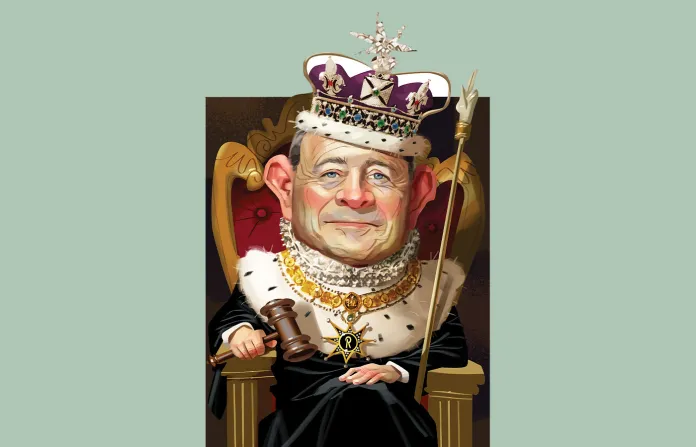
If Roberts wants to revise the bureaucracy so that it fits his view of executive power, there’s a clear recourse in the Constitution: Run for office on that platform, win an election, and build a coalition in the political branches to rewrite the law. Declaring from the bench one ancient precedent invalid while holding another controlling, using bad history to boot, is hardly consistent with our republican principles. That’s a monarchy dressed in judicial robes.
Conservatives should be mindful of the potential for this power to boomerang. As they cheer the overturning of precedents like Humphrey’s Executor, they should remember that their current majority depends upon the health of three septuagenarians — Roberts (71), Justice Clarence Thomas (78), and Justice Samuel Alito (76).
A presidential election combined with a few untimely deaths, and the conservative 6-3 majority might become a liberal 5-4 majority, or worse. And liberals will be more than happy to use the precedents set by the Roberts Court to begin clearing away political, social, and economic arrangements that they dislike — history, logic, and republicanism be damned.
Jay Cost (@jaycost) is the Gerald R. Ford senior nonresident fellow at the American Enterprise Institute.