
Memorial Day is behind us. It-girl clothing brands recently acquired by private equity firms are making a killing on ’90s-inspired viscose satin slip dresses with a complex relationship to undergarments. A certain kind of conscientious woman, between the ages of 25 and 38, with a remunerative project manager job and a reasonable skincare regimen, is teetering on the verge of a nervous breakdown. Wedding season is upon us.
I always enjoy wedding season, for all the usual reasons, but also because I can live in hope that, at least once before the summer fizzles out, I will be invited to a big wedding.
I do not mean “big” in the sense of “large numbers of guests.” A big wedding, in the sense that I mean it, includes a large number of guests, but is not reducible to them. It means big in the sense of lavish, grand — a big show, a big to-do. A big wedding means black tie and gowns; it means storied venues with bronze statues behind brownstone facades, terraces overlooking wide expanses of green or blue; it means scads of passed appetizers and perhaps, if you are very lucky, a seafood tower.
A big wedding means, fundamentally, oysters and martinis that someone else is paying for. What’s not to like?
Plenty, it seems. Among the cultured and thoughtful, if there is any competition over the size and expense of weddings, it goes in the opposite direction, in an attempt to distance themselves from the Jeff Bezoses of the world. Someone will point out how insane the wedding-industrial complex has become: after all, they got married in a parish hall. Someone else chimes in that they didn’t rent a venue at all: a backyard wedding was just as nice, for half the money! Oh yes, says the next person in line. In fact, I couldn’t be bothered with the fuss of a wedding at all and merely decamped to a justice of the peace. Fools! All fools! It goes on and on: I was captured by Somali pirates on a routine tour of duty and married off to my captor, barefoot and bleeding, in a scant ceremony of dubious legality conducted in the engine room, and now I rule the seas as his pirate queen! And so forth.
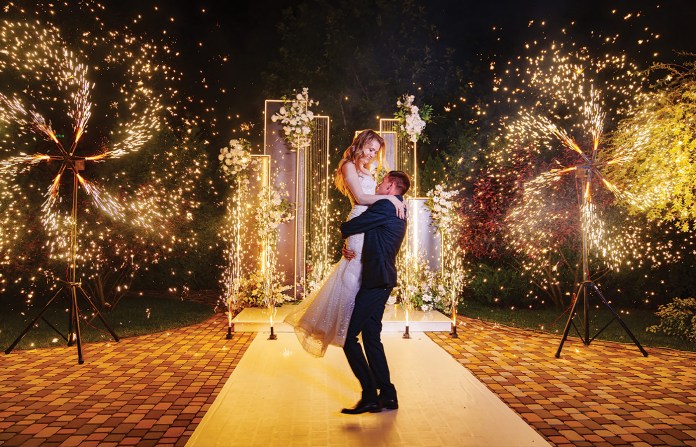
It may be that too much attention to weddings, of any kind, is suspect. The specter of the bridezilla looms over the planning; we feel an intense revulsion against, and a desire to disassociate ourselves from, a kind of grasping, whining, unreasoning, and demanding femininity.
Then there is the concern that style is being privileged over substance, the material over the spiritual. Look at all of these people spending their time and energy on things, as if things are what make you happy. Look at these dabblers in the shallows, planning a wedding when they should be preparing for a marriage. Look at them, debating a color scheme when they could be reading St. John Chrysostom.
A wedding is not a marriage, true. But a wedding is a wedding, and about as far back through the historical telescope as we are able to peer, humans have solemnized and celebrated weddings with parties. And parties are expensive. Even on modest lines, wining and dining a bevy of friends and family in a space large enough to hold them tends to run up the meter at an alarming rate.
Why do people do it to themselves? They do it because they want to bring all their disparate circles under the same roof to share in and be united by their happiness. They do it because two distinct families have forged a permanent bond, an occasion that calls for joint festivity and reciprocal hospitality.
They do it because, sometimes against all odds, the human drama has repeated itself once again: The oldest tradition continues, the lovers have found one another, and the world will be peopled. They do it because a wedding is a mysterious moment, when two souls have bound themselves to each other with pledges which they can and must enact in their lives, but which they cannot yet fully understand. A wedding, anyone’s wedding, is a big occasion.
We mark big occasions with big gestures. Only splendor and abundance will do. We cannot be content until we have seen our personal joy mirrored and multiplied by becoming an occasion of good fortune and pleasure all around us. We feel the urge to waste wealth in a particular way: to use it for the purchase of more and better than what is strictly necessary, to feel it running out of our fingers for something that will live only in glittering memory.
For some people, this kind of prodigality is always unjustifiable. A large and expensive party implies not only resources to spare, but vulgarity and waste. It implies waste, not in the sense of someone who buys a dress they don’t need, simply because it is beautiful, but waste in the sense of someone who buys expensive cars they never drive, simply because they can. It means waste in the way that the miser who spends compulsively and the miser who hoards compulsively are both wasteful: Both are misers because they are unable to order wealth to any real human good. Its only value to them is in the visible reminder that they possess it.
I admit I have seen big weddings that suffered from this kind of waste, with wealth poured into an arms race over inane details whose only function seems to be reminding everyone that money was no object and that Instagram exists. But more often, I have encountered delicious food, unstinted drinks, and live bands. I am glad all these exist — I am glad the oyster farmer and the saxophonist can make a living in the way that they do. I am glad to have stood in a beautiful place, in a beautiful dress, sampling the spread of delights someone has prepared, at great effort and expense, so that I can feel well and truly privileged.
This kind of largesse can certainly devolve into a crude leveraging of hospitality to hoist aloft the ego, but at its best, it accomplishes the opposite. Generosity ennobles the noisy internal hunger for self-assertion. It makes the satisfaction of that hunger dependent not on the sight of all those whom we have made subject, or made fearful, or made small, but on the sight of all those whom we have made happy. And this is in fact what I remember most from the big weddings in which I have been a participant: bridesmaid dresses paid for, little inconveniences smoothed away by the mother of the bride, a family’s resources marshaled to ensure that any difference in the material situation of their friends will make no difference in their enjoyment of the wedding. I cannot fault anyone who chooses to spend their money this way.
Of course, people’s financial capacities differ. For many people, a big wedding is not just a stretch or a group effort but an impossibility without mortgaging their future and setting themselves up for a life of servitude in a prison of debt. It could be argued that all big weddings represent a social blight by encouraging young couples to hold themselves to a standard they cannot reasonably expect to emulate.
THE DRESS CODE IS A GREAT EQUALIZER
I agree that magnificence ceases to be magnificence when it overtakes and destroys the other goods of human life. I am happy to concede that, in light of real people’s actual circumstances, the number of big weddings should be lower than it is. There is, in fact, a chance approaching zero that I will ever be in a position to throw a big wedding for anyone. This does not distress me. The whole point of a big wedding is that it does more than is strictly necessary. A good small wedding has its own virtues — intimacy, ease, the elevation of the warm everyday — and shares the same basic principle of excellence as a good big wedding: using what you have creatively and judiciously to throw a really great party.
I would support equalizing measures: a broad civic effort to build and maintain beautiful and elegant parish halls, community centers, and other public spaces that can be offered as low-cost wedding venues, or perhaps some sort of Soviet Ministry of Magnificence funding all weddings from the same public purse. But until then I think it would be good to cultivate a sturdy republican core of self-respect that, precisely because it sees spare cash to spend on a big wedding as wholly incidental to basic questions of personal worth and community standing, can enjoy such a wedding unreservedly; that can drink champagne and gobble down oysters as gleefully as beer and roast pork sandwiches; that, most importantly, can experience the kind of gratitude in which abjection makes no part.
Clare Coffey is a writer from Pennsylvania.